

Police dogs aren’t totally new to the UM-Dearborn campus. If you’ve attended a commencement ceremony or other major campus gatherings, you may have noticed police K-9s quietly working the event, often in roles like explosives detection. These dogs, however, have not been official members of UM-Dearborn’s public safety team, says UM-Dearborn Police Chief Paul Tennies. “For high profile events, we’ve been able to rely on dogs from the Michigan State Police or other organizations,” Tennies explains. “But at times, they had to send K-9s all the way from Traverse City or St. Ignace. The demands on our partners were growing, and we wanted to make sure we could provide consistent service in this area.”
Tennies says having an explosives detection dog permanently on the UM-Dearborn campus was a major priority for former UM-Dearborn Police Chief Dave Hawkins, who’s now serving as director of UM-Ann Arbor’s University Security and Safety Services. In July, the team got their wish when Bruce, a 2-year-old black lab, started at UM-Dearborn. Bruce’s handler, Officer Jennifer Jackson, says Bruce completed some initial training with UM-Ann Arbor’s master trainer, where the pup was introduced to scents of common materials used in explosive devices. While being exposed to these scents, Bruce was given a reward (Jackson says the food-motivated lab preferred treats to toys), which teaches the dog to associate scent detection with positive reinforcement. Dogs are also taught a specific alert behavior to indicate when they’ve found something suspicious. Jackson and Bruce then completed an additional six-weeking training in Ann Arbor, where the two learned to work as a team.

Tennies stresses that Bruce was not “hired” due to any specific threats but because having regular explosive-sniffing capabilities is a public safety best practice. “Bringing Bruce onto the team is a proactive measure and standard practice for any police department these days. He's another tool we have in our toolbox,” he says. And while explosives detection is Bruce’s primary role — he’ll be performing duties both here and in Ann Arbor — he’s also being cross-trained as a community relations dog.
Jackson gives her charge high marks for his explosives detection abilities, calling him “highly accurate,” but he still has a little work to do in his other role. For the first two years of his life, Bruce lived at a kennel near Indianapolis that specializes in identifying and pre-training potential police dogs. But it was a fairly isolated life — much different than a college campus — and Jackson says Bruce is also a bit shy by nature. “So we’re giving him lots of opportunities to get out and about so he can experience being in a lot of situations and being around lots of people,” Jackson says. “He’s slowly coming out of his shell, but he’ll probably always be a shy dog.” She says students, faculty and staff can definitely help with his training by coming up and saying ‘hi.’ Assume it’s OK to pet him unless she specifies otherwise.
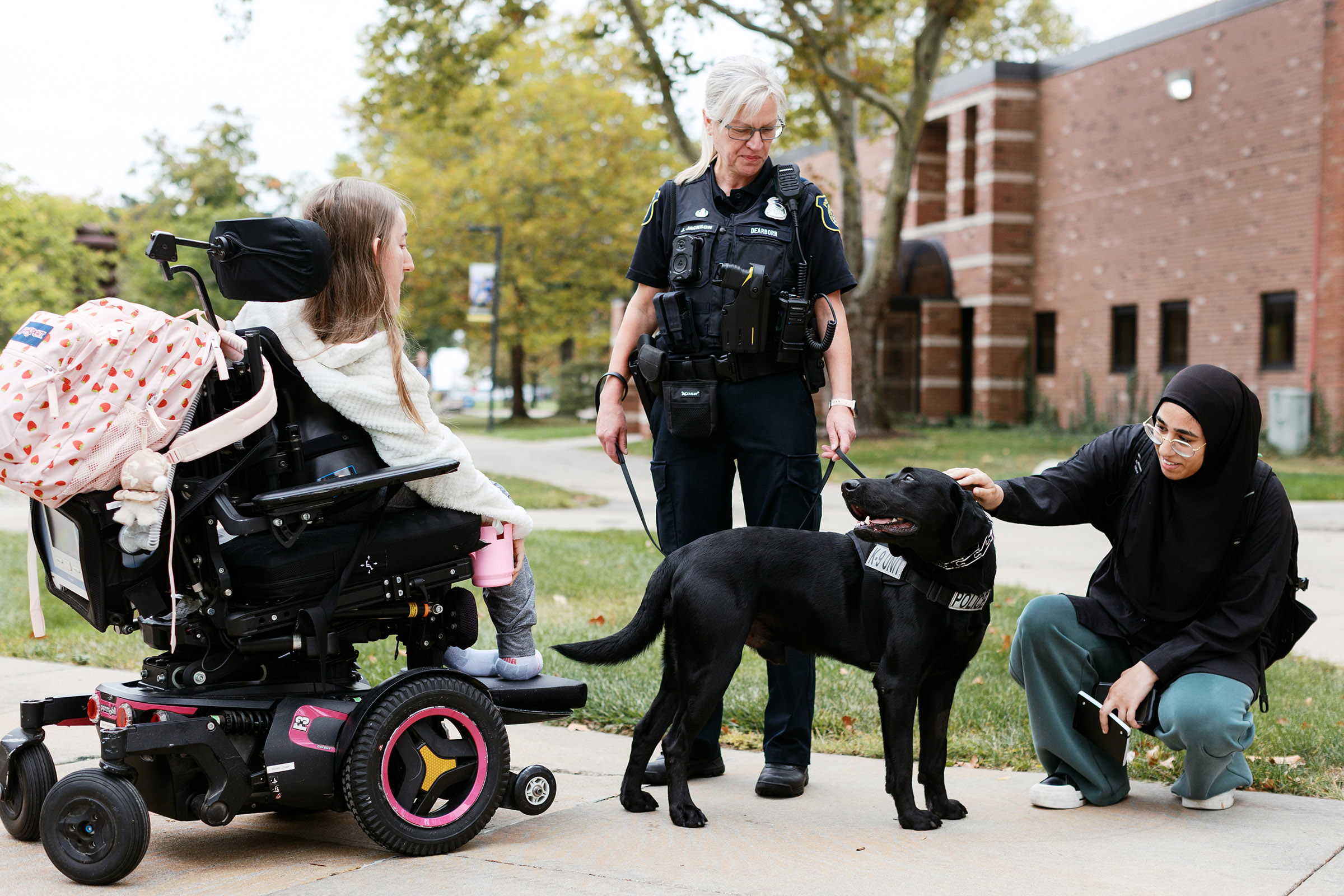
When Bruce isn’t actively working, he has free rein of the public safety office, and Jackson says people seem to enjoy having a dog around. When he’s not on campus, Bruce lives with Jackson and her other pets. (She says he’s taken a particular interest in her cat Minnie, who Jackson reports is “not looking to make any new friends.”) For Jackson, it’s her first role as a police dog handler, though much of her career has involved animals. Prior to coming to UM-Dearborn, she worked as an animal control officer and police officer for the Dearborn Police Department. She’s also a licensed veterinary technician.
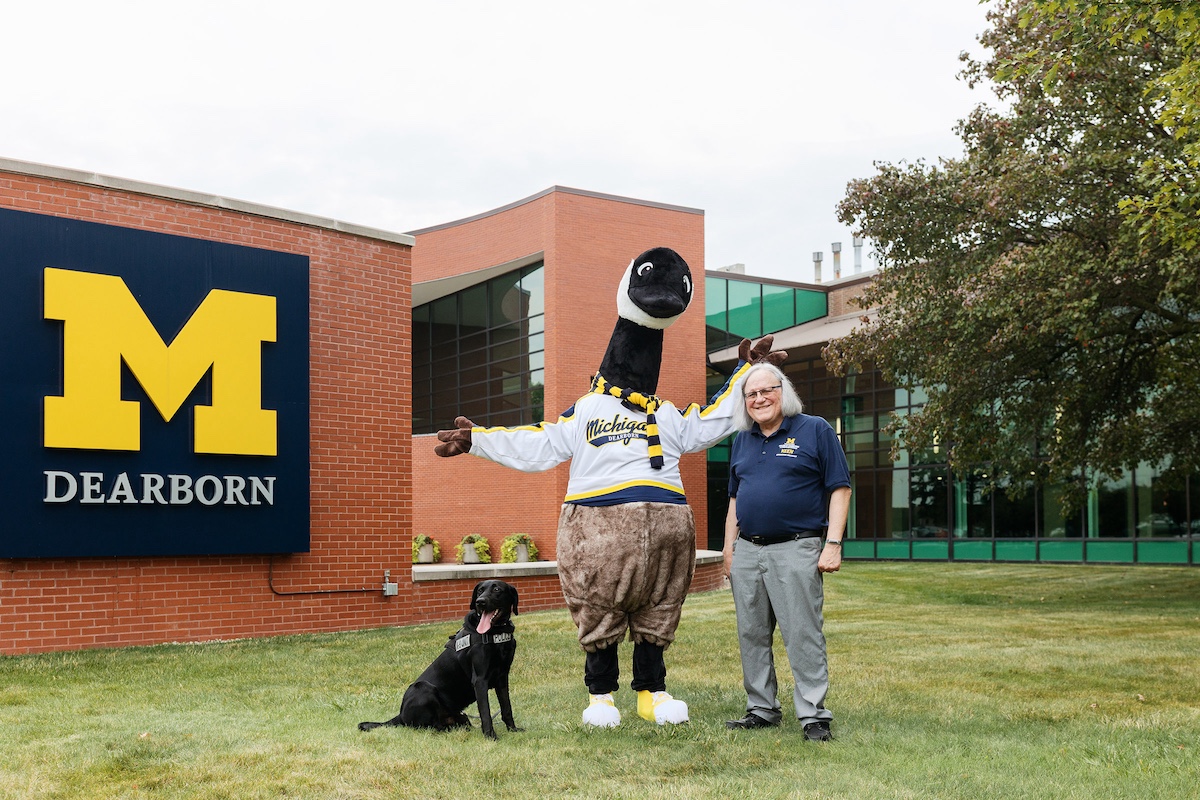
One note on Bruce’s name: Campus, of course, already has one famous Bruce in Bruce the Goose, who serves as UM-Dearborn’s unofficial mascot. (It’s actually a Bruce trifecta if you want to include longtime computer and information science professor Bruce Maxim.) So was it mere coincidence that campus’ new police dog was also named Bruce? Not so much. Tennies says when Bruce the dog arrived on campus, his name was Scrooge. “But we didn’t think this name suited a dog that is so sweet. We’ve never heard him bark. Not once,” he says. So they decided to rename him, choosing something that had “associations the community would identify” and the same basic vowel sound (to make the transition easier on then-Scrooge). Tennies says most people seem to appreciate their choice.
###
Story by Lou Blouin. Photos by Matthew Stephens


