The importance of second chances

September 15, 2025

After fighting fires for 25 years with the Detroit Fire Department, alum Orlando Gregory leads a nonprofit that helps people rebuild their lives.

Photo of a man seated in front of a maize wall that reads, "Hail to the Victors."
Two-time UM-Dearborn graduate Orlando Gregory served in the Detroit Fire Department for nearly 25 years. Today he leads a life-saving nonprofit. Photo by Matthew Stephens

Two-time UM-Dearborn graduate Orlando Gregory served in the Detroit Fire Department for nearly 25 years — first as a firefighter and later as a commissioner, retiring in 2014. Today he can be found in the apparatus bay area of Engine No. 2, a historic fire station in downtown Detroit. But he’s not there to fight fires — at least, not in the traditional sense.

Gregory leads the nonprofit Wayne County Outreach Jail Ministries, which has an office on the first floor of that 1918 former firehouse. As the organization’s executive director, Gregory has spent the last three years connecting returning citizens — people released from incarceration and re-entering society — with education, job assistance, health care and spiritual guidance for all faiths.

“I’ve spent my entire career putting out fires and pulling people out of dangerous situations,” says Gregory, who graduated from UM-Dearborn with a Bachelor's of General Studies in 2009 and with a Masters in Public Administration in 2014. “I’m continuing that today, but it looks different. We help people who have served their time get out of places where they are trapped. I’m helping them put out the fires that are stopping them from achieving greatness and becoming the neighbors we all want them to be.” University of Detroit Mercy owns the old firehouse and converted it into the George J. Asher Law Clinic Center, where Gregory’s team has a space. Gregory works closely with the law clinic when the returning citizens need legal advice. “I’m here today because my life experience has met with the pedigree of a Michigan degree. My destination and occupation have met — and they met because of my time at UM-Dearborn,” he says. “Really amazing professors saw something in me — even as an adult in my 40s — and helped me put the pieces together so I could live my purpose.”

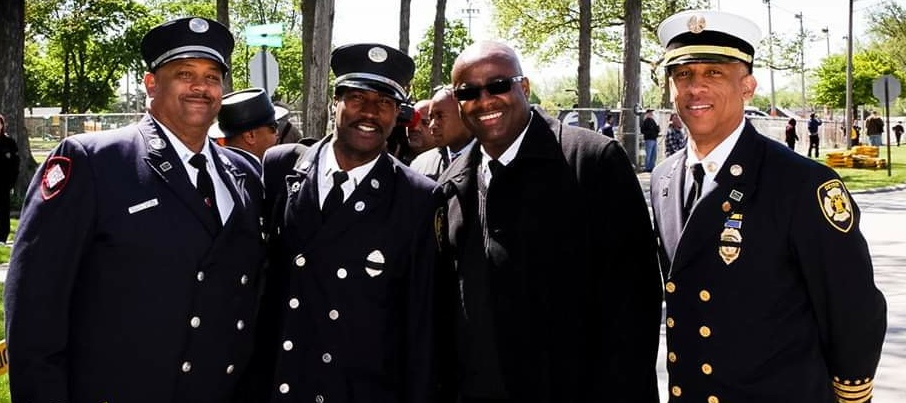
Four men, Detroit Fire Department officials, are gathered outside for a photo.
Orlando Gregory, far right, worked at the Detroit Fire Department for nearly 25 years. He's pictured in this 2012 photo with Lt. Robert Stokes, Lt. Alfie Green and Lt. James Edwards. Photo courtesy of Orlando Gregory

Taking phone calls for the nonprofit — his cell continues to ring throughout the interview for this article — Gregory connects men, women and their families to vehicles, educational training, professional clothing, legal aid for record expungement, job leads, free dental care and more. Sending someone to prison for five, 10 or 20 years will not help them change unless we have some way to prepare them for life after prison,” Gregory says. “We work with people while in prison to help them get their mind right and prepare them for what’s next. After they are out, we give them and their families support to be successful on the outside. You can’t reach everybody. But those who get their heads together and want to change, do. Impartation works.”

Data backs up the importance of work like Gregory’s. According to the Michigan Department of Corrections, the state’s recidivism rate — that’s how often people released from prison go back within a three-year period — was 20% in July 2025, an all-time low for the state. MDOC lists access to job placement assistance, housing and other resources as reasons for positive outcomes. Without giving names, Gregory talks about a few success stories that make him proud. One formerly incarcerated client recently opened a business. Another is a manager at a Fortune 500 company. Most are volunteering in their communities in some way, too, including serving on high-level civic advisory boards. 

Gregory speaks with passion about second chances. It’s something he’s familiar with because he’s lived it. As a teen growing up in 1980s Detroit, he got caught up with Young Boys Inc., a drug-trafficking gang based in his neighborhood. His involvement led to an arrest, a short jail stay and a felony on his record. When he met with the judge, he was told that, as a teenage first-time offender, he’d get a second chance. It was one that Gregory took very seriously.

 I was running the streets doing all the things you see on TV. If I didn’t get arrested, I don’t know where I’d be today. Our experiences, even the negative ones, have the opportunity to lead us somewhere greater,” he says. “When I went in front of Judge Edward Thomas in 1985, he told me that he was going to give me another chance. But if I did it again, he’d send me to prison. I saw the seriousness of the situation and knew things needed to change; I needed to find my purpose. I reached out to Judge Thomas a few years ago on LinkedIn and we met up. I told him, ‘This knucklehead came into your courtroom and you saved his life.’ Not only did Judge Thomas save my life, he started me on a path for a new one.”

In 1991, Gregory heard about an opportunity to become a firefighter with the Detroit Fire Department. With rising arson incidents in the city at the time, he saw it as a way he could show purpose and make a difference. Gregory had high placement on the DFD’s entrance exam and started training at the academy. But there was a problem: After admittance to the academy, he was pulled aside and asked about his felony from six years prior. “They did a background check and I was told that they do not allow felons in the fire department. I said I wanted to give back to my community,” he says. Gregory was able to plead his case to the hiring board and was told about expungement, which is a legal process to remove a felony. He then got his case in front of judges — some of whom now advise the nonprofit he leads — who told them they saw something in him. “They could have held that over my head like an albatross. They didn’t. They saw that my past didn’t define me; it propelled me. Those judges told me to go out and make a difference. They told me they believed in me.” The felony was removed from his record and he went back to the fire academy.

Never forgetting this, Gregory looked for ways to mentor and volunteer over the span of his career. For more than 20 years, he’s worked with MDOC as a mentor for men in the prison system and as a motivational public speaker. He was named the Michigan Department of Corrections’ “Volunteer of the Year” three times. Gregory gave blood and time to the American Red Cross, eventually becoming a certified instructor and instructor trainer. This past summer, he led trainings at an all-day First Aid Basics event co-sponsored by UM-Dearborn. For his decades of service to various organizations, he’s also a three-time recipient of the Detroit Fire Department’s Community Service Award — all while climbing the career ladder from firefighter to second deputy fire commissioner.

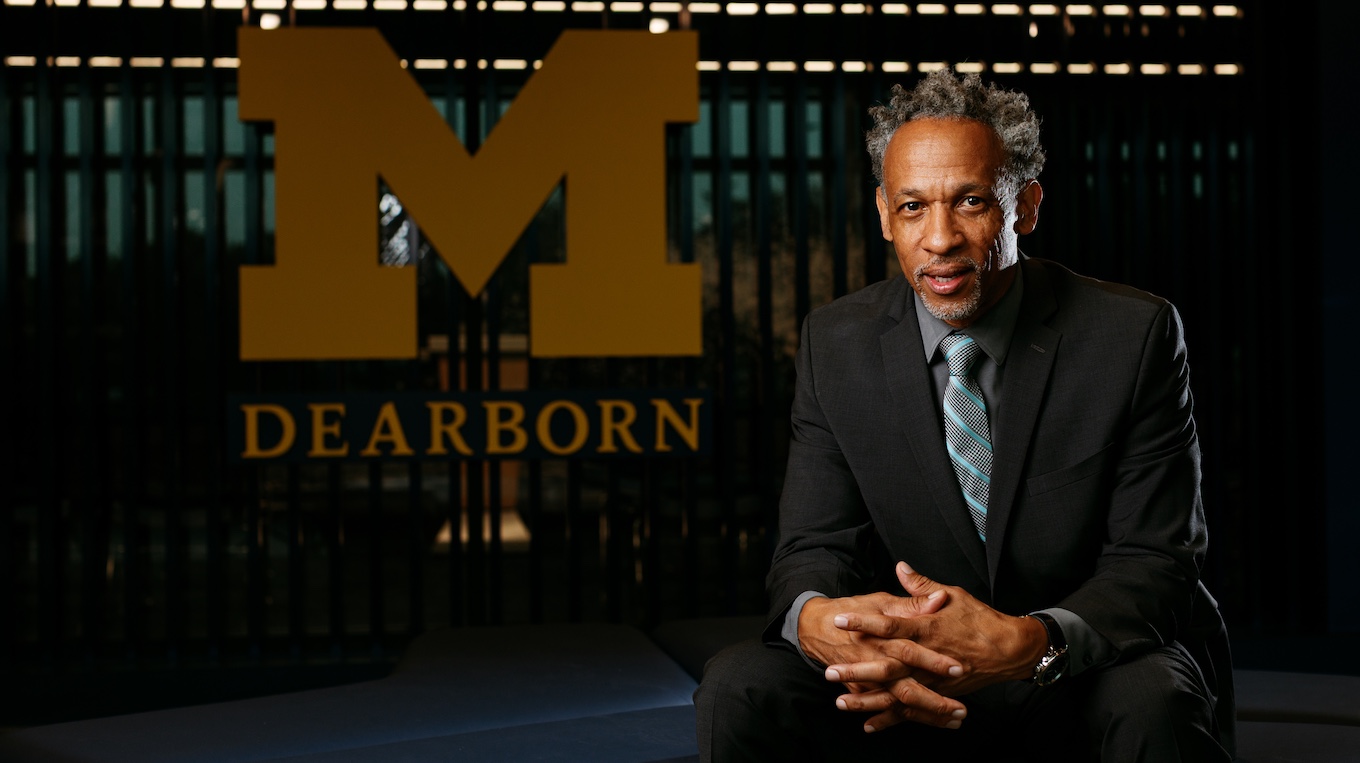
A man seated and staring at the camera in front of the UM-Dearborn Block M
Orlando Gregory says his time at UM-Dearborn made him a victor. Photo by Matthew Stephens

With the teaching opportunities that came from his job advancement and volunteer work, Gregory looked for ways to expand his education. In 2002, he chose UM-Dearborn for that next step. The university was close to home and offered classes that worked for Gregory’s DFD schedule. It also had the Block M he admired since childhood. From 2002 to 2014, he could be found on campus, often in his uniform. He earned his two degrees in 2009 and 2014.

Gregory says his graduate degree professors — namely Professor of Political Science Dale Thomson, Professor of Sociology Paul Draus and former Lecturer of Public Administration Tracy Hall — noticed his enthusiasm for public service. He enjoyed service work, but he didn’t imagine leading a nonprofit until taking those public administration-focused classes. He says the faculty members’ lessons about effective leadership styles and resource management showed him that he had what it took to run an organization and that he combined their theory lessons with his “boots-on-the-ground” experience.

“My professors lit a fire in me. It was a fire that I didn’t want to fight — it was one of passion. I could see how all of my experiences, good and bad, could come together through nonprofit work. I wanted to be ready for the right opportunity,” he says. “People come into your life for a reason, a season or a lifetime. They are all three. The reason was for me to connect the dots at that season in my life. And the mark they’ve made on my life will be with me always.” In 2022, Gregory became WCOJM’s first paid executive director. Under his leadership, the nonprofit expanded to include more volunteer mentors, community resources and city-based partnerships to reach more re-entering citizens.

As Gregory works in his office today — a former Detroit firefighter in that old Detroit fire station — he looks at the way his past and present have intertwined. He meets people who need a new start just like he once did. And how, over the years, he’s acquired the education and experience to help them.

 “I was born and raised in Detroit. I have seen how things can fall apart and have seen how things can be put back together again. Detroit is a city of second chances,” he says. “I’m here today to help people pick up the pieces they need and support them while they put them together, just like people did for me,” Gregory says. “No matter when or how you get the pieces to build your life, you can always build something beautiful. I’m a ‘Victor’ and, through my education and the platform I’ve been given, I’m going to show others how they can be victors too.”

Story by Sarah Tuxbury