The Michigan Journal is hot off the press

March 11, 2026

After a two-year print hiatus, two students worked to bring the 55-year-old student newspaper back into readers' hands across the university. The print edition, now published monthly in addition to the online publication, relaunched in February.

Two people  — both student journalists — are in a small room surrounded by laptops and old newspaper. One of the students, who is a lacrosse player, holds a lacrosse stick and ball.
The Michigan Journal Co-Editors-In-Chief Reena Hamad and Harrison Stidolph are frequently found in The Michigan Journal office, which is located in the Renick University Center. Photo by Matthew Stephens

The Michigan Journal, UM-Dearborn’s student newspaper, turns 55 this year.

Since 1971, student reporters have covered high-profile visits, war protests, building openings, student opinions and more. There’s an article about President Gerald Ford’s visit to campus in 1978 when he gave a talk in Professor Helen Graves’ “Interest Groups and the Political Process” class. The paper’s staff also wrote an article about how the university stayed open on Sept. 11, 2001 to give students a familiar, safe place to connect with friends and professors while many other places closed following attacks on the World Trade Center and Pentagon.

Co-Editors-In-Chief Reena Hamad and Harrison Stidolph believe in the power of the press. Advised by Communications Professor Tim Kiska, the two students write, assign and edit articles for The Michigan Journal website. And, this powerful team of three has now gotten the first print edition in nearly two years back on university newsracks. The first monthly issue hit in February and the March issue is on newsstands this week. The students say producing a regular print edition has been a post-pandemic challenge with a shortage of staff and resources.

The Michigan Journal is seeking students writers and photographers. Know a talented student who may be interested? Have them reach out to Hamad.

In a small room that’s lined with computers and decorated with large poster-sized front pages of MJ's old editions, Stidolph and Hamad discussed the upcoming March issue. They put out the paper — from story ideas to writing to design — as a duo. On a recent Wednesday afternoon, Hamad, who is thoughtful, thorough and task focused, sits at her Apple laptop while looking up archived issues to find information and past UM-Dearborn chancellor hires. Stidolph, an energetic problem solver, says the March edition will include an article about the current chancellor search.

Stidolph, a UM-Dearborn Men’s Lacrosse player, holds his lacrosse stick and bounces a yellow tennis ball while talking about university chancellor history. “The university has had an interim chancellor three times — each time it was Bernie Klein — and his longest interim term was 11 months. Chancellor Grasso went to UM-Ann Arbor for the presidency last May, meaning 11 months would be in April. That’s right around the corner. Are we on a similar time schedule?” Klein, who died in 2020, taught political science at UM-Dearborn from 1971 to 1993; he served as interim chancellor in 1979 and 1992 and came out of retirement for a third term in 1999.
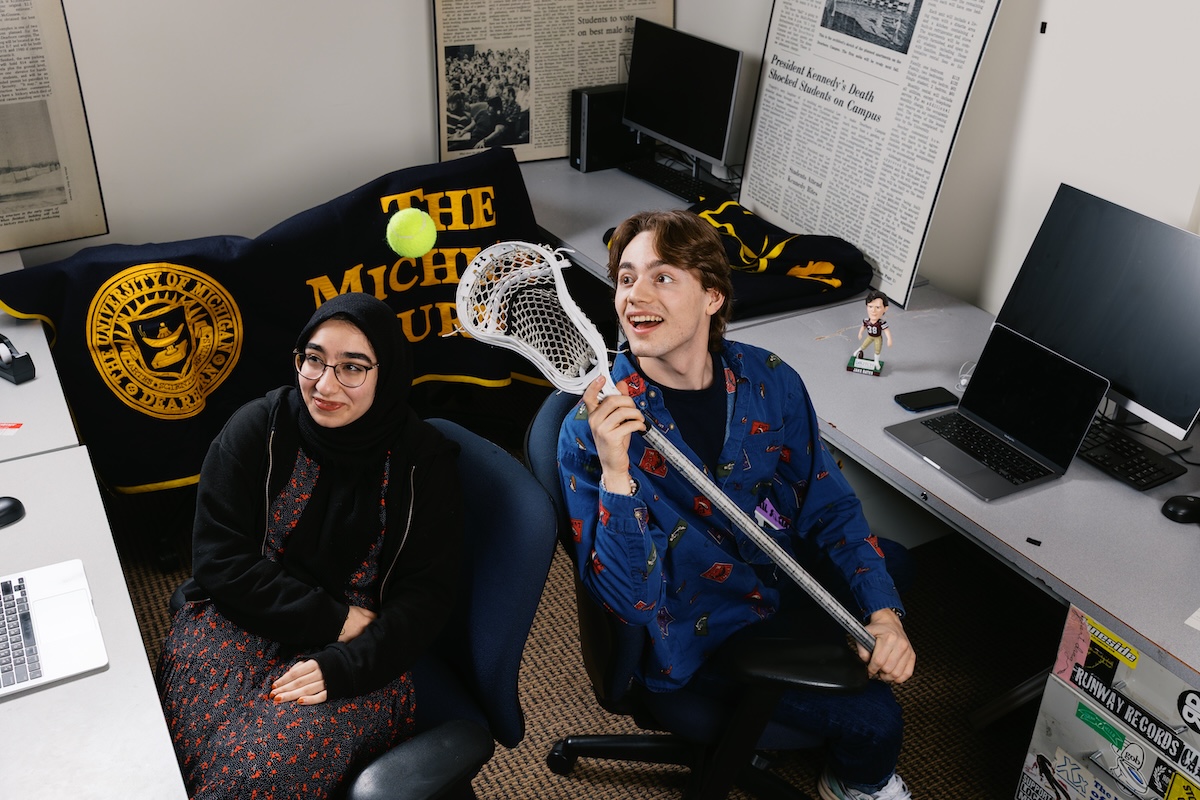

Two people - a female and male - sit in the Michigan Journal office. She smiles and he bounces a tennis ball with a lacrosse stick
 Reena Hamad and Harrison Stidolph make sure to have fun while also getting the news out in The Michigan Journal office.

As Stidolph continues sharing his thoughts, the ball drops and bounces. Hamad catches it on the upward bounce with a surprised look and — after a moment — laughs while tossing it back to Stidolph. “She is the Mr. Spock to my Captain Kirk,” says Stidolph, referring to the 1960s “Star Trek” television series. “We are very different people and our differences really work well together.”

Hamad, a sophomore from Chicago, and Stidolph, a junior from Grand Rapids, grew up reading newspapers. In Hamad’s family home, she knew the newspaper was available for her to read when her parents placed it on the kitchen table to indicate they were finished reading. Hamad is a sophomore double majoring in Arabic studies and computer information science. And Stidolph — who remembers reading newspaper articles about Barack Obama’s presidential campaign when he was in grade school — was an “NPR kid” whose rides to school featured either news radio or the “Hamilton” soundtrack. Stidolph says that news exposure helped him start making connections with past and present world events and how they affect our culture. For example, a recent paper he wrote for Lecturer of Journalism and Media Production Shelby Zuk’s class argued that the 1987 movie “Spaceballs” is an allegory about Reaganomics policy and excess consumerism. 

Both students believe that consumer-minded thinking is what eroded the newspaper industry today. They say that increases in ads and cuts to editorial staff to maximize profits pushed aside the civic purpose of papers. They see social media heading toward a marketing saturation point — and say it’s the right time for an older format to re-emerge.

“The information we get on social media has so much misinformation or disinformation at a critical time. We need objectively written news. We need facts, we need correct grammar,” says Stidolph, who is pursuing a dual major in Journalism and Media Production and in secondary education, with a focus on English. “People have told me that newspapers are dying — but I have friends who are reading them because they are a more reliable news source. Newspapers are having a resurgence.”

Professor of Communications Tim Kiska

Speaking of resurgence, Hamad says the MJ paper editions are reappearing on racks in thanks to their advisor Kiska. Kiska is a life-long journalist who started at The Detroit Free Press in 1970 at age 18 — that’s one year before the beginning of The Michigan Journal. After retiring from the news business, Kiska started teaching journalism at UM-Dearborn in 2001. He served as the MJ advisor for nearly 25 years and plans to retire at the end of the semester.

Hamad, who’s worked with Kiska since joining the paper in 2024, says The Michigan Journal will print an issue dedicated to him in April. The team is seeking community-sourced stories that show Kiska’s spirit. They are asking interested readers to fill out a short retirement tribute form.

“When I told Dr. Kiska that I wanted to start publishing a print edition again, he did everything in his power to make it happen and helped us prepare for it. We’d message him at 10 p.m. with a question and he’d reply right back — even when we thought he might be sleeping. Getting a paper out is a lot of work. Since the pandemic, we haven’t had a full staff, so we knew it would be difficult — but it was important to us and for the university to get the Michigan Journal in the hands of readers again,” Hamad says. “Dr. Kiska has always held the Journal to a high standard. Even without him on campus with us, we will continue to channel his dedication to journalism that uphold standards as high as his.”

Story by Sarah Tuxbury. Photos by Matthew Stephens