A student veteran’s course project looks to serve vets in need

March 30, 2026

MBA student Michael Matteis designed a veteran-focused mental health app for a classroom assignment — it’s now gaining attention in the field.

A man in a white-and-blue plaid shirt talks to another man who is standing on the opposite side of the table.
MBA student Michael Matteis, an Air Force veteran, talks to guests at the College of Business Innovation Showcase about the AI Veteran Companion chatbot. Photo by Matthew Stephens

The rapid rise of generative AI is already touching nearly every area of our lives, from work and school to finding the best pie recipes online. For veteran and UM-Dearborn MBA student Michael Matteis, though, AI presents an opportunity to serve a community in need of support — a cause very near to his heart. 

As part of a classroom assignment focused on using emerging technologies to solve real-world problems, Matteis developed a prototype AI chatbot to check in on veterans' mental health between in-person therapy appointments. "One of the biggest challenges for me after leaving the military was navigating the transition to civilian life while dealing with post-traumatic stress disorder," Matteis says. "I really have had a deep passion for wanting to help other veterans navigate from the transition from military life to civilian life.”

The prototype, which he calls the AI Veteran Companion, was created as a class assignment for AI Fundamentals for Business, a new course designed and taught by Professor of Information Systems Management Maggie Guo. Tying into UM-Dearborn's practice-based learning philosophy, Guo asked the students to propose an idea where AI could be used to solve problems in your school or workplace. Each student had to create a full business proposal. 

"Because I have been through all the programs and VA-supported resources you can think of — including mental health care, substance abuse treatment, homeless programs, employment assistance and transition/reintegration services — I had a firsthand understanding of both the strengths and gaps within the system,” Matteis says. “I feel I can put myself in a veteran's shoes and help navigate them through it." 
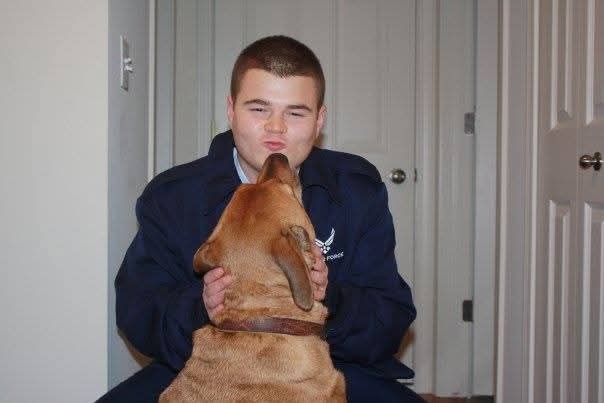
A man wearing an Air Force uniform is greeted by his dog following his return home on leave.
Mike Matteis, pictured in this 2002 photo, is greeted by his dog Jeffrey after returning home from basic training. Photo courtesy Mike Matteis

Matteis left the Air Force with an honorable and medical discharge in 2011. He struggled to adjust after leaving, missing both the structured environment and feeling of purpose the military offered.  He also suffered from PTSD.  “It made it very difficult to maintain stability — whether that was holding a job, staying in school or sustaining relationships. It took me about nine years to reach a place where I felt stable enough to build what many would consider a 'normal' life, meaning one where I was working consistently, pursuing my education, getting married, having a child and buying a home,” he says. “That journey, along with my growing interest and education in information technology and AI, gave me the perspective to recognize where additional support could exist and ultimately led me to design a solution like this."

Eventually, he secured a job as an infrastructure solution architect for the State of Michigan and earned a master’s degree in cybersecurity from Eastern Michigan University. He is now pursuing an MBA to support his career goal of moving into a management role. He chose the MBA program at UM-Dearborn in part for the school's reputation for veteran-friendly programs and for its accessibility of online degree programs.

The AI Veteran Companion users can opt in for daily check-in prompts that encourage them to report instances of anxiety, PTSD symptoms and other mental health challenges, as well as walking them through grounding exercises as needed. Matteis hopes to see the chatbot developed into an app that could be downloaded to Apple iOS and Android devices. 

"It'd be right there in the palm of their hands to reduce their mental health symptoms and not feel alone in their progress of trying to get better," Matteis says. His ultimate vision for the companion is even bolder: "With their permission, what the veteran communicates to the app would be routed directly to the clinician for their notes." Matteis says this would enable therapists to have a more complete picture of the veteran's mental health.The chatbot would also immediately inform the clinician if the veteran used certain trigger words, including language relating to self-harm and suicide.

Matteis' project was featured at the recent College of Business Innovation Showcase. Guo says it stood out among her course’s projects. “It’s indicative of what technology can do and how it can be used to help people," Guo says. The AI Veteran Companion took the top graduate project prize at the event. 

News of Matteis’ award was shared on the College of Business at UM-Dearborn’s LinkedIn page — and that got the attention of VETLIFE, the nonprofit responsible for the popular veteran resource app Battle Buddy. Matteis is in talks with the VETLIFE team about potentially licensing his product for integration into their application.

Matteis says support tools like his are vital and he’s glad to have had a classroom assignment that encouraged him to develop it. "Veterans are trained to be strong for others, but they still need support too," he says. "My goal is to use technology to meet them where they are and make sure they never feel like they have to face things alone."

Story by Shaun Manning