

First-year student Wyatt Serrato is one of those sports fans who can, in the course of conversation, comfortably switch from talking about the NFL to international track and field to the prospects for expansion teams in a burgeoning professional women’s hockey league. (He’s currently studying that last topic for a class project.) He's also an athlete himself — he wrestled and golfed in high school. But he didn't pick up track — the sport he's devoted to now — until four years ago. Serrato recalls the pivot came during a difficult time for him personally, when he was “in and out of the hospital because of anxiety and depression.” One of the really positive parts of his life, though, was competing with the Special Olympics — first as a distance runner and then as a sprinter. (Serrato is on the autism spectrum.) At that time, Serrato says he was on the fence about whether to attend college. And sports, it turned out, was one of the things that eventually pushed him toward going.
It was a simple Google search that got things started. “I was in Big Lots picking up some things for my mom. Then, after I got back to my car, I looked up on Google, ‘track and field teams for people with disabilities’ and the University of Michigan’s Adaptive Sports and Fitness website came up,” he recalls. This program supports student-athletes and community members who have physical and intellectual disabilities, and fields competitive teams in wheelchair basketball, rugby and tennis, as well as para powerlifting and adaptive track and field. Serrato decided to send an email inquiry, and the program’s assistant director got back to him right away. They exchanged a few emails, did a Zoom call and then arranged for Serrato to visit campus. “So it’s July 23 last year, and I walk in, and lo and behold, there’s Sam Grewe and Leo Merle, two U.S. paralympians — as they’re training for the 2024 Paralympic Games in Paris,” Serrato remembers. “I did a fun little high jump session with Sam and then we had some fun getting to know each other. And then we did another little session in the weight room, to see where I was at. I was like, ‘Man, where am I at?’ Just to work out with these guys was so cool.”
The Adaptive Sports and Fitness program is open to students on all three U-M campuses, but it also welcomes participants from the community. So Serrato was able to join the U-M Adaptive Track and Field Team even before he was a student. Then, this fall, when he started at UM-Dearborn, he got to officially compete as a student-athlete. He says one of the big perks is that adaptive student-athletes get to train at some of the same top-notch facilities as the U-M varsity teams. And in just the year and a half he’s been competing, he’s already traveled to meets in Alabama, Arizona and Chicago, as well as several competitions in Michigan.
His top highlight so far has been competing on Team USA at the 2025 Virtus World Athletics Championships in Brisbane, Australia — an event run by the premier international sports federation for athletes with intellectual disabilities. (Virtus is also a founding member of the International Paralympic Committee.) Serrato says it was a pretty wild experience — especially considering he wasn’t sure he was going to be able to go until three weeks before the October event. To qualify at this level in specific categories, adaptive athletes not only have to have competitive qualifying results in their events (Serrato’s personal best in the 100m is 12.03 seconds). They also have to prove they meet certain criteria for their specific disabilities. For Serrato, that meant getting an assessment from a psychiatrist and taking an IQ test. Initially, it didn’t look like he was going to meet the qualifications for the II3 eligibility classification for athletes with autism. But after a second assessment, he got the green light and booked a ticket to Brisbane with less than a month to get in race shape.
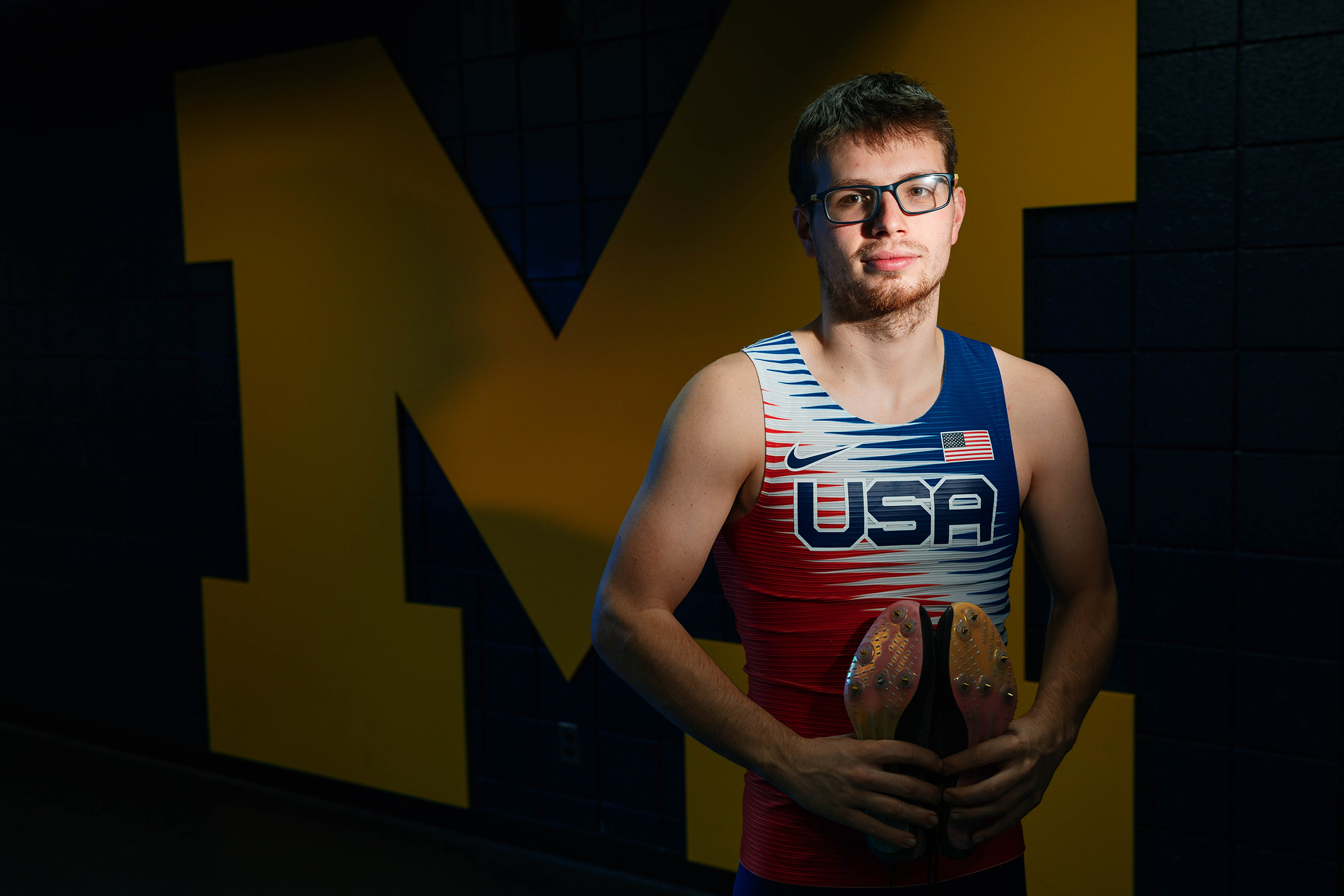
Brisbane was quite the experience, both on and off the track. On his first day of competition, Serrato took fourth in the 100m final in 95-degree heat. On his second day, the conditions were 20 degrees cooler and cloudy, but he ran into an unexpected snag. As he was preparing to compete in the long jump, he found out that the spikes he was using were actually banned by World Athletics. “So the Team USA manager’s friend’s brother-in-law donated me a pair of long jump spikes the day before I jumped. I liked how they felt, but I definitely wasn’t used to them,” he says. Serrato had four faults but ultimately managed another fourth place. Then, in the 200m — you guessed it — another agonizing fourth-place finish. “To get fourth place in three events, it stings a little bit, but it’s a learning experience,” he says. “You get your first international experience out of the way, and then you move on to the next one.” (Serrato is eyeing the Virtus American Games in Lima, Peru in October as his next chance to make the podium.) Aside from his time on the track, Serrato says highlights of the games included bonding with the loud-and-proud Italian and Australian delegations, enjoying a steak dinner to celebrate a teammate’s gold medal, and petting — and not getting kicked by — a kangaroo at a wildlife sanctuary.
As a first-year student, Serrato is still figuring out his career path. But it’s quite possible adaptive sports could be at the center of that too. He’s found a natural fit in the College of Education, Health and Human Services’ new undergraduate sports management program and is currently keeping a close eye on the upward trajectory of adaptive sports at the collegiate level. He says his dream right now is to combine what he’s learning in his program with his experience as an athlete, potentially helping colleges and universities build out their adaptive programs. “It’s definitely a scene that’s growing each year,” Serrato says. “And you’re definitely seeing more Division I varsity programs and adaptive teams working together and sharing facilities. With more and more programs coming online, I could see an adaptive nationals happening in the near future. I think in the next decade, the new norm is having adaptive athletes be recruited like Division I athletes. We deserve it. We’re athletes just like everybody else.”
###
Story by Lou Blouin. Photos by Matthew Stephens.


