Approaching AI through a human lens

February 25, 2026

Two speakers from U-M and a UM-Dearborn panel recently discussed strategies, questions and quandaries about ethical, effective uses of AI in the classroom.

Four professors are speaking to an audience from a stage. One of the faculty members, a woman, holds the microphone and answers an audience question
Professor of Information Systems Management Barbara Klein speaks at a recent event on AI in the classroom. Also pictured, from left, are CECS Assistant Professor Jason Song, CEHHS Professor Mesut Duran and Hub Lead Instructional Designer Autumm Caines.

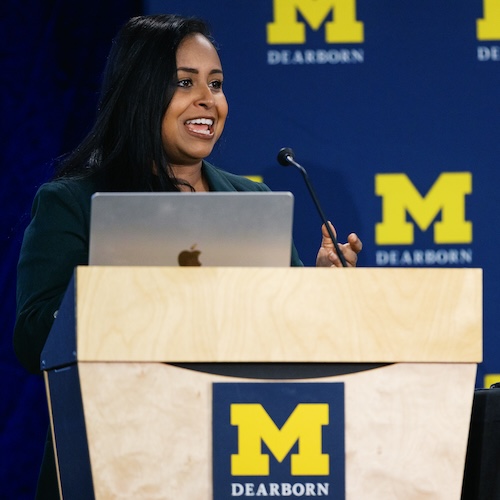
When Tazin Daniels asked a group of UM-Dearborn faculty and staff how they were feeling about AI, the top three answers were: hopeful, curious and optimistic. Daniels, an associate director of the University of Michigan’s Center for Research on Learning and Teaching, then cited additional responses: nervous, daunted, scared, overwhelmed. ”The reason I start with this is to normalize the range of emotions that probably come up when we talk about generative AI,” she explained.

A woman wearing a teal blue suit jacket and a black shirt speaks to an audience from a podium
Tazin Daniels, an associate director of the University of Michigan’s Center for Research on Learning and Teaching

Daniels, the keynote speaker at a Feb. 13 discussion held in Kochoff Hall titled “How can Innovation and Integrity Coexist with AI?," explained that she views AI through a broad lens. “I’m a humanist. I love stories,” she said. “I see technology not just as a shiny object, but I see it as a reflection of our own values and our own goals as a society.”

Daniels then detailed a framework for faculty engagement with AI — generative AI, in particular — that offered practical advice for educators at every stage. For those feeling apprehensive, she advised them to base decisions on their fundamental teaching philosophies, not outside pressures, and to limit their focus to their discipline. For those who are curious and beginning to explore — the “approaching” stage — she recommended anchoring decisions on teaching needs, not technology trends. At the “adopting” stage, Daniels advised resisting trendy tools because “sometimes technology is not the right answer.” For those who are “abstaining” — faculty who are open to the use of generative AI, but have decided it’s not a fit for their discipline or specific course at the moment — she urged framing that abstention as an intentional pedagogical decision and staying open to reevaluation. Her advice for the evangelists most sought out for panels, policy efforts and mentoring, referred to as the “advancing” stage? Set boundaries. 

Watch the full "“How can Innovation and Integrity Coexist with AI?" presentation

Centering classroom objectives and fundamental philosophies is key, Daniels insisted. “Critical engagement is not about keeping up with AI,” she said. “It's about staying aligned with your learning goals and your values. Those things can coexist.”

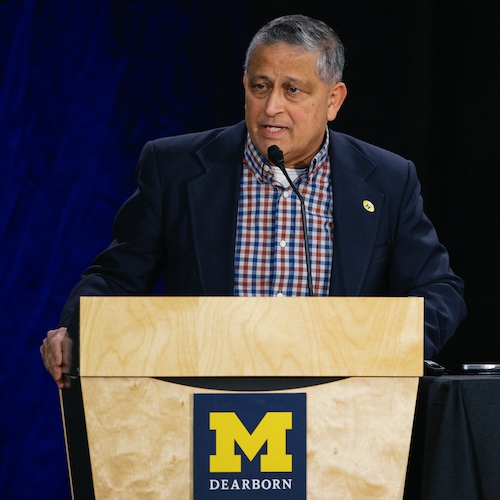
A man wearing a red, white and blue checkered button-up shirt and navy blue suit jacket speaks at a podium.
Ravi Pendse, vice president for information technology and chief information officer at UM-Ann Arbor

Daniels’ address was followed by a panel discussion with UM-Dearborn faculty and staff members on the uses of AI in teaching, learning and research. Faculty from all four colleges — including Professor of Information Systems Management Barbara Klein, who noted she has been experimenting with AI since 1985 when she was working at IBM — as well as staff from the Hub for Teaching and Learning shared concrete and candid examples of strategies they’ve employed, quandaries they’ve faced and ways they’ve addressed academic integrity concerns.

In a closing presentation, Ravi Pendse, vice president for information technology and chief information officer at UM-Ann Arbor, shared the philosophy behind the university creating its own suite of AI tools, which were made available to all three campuses in fall 2023. “The reason we made the tools available with the speed with which we did for our entire campus community, including, of course, Flint and Dearborn, is because I sincerely believe that this is the most impactful technology of this century, and can be a force for positive disruption, if used thoughtfully, if used responsibly, if used ethically, if used legally,” he said. He noted that the speed of adoption for AI is moving much more rapidly than any preceding technologies and stressed that, to teach students how to use AI responsibly, faculty and staff must spend time experimenting with it. “It’s our responsibility to walk the talk,” he said. “If you're going to show people how to use this technology responsibly, then we have to be actually willing to try it out and explore it." 

Faculty and staff panel participants included Associate Professor of English Literature Shelly Jarenski, Assistant Professor of Computer and Information Science Zheng (Jason) Song, Professor of Information Systems Management Barbara Klein, Professor of Educational Technology Mesut Duran, Hub for Teaching and Learning Lead Instructional Designer Autumm Caines and Associate Professor of Biochemistry Besa Xhabija. The panel was moderated by Interim Associate Provost for Faculty Development and Digital Learning Stein Brunvand.

Story by Kristin Palm. Photos by Matthew Stephens