

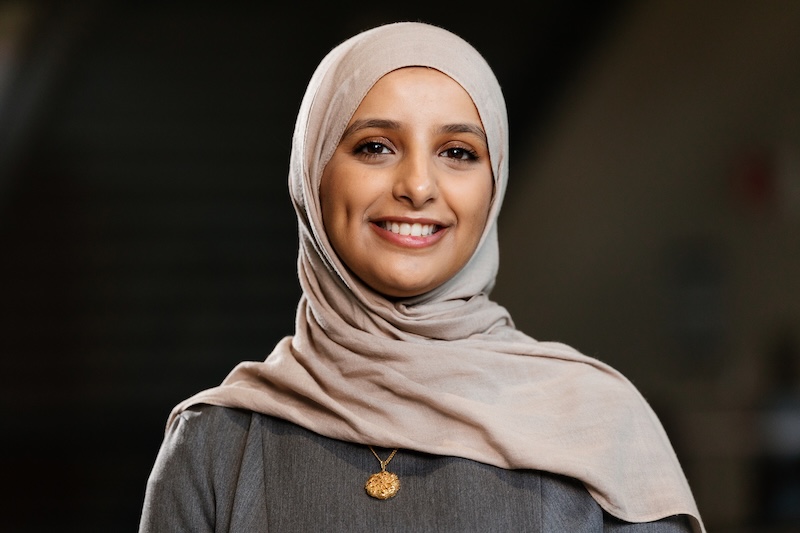
When they walked across the commencement stage with 1,000 of their fellow Dearborn Wolverines on May 6, Sumia Saleh and Chance Inosencio were prepared for their next steps. Both computer engineering majors, Saleh landed a cloud engineer position at Consumers Energy and Inosencio secured a research assistantship in graduate school.
"I was so excited and had so many people in my family there supporting me," Saleh says. "I am a first-generation college student and the first in my family to become an engineer. I dreamt of that day — and now it’s part of my story."
Saleh and Inosencio were among the first graduates from the university’s STEM Scholars program. The program, which launched in fall 2022, creates a community for Pell-eligible students pursuing science, technology, engineering and mathematics.
"We noticed that many of our students, especially our Pell-eligible students, work. They are responsible for family care, live in underserved areas and are often the first in their families to go to college," says Joan Remski, professor of mathematics and lead director of the program. "They want an education, but don’t have the time or the experience to work through a challenging course of study. We needed a plan to better support these students."
Built on belonging, proven by results
Remski — along with Professor Emerita of Biochemistry Marilee Benore and Professor of Chemistry Dan Lawson — created the program because she and her colleagues noticed that graduation rates for Pell-eligible students in STEM majors lagged behind those of their non-Pell eligible counterparts. They wanted to test whether additional support could dismantle barriers these students face, like needing to prioritize working long hours instead of studying to make ends meet financially.
The program, currently funded through a six-year grant from the National Science Foundation, offers full-tuition scholarships to participating students. Over the last four years, 52 students have been admitted to the program.
"We noticed that our low-income students didn't persist in their STEM degree programs or graduate from these programs at the same rate as their peers and we wanted to close this gap," Remski says. "Our numbers from the first cohort show that we did that."
Of the original 16 scholars, 63% completed their degrees in four years, while nationally, only 38% of students from lower-income households finish undergraduate STEM degrees in six years. And 90% of all admitted STEM Scholars have graduated or remain actively enrolled on campus.
The program uses a cohort model, so STEM Scholars study together, meet with peer mentors in gateway courses like Calculus I and General Chemistry, participate in professional development workshops and conduct research with STEM faculty. Beyond Pell-eligibility, students are selected based on their academic performance and interest in STEM fields.
"Putting them together in these courses created a community," Remski says. "I really think community, a sense of belonging, and the amazing team of faculty and staff supporting this program — that’s the secret to our success."
Since most UM-Dearborn students remain in the state following graduation, Remski says the program could help grow and diversify Michigan’s STEM workforce. "We took every student who was eligible. We didn't cherry-pick and say we're going to take only the best students with the highest GPAs that came from the best high schools," she says. "Some students struggled, but we were just really committed to being there for them and letting them know that setbacks are part of the journey."
"Being there" for students means mentorship was personalized depending on student needs. STEM Scholars program advisor Dina Shohatee and faculty mentors like Associate Professor of Mathematics Alan Wiggins, Associate Professor of Anthropology Patrick Beauchesne and Benore created an accessible and welcoming way to discuss any concerns they had.
For first-generation students like Saleh, their support made all the difference. Saleh, who excelled in high school, says the rigor of college STEM classes made her temporarily doubt her abilities. "I had a severe case of imposter syndrome," Saleh admits. "I was like, 'I don't belong, I don't think this is for me.'"
When academic pressures felt overwhelming during her freshman year, Saleh turned to Shohatee. "I remember going to the office and just crying to Dina. She was very encouraging," Saleh recalls. "I loved the mentorship we got because I knew I had someone who would support me academically throughout my journey."
Inosencio recalls struggling early in his college career too. "I remember our first exam we did. I got like a 60% and I had never gotten a grade that bad. I went home and I cried," he says. "But all of my other STEM Scholars peers were in that same class, so I was able to reach out to them and ask, 'Hey, is anybody else really struggling?' It was reassuring to know I wasn't the only one." Together, the students formed study groups and attended the professor's office hours to master the material.
Remski says STEM fields are challenging for most students — and the STEM Scholars’ growth during the program impressed her. "I think the students that I'm most proud of are the ones that faced challenges and then came back and crossed that stage at graduation," she reflects. "I know how hard that can be. And, as a professor, to get students who really struggled at the beginning across that stage is why I do my job."
Hands-on research and career pathways
Saleh partnered with Professor of Electrical Engineering Samir Rawashdeh, a faculty mentor, on human-centered electrical engineering research, co-authoring work on a carbon dioxide-detecting face mask. "He gave me a lot of opportunities to learn," Saleh says. "He even became my advisor for my senior design project."
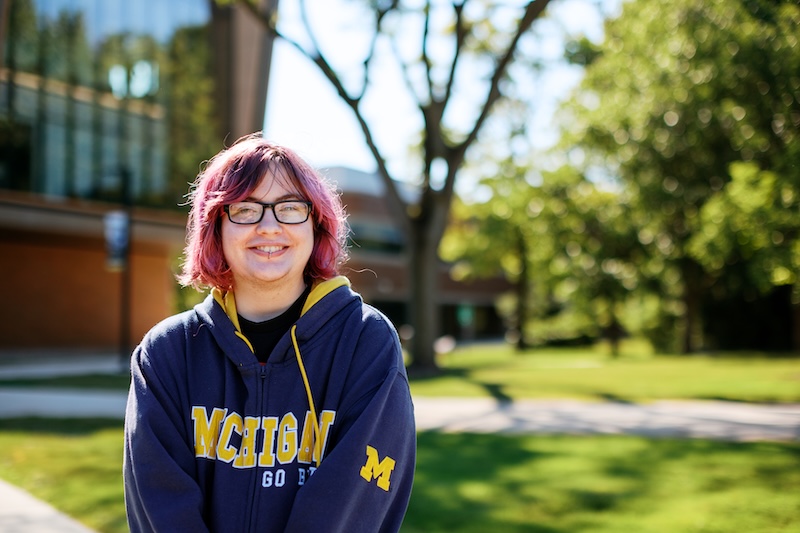
For Inosencio, who had always dreamed of being a scientist but hesitated to attend a four-year university due to costs, the hands-on research opportunity was the defining feature of the program. He joined a summer research project in the Electrical and Computer Engineering department where he processed video data to study driving behaviors linked to early Alzheimer's onset. Through STEM Scholars, both opportunities offered a stipend to the students so they could have the financial freedom to do research work.
"It was exciting. I had never really been on a research team like that before and I got to sit in on meetings and see how they organized the project. That experience confirmed for me that research was something I could realistically pursue," he says. This fall, he started a master’s program in linguistics at the University of Saskatchewan, where he will use machine translation to help preserve endangered North American Indigenous languages like Anishinaabemowin.
"I think the STEM Scholars program is really important — honestly, it's life-changing," says Inosencio, who has Potawatomi ancestry. "The community that the program creates definitely helps because you have a built-in support group."
For Saleh, workshop guidance on resume updating, elevator pitches and career fairs helped her secure an internship with Consumers Energy as a junior, which evolved into a co-op and ultimately a full-time role as a cloud engineer. Today, she returns to campus regularly as a Consumers Energy recruiter and mentor for incoming students.
"I feel like I was really confident and very ambitious because of the STEM Scholars," Saleh says. "It gives you people that make you feel more confident and push you to pursue things. It’s always great to give back and see other people grow."
As Remski and her team evaluate next steps and explore new funding to sustain the initiative, she says the core lesson of STEM Scholars is clear: Students from all backgrounds can thrive when they receive support carefully tailored to their needs.
"Every student has a different path, and sometimes you have to be patient to see where that path is taking them," Remski says. "Having that understanding and patience while they're figuring it out really pays off in the end."
Story by Sarah Tuxbury. Photo by Michigan Photography.


