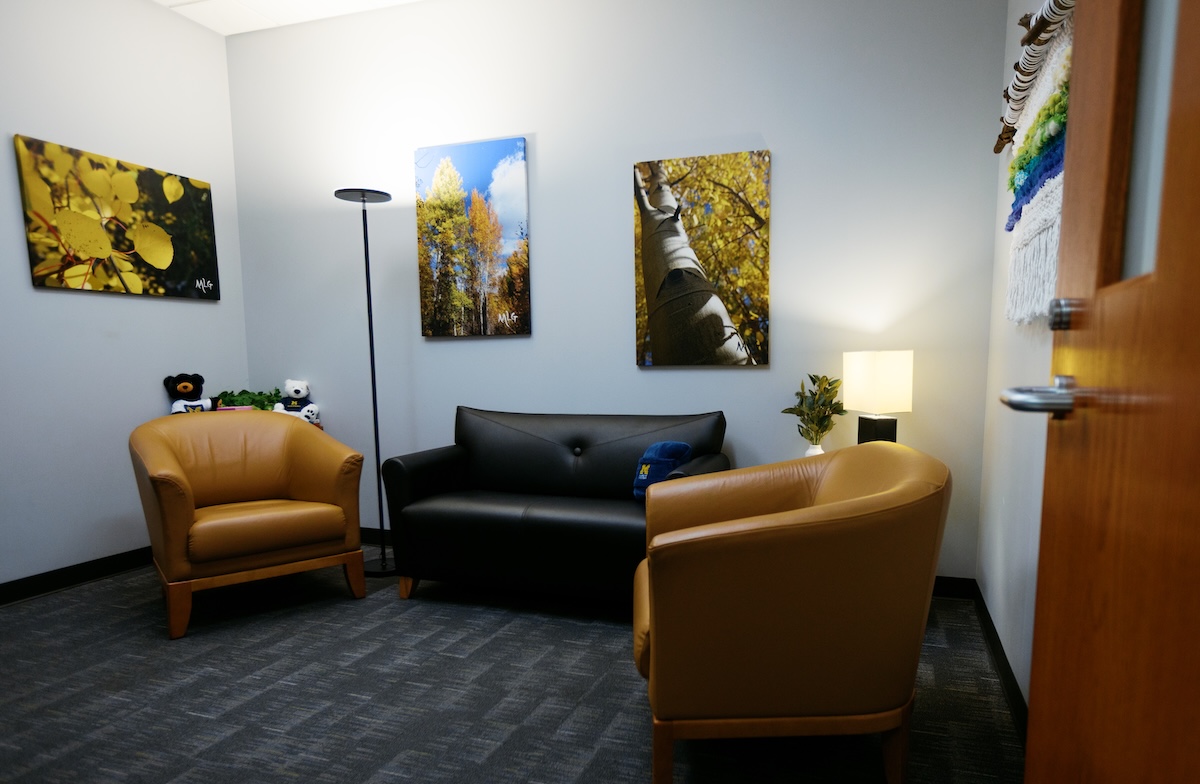
A few forces converged to make the supportive interview room a reality. One of those forces was Kaitlin Deslatte, a UM-Dearborn police officer who helped found the special victims unit at UM-Ann Arbor when she was an officer there. Drawing on her ongoing training in trauma-informed policing, Deslatte approached McDaniel about the idea of a supportive interview room a couple years ago.
“I have slowly been implementing different law enforcement elements on campus related to survivor-centered, offender-focused and trauma-informed approaches to investigating interpersonal violence,” Deslatte says. “I really saw a need for some more resources here on this campus, and I thought a supportive interview room was an easy enough ask.”
Similar spaces already exist on the Ann Arbor and Flint campus. “I wanted to make sure that we were doing all that we can to provide some of those resources to our students here,” Deslatte explains. She and her colleagues in UM-Dearborn’s Department of Public Safety will also use the room for interviews with survivors of traumatic incidents, such as intimate partner violence or sexual assault.
McDaniel and Deslatte talked to Emily Hamilton, director of facilities planning and construction, who was managing the renovation of the Daniel Little Building, where ECRT was previously located. With the consolidation of the university’s administrative offices as part of that project, McDaniel requested that ECRT be moved to a location that offered more privacy for those who come to talk to her and her team. They are now located on the second floor of the Science Faculty Center, where Hamilton found space for the supportive interview room as well.
The room, which is painted in muted tones and lit softly by lamps, features a couch, armchairs and end tables — one with stuffed animals placed discreetly in a corner, another stocked with a Rubik’s Cube and other fidget toys. Large nature photos, with a loose maize-and-blue color scheme, adorn the walls. Deslatte secured the photographs from Project Beloved, an organization that advocates for supportive interview spaces. There is a sound machine for privacy and a scent diffuser to promote calm. Recognizing the need to maximize work space on campus, Hamilton also equipped the room with a desk and computer monitor so it can be used as a flex office when interviews aren’t taking place.
Above one of the armchairs, hanging from a large branch found on campus, is a wide textile work, constructed from soft woven and knotted white yarn accented with vibrant turquoises and greens — dyed in Kool-Aid — that play off the colors in the photographs.
It was created by Hamilton, who has long been a visual artist but only started weaving during the pandemic. She says weaving brings her a sense of calm and she saw an opportunity to extend that feeling to those using the room. “I thought my cozy weaving would fit in and make it feel like a more of a soft and comfortable space,” she says.
McDaniel stresses that the room is intended as a safe space for anyone she or her team may need to speak with. “Those that are accused of misconduct are still part of our community. At the time we speak to them, they haven't been found to have violated any policies and they may need support as well,” she says. “We wanted a space where it didn't feel clinical and instead felt like somewhere everyone could be relaxed.”
McDaniel says that the room will enable ECRT and DPS to infuse an extra layer of compassion into their work. “For folks who have hard things to say, we wanted to make it as easy as possible for them to share that with us,” she says.
ECRT will be hosting an open house to introduce the campus community to their new office space and the supportive interview room on Oct. 13 from 2-4 p.m. in the Science Faculty Center, rooms 208 and 210.
Hamilton’s textile works can be viewed on her website.
Story by Kristin Palm, photos by Matthew Stephens