

Yusef Bunchy Shakur has a bachelor’s degree in liberal studies from the University of Michigan-Dearborn, a master’s degree in community organization and advocacy from the University of Michigan School of Social Work, and a PhD in public policy and social change from the Union Institute and University. Yet the educational experience that changed his life most profoundly was sparked by a series of letters he exchanged with his father while they were both incarcerated at two different institutions separated by a dirt road in rural west Michigan. Their neighborly geography meant the correspondence was frequent, and it was Shakur who initiated the contact. At the time, the 19-year-old Shakur had recently begun serving a nine-year sentence for an assault for which he maintains his innocence, and the “low point” sent him “looking for a lifeline.” Reaching out to his father was both a natural and unlikely place to search out a steadying force. Shakur notes that he was a “product of a teenage love affair”; his mother was 15 when she got pregnant, his dad 17, and “by the time I had come into the world, they had parted ways,” he says. His father drifted out of the picture, joining the Navy, leaving his mother to raise Shakur with his maternal grandfather.
Other than an earlier exchange of a letter each when Shakur was in a state facility for youth, the two men didn’t have much of a relationship. So Shakur approached the new attempt at correspondence with few expectations. He says his first letter was simple, basically informing his father of his incarceration. But his father responded quickly and thoughtfully. It wasn't the “I told you so speech” that Shakur feared, but instead a blend of his father’s own personal history in prison, his perspectives on systemic racism, radical Black politics and earnest fatherly advice. Shakur says that was typical of many of his father’s letters. Sometimes, he would directly coach Shakur on strategies for not getting swept up in the violence of prison life, or to be wary of the many men who oversold themselves as spiritual leaders. Over multiple letters, his father also unveiled the story of his own personal transformation in prison, which was fueled by deep immersion in Black intellectualism and radical politics, as well as a focus on his physical health. He shared stories of a years-long stint in solitary confinement, in which he organized a reading curriculum for himself and “turned prison into a school.” The one hour a day he spent outside his cell, he’d run to stay fit. The letters were frequently full of book recommendations: Malcolm X, James Baldwin, W.E.B. Dubois, Richard Wright. Sometimes, there was gentle fatherly chiding, like in his father’s very first letter when he “highly recommended I get a dictionary” as a remedy to Shakur’s frequent misspellings.
The intellectual tone and the emphasis on self-betterment were new to Shakur, and the approach resonated deeply. “It was like a great professor — that profound guy who’s not trying to be smart but can also connect in that human way,” Shakur says. “I’d read the letters over and over. It felt like there were secrets in there, like I was putting together a puzzle.” After about a year, their personal connection got a deeper platform when Shakur was transferred to the same maximum security prison as his father. The two met for the first time in the library — a quick moment whose intimacy was muffled by guard supervision. But Shakur remembers the sweetness of his father walking him back to his cell that day, the two of them “trying to cram a two-hour conversation into two minutes.” His father handed him a Malcom X tape and a fresh letter, and for the next few months, they could use voices instead of pens to communicate.
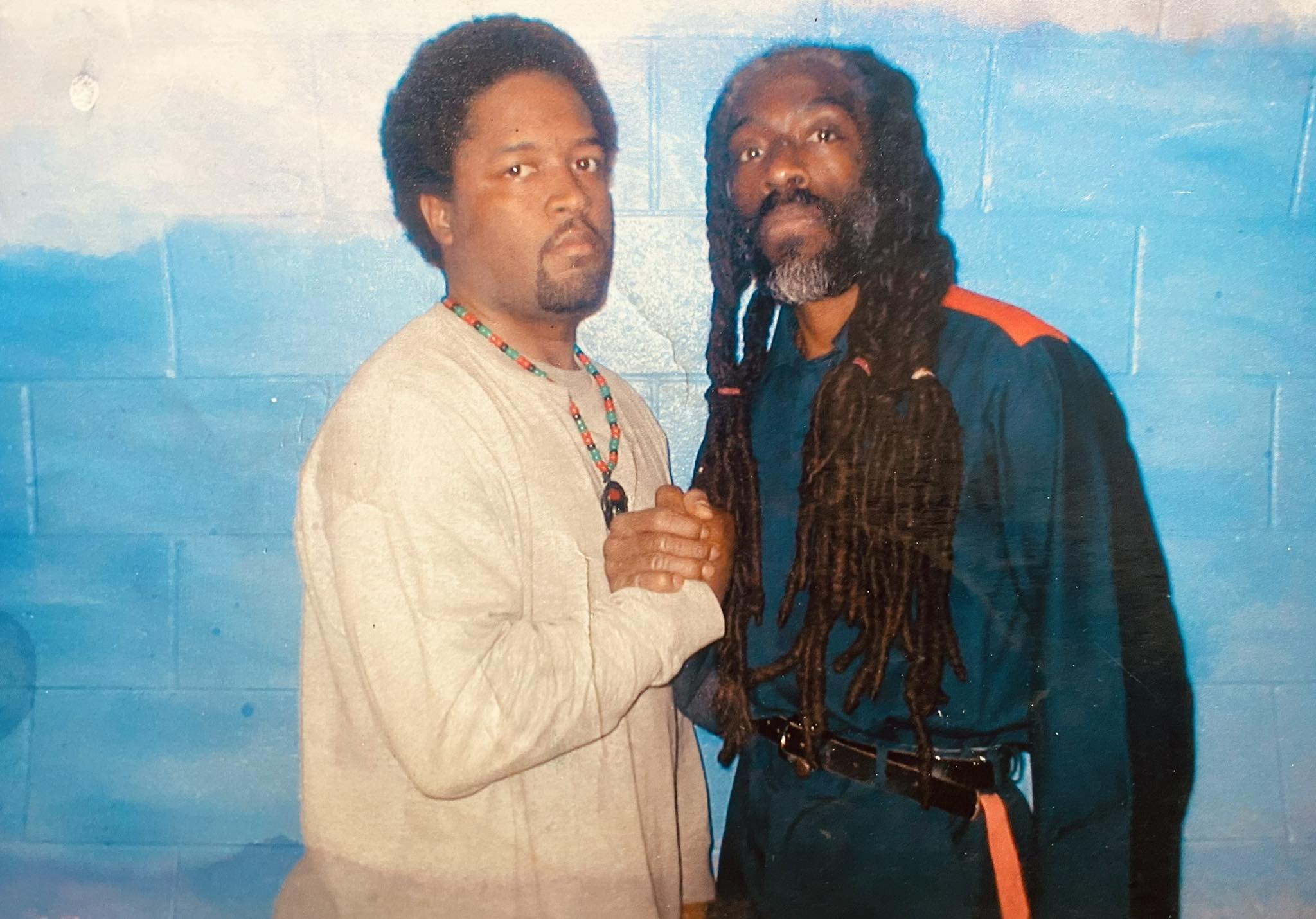
They’d get only six months together before Shakur was again transferred to another prison, but the newfound relationship would have an enduring influence on his life. He realized the “puzzle” he’d felt compelled to put together from his dad’s letters was really “a formula for me putting my own life together.” First and foremost, he totally recontextualized his own personal history, especially his childhood. He began to shed the reductive, often dehumanizing narratives that had invaded his own understanding of his identity: himself as “gang member,” his father as someone who had “abandoned the family,” his mother as “welfare queen.” Instead, he came to see how he, his family and his neighborhood were shaped by systemic social and economic forces that were fundamentally hostile to the well-being of poor Black people. Indeed, Shakur’s childhood overlapped one of the saddest chapters in Detroit’s history, a period in which decades-long disinvestment and depopulation fueled by white flight, racist real estate policies, and the crack cocaine epidemic left many Black residents with few options to build better lives for their families. As a teenager, he had pulled away from his mother, even as she did her best to protect him from the violence of the streets. Now, he found himself imagining what it must have been like for a 15-year-old Black woman to raise a child in an era where women had just gained the right to get a credit card in their own names. Likewise, he came to see himself not as a “thug,” but as someone who had been “molested by the streets,” a child whose humanity slowly “evaporated” under desperate circumstances. “My father and mother, they’d been thrown away by a society that rejected them,” Shakur says. “So I had to choose not to reject myself. I had to choose to love myself.”
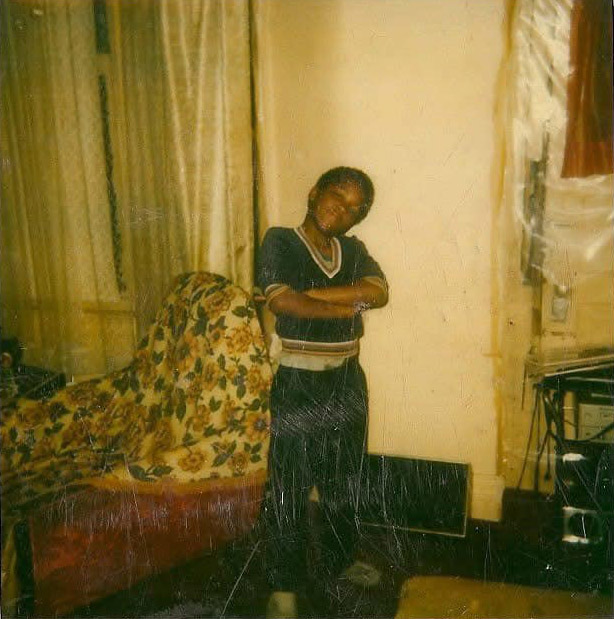
The awakening reshaped the remainder of his prison experience. Following his father’s formula for transformation, Shakur himself was now known as the “guy with a footlocker full of books.” Like his father, he also saw an opportunity to use his re-education to mentor other men in the prison. Shakur says he’s always been a natural leader, but this was a period in which he learned how to lead “in the right way.” One day, as an invited guest at a religious service for a group of inmates, he was giving a not-so-sympathetic talk on the nature of the police. In the corner was a guard who had, a few months earlier, been responsible for his months-long stay in solitary confinement, essentially because the guard hadn’t liked the way Shakur had looked at him. When Shakur’s presentation was over, the guard shared a few thoughts of his own on the subject, at which point, the other men asked Shakur if he’d like them to stick around. Shakur waved them off, and he and the guard proceeded to have a surprisingly deep conversation about the reasons for the chronic hostility between guards and inmates. “We had a very intense, confrontational but respectful conversation,” Shakur remembers. “I wasn’t talking to him as a gangster. I wasn’t talking to him as a thug. I was talking to him as a man — as a human being. The important thing is that it did not become physical. It had been so ingrained in me to handle conflict in a physical way. But I was using my intellect to try to persuade this man. That showed me the power of who I was — of who I was becoming.”
Shakur was 28 years old when he was released from prison. He returned to his childhood home in Detroit, where his mother and sisters were his main source of support. But as it is for many formerly incarcerated people, especially those with felony convictions, Shakur struggled to find his footing. Temporary employment became his norm — a custodial job at the airport, a factory position that only lasted a couple months — but it was nothing that could help him build momentum. At one point, feeling the pressure to contribute financially, he dipped a toe back into his old life. “One day, here I was trying to sell drugs to this guy, while I’m also trying to save his soul,” Shakur says, wryly. “And the guy said to me, ‘Are you gonna sell me the drugs or are you gonna preach to me? ’Cause you can’t do both.’ And I woke up the next morning, and I looked in the mirror and I said, ‘Man, this ain’t who I am.’”
At the time, Shakur was dating a woman who had a child in Head Start, a federal program that provides early childhood education, health, nutrition and parent support services to low-income children and families. With some free time on his hands, he decided to volunteer. Shakur notes that he was a bit of a “novelty” at Head Start, as early childhood education doesn’t attract a lot of men. But the staff noticed his rapport with the students, and after he volunteered for a few months, they offered him a temporary and, eventually, a permanent position. His initial role was parent involvement coordinator. He created and organized outreach events like the Fatherhood Olympics, in which kids and their dads participated in uber-wholesome activities like fishing, digging for pennies and reading books together. Shakur says the support he got from staff for his ideas was a huge confidence booster, and he soon started organizing his own community events. Around this time, Shakur launched his annual Backpack Giveaway, which outfits kids in Detroit’s Northwest Goldberg neighborhood with free backpacks full of school supplies. In 2025, the Backpack Giveaway celebrated its 20th anniversary.
Shakur also began to cross paths with other Detroit activists, including many of the iconic leaders who’d lived through the era of radical Black politics that inspired his own personal transformation. They were often a generation or more older than Shakur, but they each recognized the other as kindred spirits. He met General Gordon Baker Jr. and Mariam Kramer, two of the city’s storied anti-poverty activists, because the husband and wife had a grandchild at Shakur’s Head Start location. Often, like the time some years later when he got to meet labor organizer Grace Lee Boggs, Shakur says he wasn’t even aware of these activists’ legendary history before getting to know them. But their sharing of stories and wisdom was profoundly meaningful to him, both as a form of mentorship and because these people were touchpoints to a history that meant so much to him. “People like Grace — they knew Malcolm X, she had him over to her house,” he says, still with a sense of amazement. Some years later, when he was sharing a stage with Boggs and other Detroit activists on a panel at the World Social Forum, a man approached him after the discussion wanting to know more about the work he was doing with formerly incarcerated people. First, though, the man was curious about his name, “Bunchy,” which Shakur had taken in prison while studying the writings of Black Panther leader Bunchy Carter. It turned out the man was Arthur League, an original member of the Los Angeles chapter who had served with Carter in the 1960s. The chance meeting kicked off a 15-year friendship.
Shakur says these connections with other activists had a profound influence on him, but his activism has always been somewhat self-styled. In prison. Shakur says his strength in reaching people was rooted in his authenticity, seriousness and reputation as a good person who walked the talk. Rather than loudly proselytizing, he tended to let people come to him, often offering them books and then counting on the monotony of prison life to eventually trigger an interest in reading them. He also notes he possessed a kind of paradoxical credibility: As a former gang member, he understood the experience of many of the other men. “But I wasn’t known for being a gangster. I was known for being a good brother,” he says. “Even now, I take pride in the fact that I never stabbed a guy. That’s not on my resume.”
On the outside, Shakur leveraged a similar approach, with projects flavored by intellectualism, hyper-locality and direct human contact. When a liquor store in his neighborhood closed, taking with it the last local place residents could buy a newspaper, Shakur opened the Urban Network bookstore, recording studio and community space. A few years in, the landlord raised the rent, which forced Shakur to close the store. A neighbor who was familiar with his work responded by giving him a nearby vacant house. Shakur renovated it and opened it as the Mama Akua Community House. Shakur describes it as a “multipurpose space,” which is greatly underselling it. Throughout the week, the building is home base for everything from block club meetings, to cooking and nutrition classes, to forums on community policing. On Fat Burger Fridays, neighbors can order a burger with a donation and work in the free computer lab. Another community group hosts Vegan Tuesday at the space for those preferring a meatless option. This past September, Mama Akua hosted an event where 50 formerly incarcerated women got together to share their stories and discuss practical ways to improve their lives. The house is also beautiful. A bit worn on the outside, but on the inside, filled with Afrocentric art, bits of Black history and books. Shakur harvested doors from the house and other nearby homes scheduled for demolition and screwed them to the ceilings and floors to represent “doors of opportunity for people who society has pushed out.”
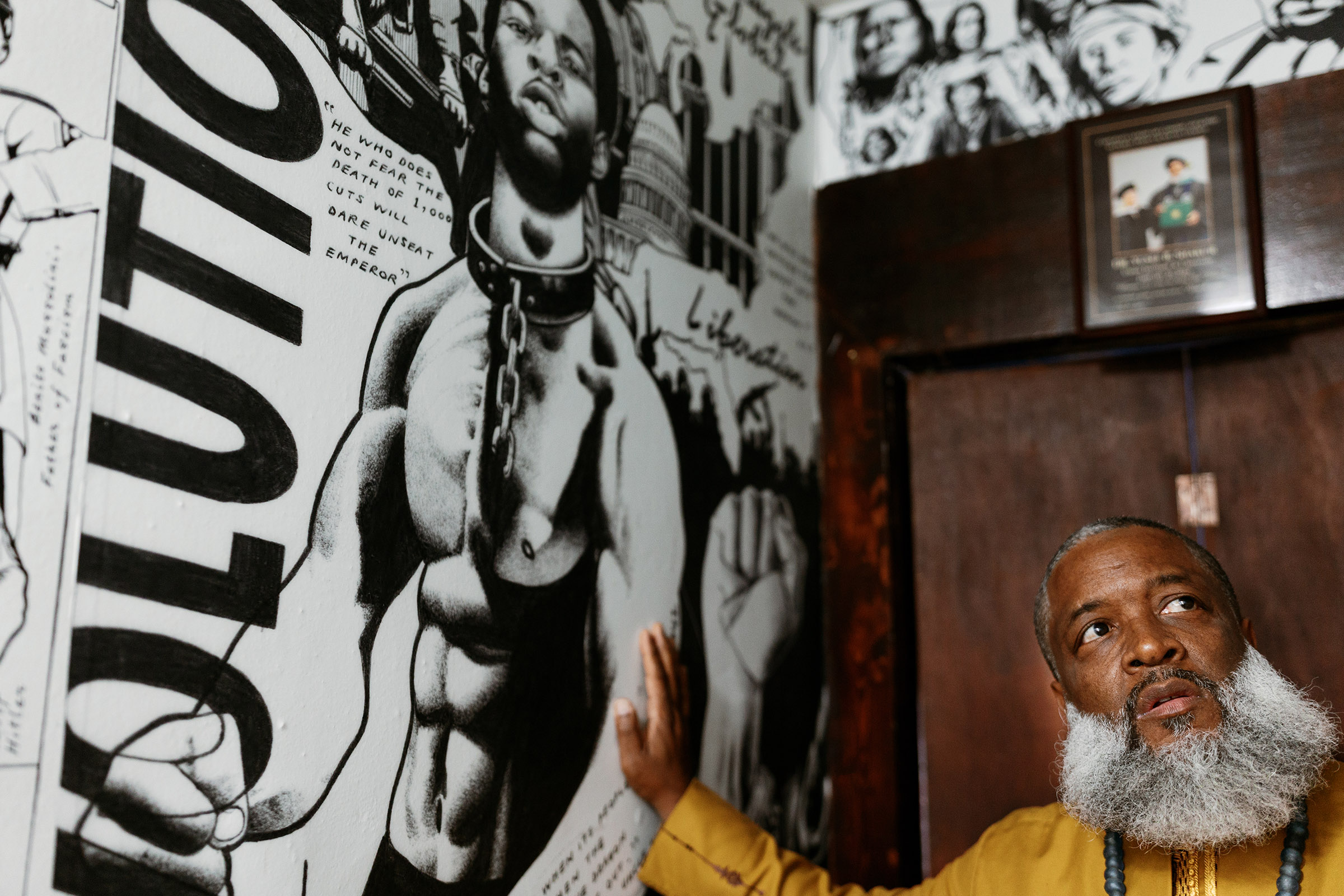
Through this period when he was developing as an activist, Shakur was also a college student. He says a man who he knew from prison, who had been working on his bachelor's degree, practically “kidnapped” him and drove him to Wayne County Community College to fill out the enrollment forms. At WCCC, he focused on prerequisites and taking every African American Studies course in the catalog. He remembers one time, some classmates who knew of his activist background teased him that he was “cheating” by choosing the Black Panther Party as the subject for a class paper. While at WCCC, he also published a memoir about his childhood and personal transformation in prison. Later, he enrolled at UM-Dearborn after hearing about the SOAR program, which has a wide range of services to support adult learners and nontraditional students. He was drawn to similar academic themes, earning a degree from the multidisciplinary liberal studies program with concentrations in African American studies, psychology and sociology. At Dearborn, he also started formulating plans for additional formal education. He recalls a conversation with a group of guys he’d met on campus, where they were all pondering what’s next. “U-M seemed like the top of the hill, and I said something, like, ‘I’d really like one of us to end up at Michigan,’” he says. Shakur never thought it would be him.
It’s worth noting that for many with his background, college would have been valued as a ticket to a good job. Indeed, with his life experience and an MSW from UM-Ann Arbor, it’s easy to imagine Shakur building a steady, bill-paying career as a social worker. But he says he never viewed his formal education in transactional terms. It sounds like a sentiment from a bygone era, but the goal in going to college was always “just learning.” It was a focused space — not completely unlike the one he’d had in prison — where he could devote himself to books and knowledge with minimal distraction. At Dearborn, in particular, he says college became a sort of refuge from his role as a community organizer, which was increasingly consuming his time, energy and identity. “I’ve learned that I’m at my best when I’m learning,” he says. “At school, I didn’t have to be Yusef the activist, the author. I was Yusef the student. I could just be a regular guy.”
There’s something uncanny about the way Shakur talks about his past, particularly the less-than-flattering parts. A case in point: To explain his “rawness” as an activist after getting out of prison, he offers a story of how his now-friend Malik Yakini, a longtime food security activist in Detroit, still likes to tease him about the time Shakur got into an intense discussion with a fellow activist. “‘You’ve come a long way from telling people you were going to crack their heads,’” Shakur remembers Yakini telling him. Shakur ends the anecdote by saying that, growing up the way he did, he still has to actively work on resisting his impulses for physical confrontation. This is frankly not something most people would casually admit about themselves. And yet when Shakur tells the story, the tone feels matter-of-fact, untinged by judgement or embarrassment — almost as if the anecdote has become qualitative sociological data to him. I ask him how he developed that kind of perspective. Shakur talks on this subject for a little while and eventually offers an explanation: “I earned a bachelor’s, master’s and PhD long before I enrolled in any school,” he says. “In those eight years — I did nine years in prison, but the first year, I was a f*ck up — I read everything. I never turned the TV on. I was locked in. Thousands of us read, but not everyone is authentically committed to transformation. And that transformation is born out of my ability and willingness to swim in my own vulnerability. Vulnerability is a scary thing, it’s painful. But it can free you. And it’s not religious, in the sense of ‘Oh, I made a mistake and I’ll ask for forgiveness so now I’m free.’ It’s about legitimately learning from your mistakes. It’s about embracing your flaws and harnessing them so you can identify the path to becoming better.”
Shakur’s embrace of introspection as an engine of personal transformation also reflects a confidence in his own intellect. It’s through personal reflection that one finds the way forward — more than following trends or listening too much to what others think about your decisions. It’s a character trait that has often given his post-incarceration activism an independent, unconventional character. He recalls a moment after his bookstore closed when a friend commented that he “should have opened the bookstore in Midtown.” Sure, Shakur could have. Maybe it would have been more financially viable. Except that would have totally defeated the purpose of serving residents in his neighborhood, who didn’t already have access to those kinds of resources. “If I had a dollar for every time someone told me, ‘Once you learn to play the game, Yusef, you’ll be so much better,’” he says. “And people don’t realize how that’s laced with anti-Blackness, laced with devaluing who I am, laced with implications that I needed to code switch. I know we live in a world where we need to make compromises. And I’ve evolved. But I’ve evolved on my own terms, not because I’ve tried to fit in with anything.”
This intellectual independence has also given Shakur an ability to recognize opportunities in unexpected places. There are perhaps few better examples than his current gig: In September, the man who still sees himself most fundamentally as a “revolutionary” became the executive director of the Michigan Roundtable for Just Communities — an 85-year-old social justice nonprofit that was founded as an interfaith Jewish-Christian organization and has been historically associated with metro Detroit’s white activist community. Shakur understands why people could, on first glance, see it as a strange platform for him. But there’s history there — one that started many years ago, when he was invited by the Roundtable to talk about his personal transformation with Detroit kids who had backgrounds similar to his own. From there, the partnership grew, with young people coming to participate in, and eventually organize, events like neighborhood cleanup days and the annual Backpack Giveaway. Shakur later joined the staff as the Roundtable’s co-director of programs, with the Mama Akua Community House almost “functioning as an annex” for the Roundtable. He says this gave the organization a physical presence in exactly the kind of Detroit neighborhood it hoped to make a difference in, and a platform for working on pressing contemporary issues, like gentrification.
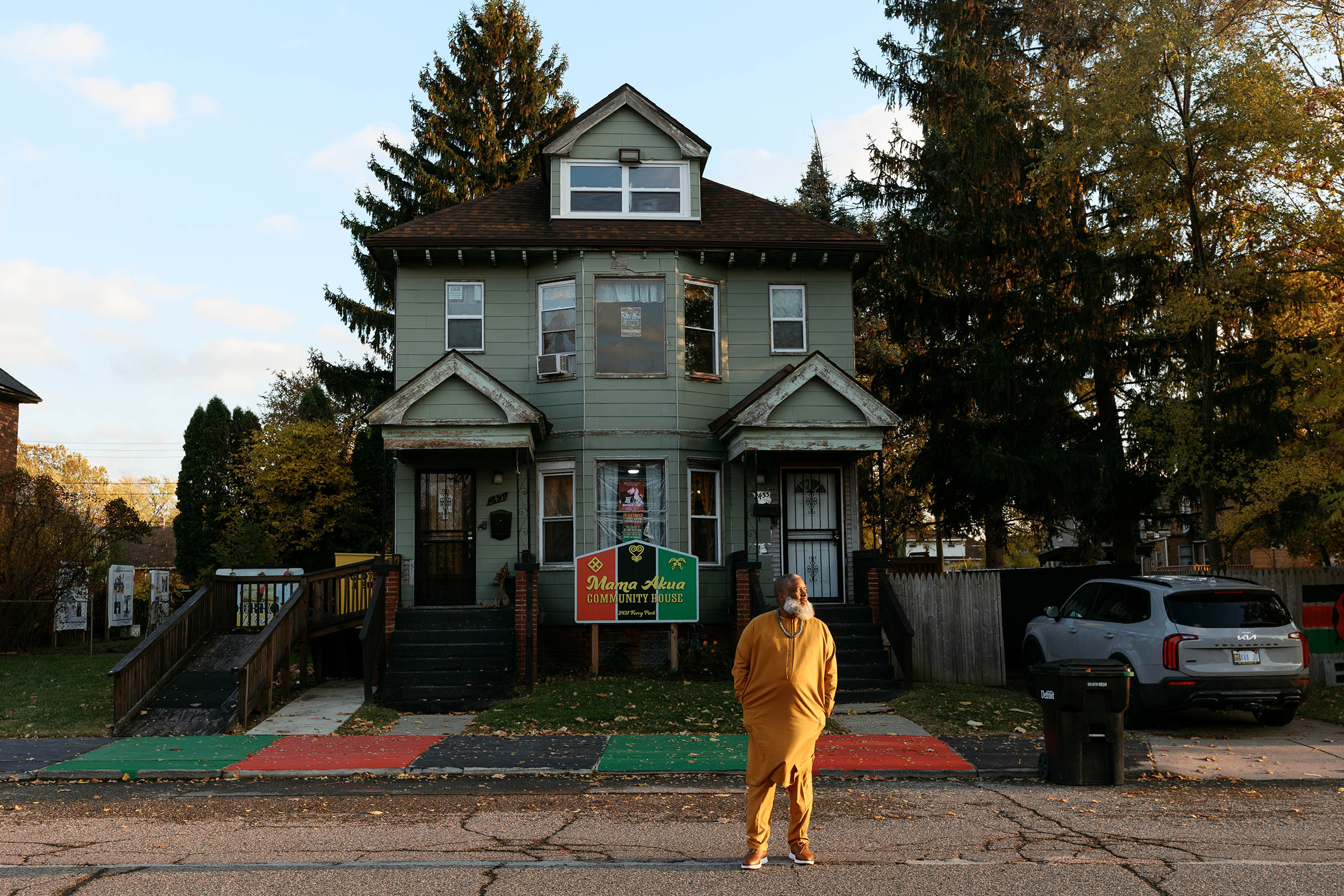
Shakur was later promoted to a leadership role within the organization, but he says it was still sort of a “coup,” albeit an “organic one,” that landed him in the Roundtable’s top position. The organization had never had a Black executive director, nor one who was formerly incarcerated, and he says there were people within the organization who likely didn't see him as a natural successor to longtime executive director Steve Spreitzer. “To be honest, the organization had been struggling, we weren’t getting the funding we once were, and I think we were at a point where we were figuring out who we were,” Shakur says. “But you’re still embedded in a corporate culture, which is a white culture. So having a leader who is a Black man — who lives as a Black man — some people were unsure about that. But some people saw the opportunity.” Shakur says Spreitzer was among his biggest advocates — fighting for Shakur’s promotion to co-executive director, a position which the two shared for about a year as a means of passing the torch.
Under Shakur, the evolution of the Roundtable is underway. He says the organization is currently reworking its efforts to focus on four main priorities: building power in communities through neighborhood organizing; dismantling stigmas, particularly those faced by women, mothers and formerly-incarcerated people, while creating pathways for people to create better lives; youth leadership development using the arts; and nurturing a new culture around corporate practices and philanthropic giving that ties businesses to social justice efforts in non-superficial ways. The first three are bread-and-butter stuff for a social justice-focused organization. But the fourth stands out — particularly because, in the past year, corporations have grown increasingly comfortable gutting their previous initiatives around diversity, equity and inclusion. Shakur says the full programming to support this corporate-focused vision is still coming together. But he’s particularly interested in changing the mindset of those in corporate leadership — away from a charity orientation to a full-throated, post-DEI understanding of what it means to use corporate structure and financial power to create racial and social justice in the communities these businesses operate in. “So when that CEO is at the table with the mayor, who’s maybe asking for a couple million dollars to ‘renovate a neighborhood,’ that person’s first thought is, ‘Did you talk to the residents?’” he says. “Then maybe they say, ‘And as a matter of fact, we’re going to send a team to knock on doors and talk with residents to make sure we’re welcome in the community and not dumping a million dollars into something that pushes people out, versus lifting people up.’ That right there would change the landscape of how we build a social justice community.” Ever the believer in the power of personal transformation, Shakur says he is willing to give corporate leaders the benefit of the doubt, because many may not know what meaningful social justice work entails. What he’s unwilling to overlook is a “lack of interest, an inability to ask questions, a lack of curiosity in understanding people’s pain.”
Shakur appreciates that his new position gives him a platform for persuading powerful people. Because he’s now a guy with advanced degrees and an executive director title in front of his name, a CEO may actually take his calls — though, if they do, he often urges them to take a meeting at the Roundtable office at the Mama Akua Community House. Having lived through everything he has, many people would no doubt be extremely proud to have his resume, now filled with traditional bonafides. But on a fundamental level, Shakur says he doesn’t care about that stuff or what others might make of it. He still sees himself not as a product of qualification-granting institutions, but of his “experiences.” Deep down, he’s an “introvert”— someone whose most gratifying accomplishments are of an internal, personal nature. Among these, his proudest is that his mother, the person who “saw who I am today before anyone else” and who died in 2022, lived long enough to see his transformation. Another is his fierceness in refusing to accept that the transformation will ever be complete.
###
Yusef Bunchy Shakur is the author of four books: “The Window 2 My Soul,” “My Soul Looks Back,” “Scribes of Redemption” and “Redemptive Soul: The Yusef Bunchy Shakur Reader.” Shakur also recently produced an autobiographical documentary, “Redemption Road,” which has been shown at more than 30 film festivals and has earned more than a dozen awards. Story by Lou Blouin. Photos by Matthew Stephens. Archival photos courtesy Yusef Bunchy Shakur.


