‘Postmarked from the Inside’ — an exhibit curated by a UM-Dearborn professor and student — explores the personal stories and weight handmade cards carry.
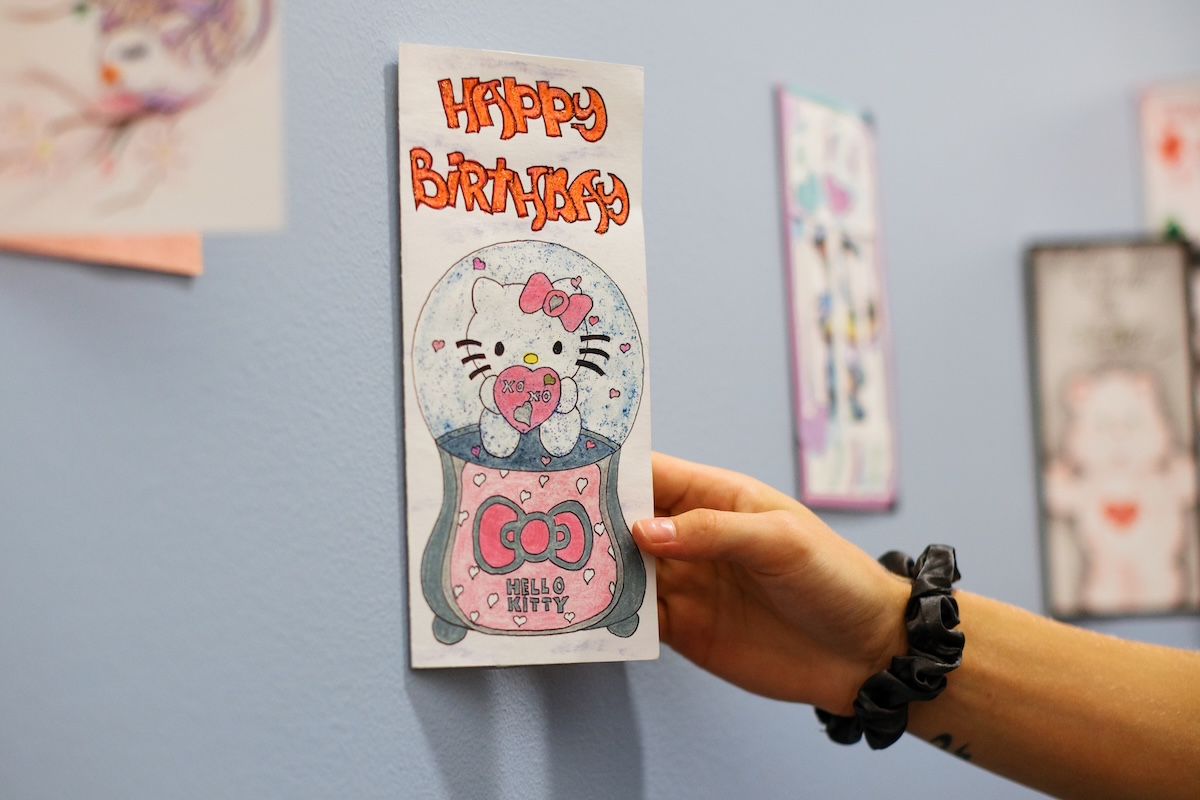
UM-Dearborn student Brianne Sheltraw helped curate the "Postmarked from the Inside" exhibit. On the wall to her left, there are several colorful greeting cards from her father that feature flowers, a deer and Hello Kitty.
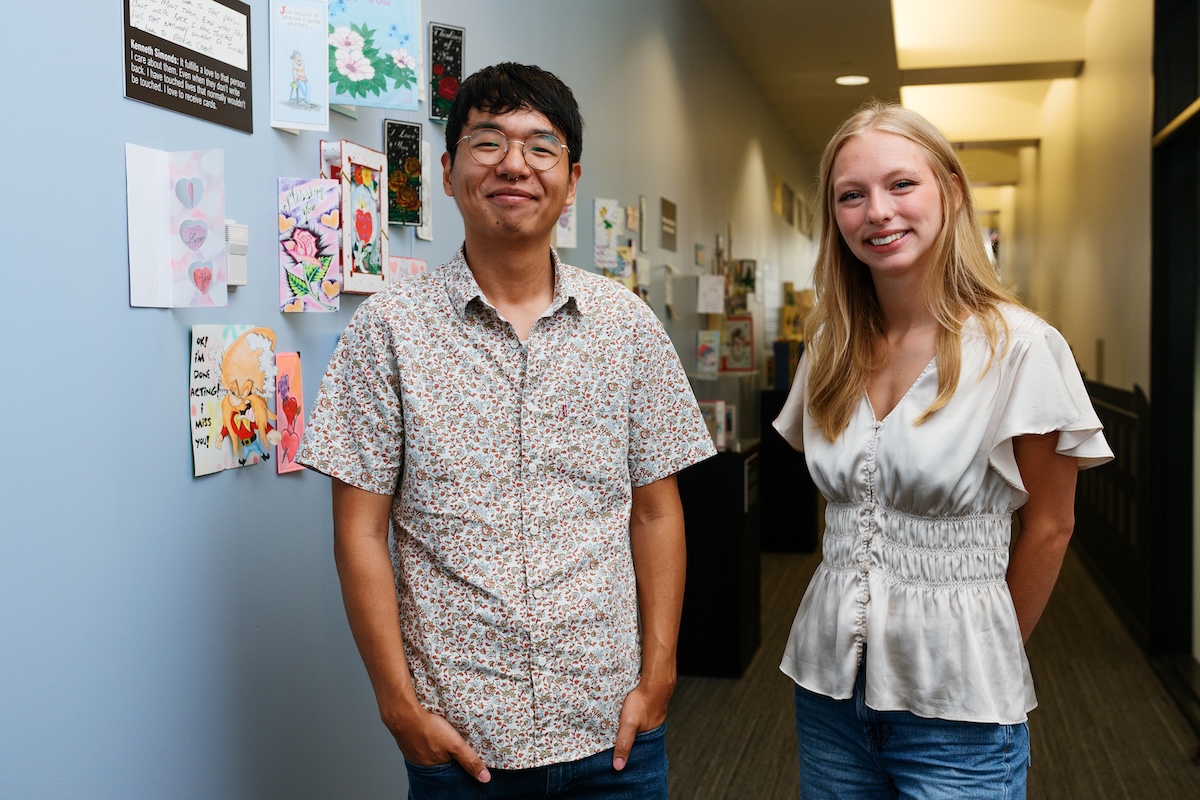
Brianne Sheltraw stands in the middle of an art exhibit. She’s surrounded by hand-drawn images of Minnie Mouse, flowers and angels.
“Here’s one that’s very special,” Sheltraw says, pointing to a card from her father that is decorated with Hello Kitty’s signature white cat with a red bow. Her dad pressed flowers inside the card. “I kept the flowers because my dad picked them for me,” she explains.
Sheltraw opens one of her favorite cards that her dad sent to her. It was customized with Hello Kitty, one of her favorite childhood cartoon characters.
Sheltraw, a UM-Dearborn senior, describes how her father took her on bike rides, surprised her with 7-11 Slurpee runs and often played games with her as a child. “He was like my best friend. When he was with me, he was present. He was fun. He’s my dad,” she says. “But he’s also an addict.” Sheltraw’s dad sent her the cards when he was in prison for a 10-year sentence connected to his addiction.
While opening the cards, Sheltraw remarks how they marked important milestones in her life and represented the evolution of her relationship with her dad. “When people go to prison, the whole family is sentenced,” she says. “This is the first time I’m showing these cards. They’ve been tucked away in a box for years — until now.”
A health and human services major who plans on a career in social work, Sheltraw is one of several curators of “Postmarked from the Inside,” an exhibit at the U-M Detroit Center that shows how people in prison craft messages and materials to keep in contact with their loved ones on the outside.
There are nearly 100 cards in the exhibit: anniversary, birthday, holiday, get-well wishes and thinking of you messages.
Turning classroom insights into transformation, collaboration
Assistant Professor of Health and Human Services Vitalis Im is the chief curator of “Postmarked from the Inside.”
A psychotherapist and social worker, Im has worked with hundreds of artists in Michigan prisons. He’s also a trained violinist and opera singer and facilitates creative writing, theater and music workshops through U-M’s Prison Creative Arts Project. Additionally, he’s a member of the board at The Linkage Community, a statewide collective of artists with lived experience of incarceration.
Throughout Im’s time working in prisons and with prisoners, artists have shown him their own paintings, crocheted blankets and pottery. Every now and again, someone would bring a greeting card.
Assistant Professor of Health and Human Services Vitalis Im and UM-Dearborn student Brianne Sheltraw are two of the co-curators for the exhibit "Postmarked from the Inside." The exhibit is open through Sept. 30 at the U-M Detroit Center.
“The cards caught my attention because we, on the outside, often see greeting cards as these little happy disposable things. But, for system-impacted artists, there are real, and often sad, stories attached to them,” Im says. “They represent missing their children's graduations or funerals they couldn’t attend. Folks in prison, through their stories, have shown me what an important aspect cards can be for life on the inside.”
Im teaches a College of Education, Health and Human Services course on working with vulnerable and hard-to-reach populations, which examines the personal, social, institutional, legal and environmental factors that create disparities and vulnerabilities in certain individuals and groups — including incarcerated people.
Sheltraw, who took that class in Winter 2025, says it served as a mirror. She thought about her family dynamics when discussing topics like poverty, drug consumption and brain development — and the ways they impact decisions.
She says her courses, combined with her personal experiences, are giving her the tools she needs for her future career as a social worker and the knowledge she’s seeking for personal growth.
“Rather than my experience being something shameful, I learned that it’s a form of intelligence,” she says. “My grandma always pushed for me to get an education. I’m glad she did. My college education is changing my life.”
While in Im’s class, Sheltraw learned about the importance of greeting cards within prisons. She thought about the cards she received — the ones tucked away in a box in a closet. A few class sessions later, Sheltraw shared her collection with Im and, after some discussion, the two decided to work together on an art exhibit. They collaborated with Martín Vargas, an artist and curator who is a member of Linkage, as well as curators Suzy Moffat and Emily Chase, who both work with the PCAP.
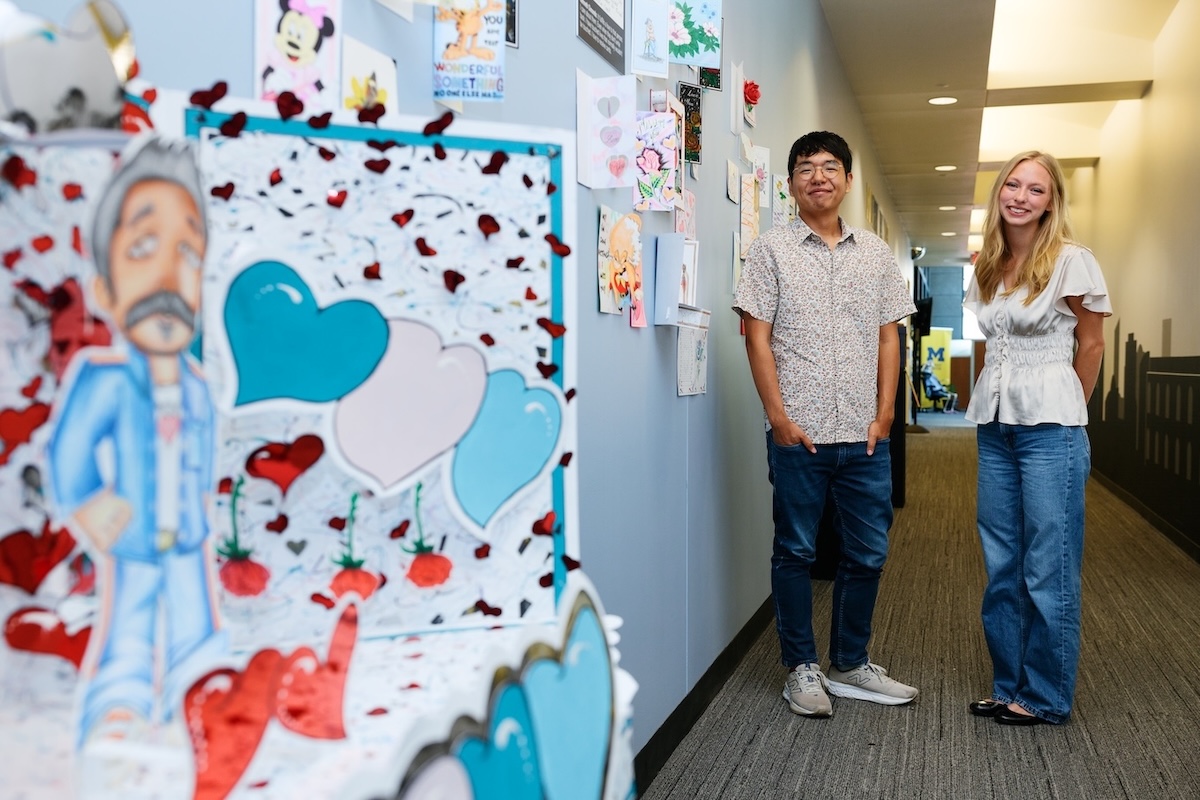
Im and Sheltraw are surrounded by hundreds of hand-drawn cards created by — and for — people who were impacted by incarceration.
“I wanted to be a part of the exhibit because my education has taught me when to be vulnerable, especially out of necessity, for the field I plan to work in,” says Sheltraw, who would like to help families impacted by incarceration.
Unpacking the complexity of cards
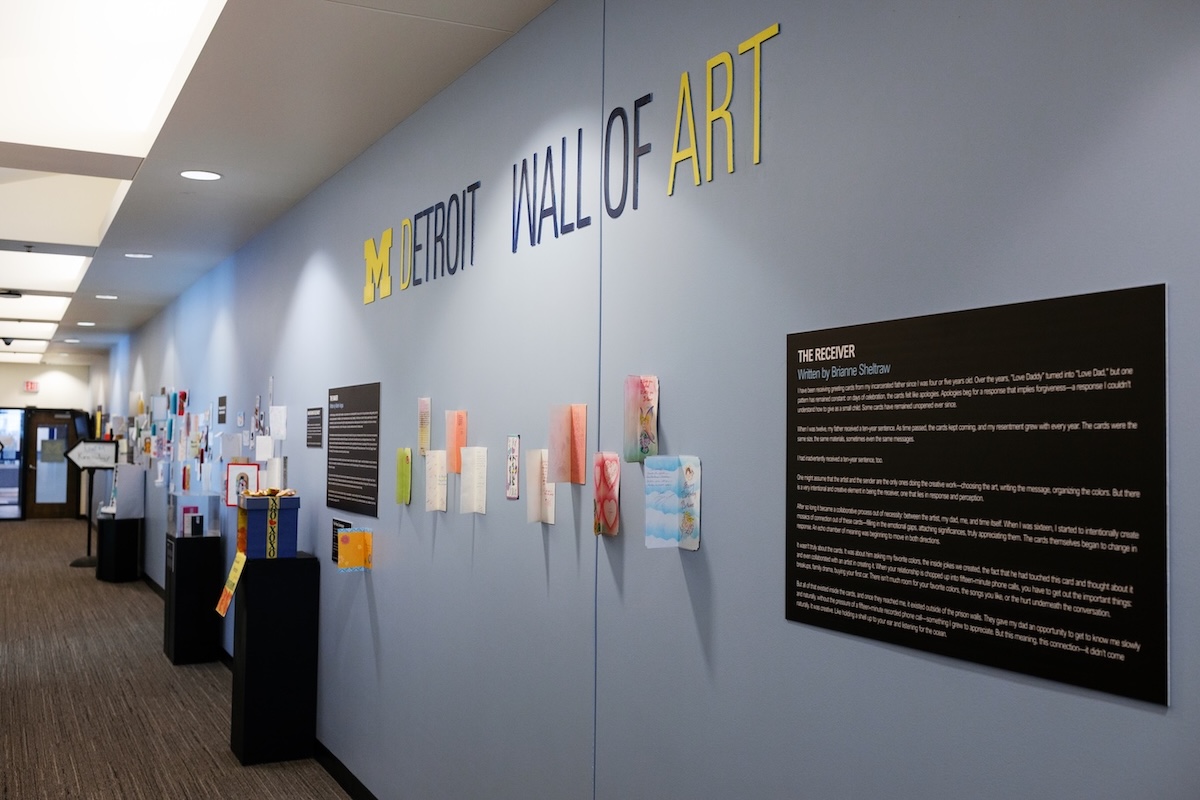
Sheltraw opens one of her cards, which is displayed in a long hallway at the U-M Detroit Center. It reads, “I can’t wait to get back to ‘our world.’ I love you and miss you so much. Dad.”
She loves her father dearly, but says they never got back to that place of bike rides, Slurpees or hide-and-seek. Time moved on. She’s grown up. And her dad continues to face challenges that have led to reincarceration.
“Of course that’s not what I wanted. It’s not what he wanted. I always want the best for my dad, but I’ve learned about institutionalization and addiction in class and I’ve seen what the data shows,” she says. In the U.S., about 28% of formerly incarcerated individuals return to prison within three years of release — down from nearly 65% a decade ago. The CSJ Justice Center attributes this shift to law changes and increased support, like healthcare and job training opportunities, for recently released citizens.
Im says those leaving prison still need more support and he hopes “Postmarked from the Inside” helps people on the inside and outside of prisons find a common ground.
“We all know what it’s like to care for someone and miss them. We all know what it’s like to want the best for our loved ones,” he says. “People who are just coming out of prisons do have this fear that they are going to be seen as lesser than or as animals. Because of this, they don’t often get the help they need, which doesn’t address the root trauma and often leads back to a return to prison. For people to successfully reacclimate into their communities, they need to be part of the community.”
Showing and sharing for advocacy
Sheltraw has learned a lot about herself while preparing for the exhibit. She never planned on showing her cards to anyone. But opening that box also unlocked a new way to advocate for herself and others.
There are hundreds of unique art pieces in the exhibit "Postmarked from the Inside."
“I’m sharing my cards now because I feel it’s important to remember that entire families are affected by incarceration. Other than occasional 15-minute phone calls, these cards represent my relationship with my dad for a big part of my life while growing up,” she says. “There are many people like me but they might not feel comfortable coming forward or may not be able to articulate what they are feeling yet. I thought my perspective may help provide a more 360 view on the importance of greeting cards made by people on the inside.”
Sheltraw says stronger support efforts and community acceptance would make a difference in many lives — including the children, friends and family of people who are or have been in prison. Her career goal is to work as a therapist for system-impacted individuals.
Meanwhile, she’s shared a part of her life in an effort to make the world a more caring place through something universally human: heartfelt messages written by a parent to a child.
“Postmarked from the Inside” ison display now through Sept. 30 at the U-M Detroit Center, 3663 Woodward Ave. There is no admission cost and it’s open to all.