Summer course will take place on two continents — and two wheels

October 22, 2025

Associate Professor of Sociology Carmel Price and Professor of Public Health Natalie Sampson will lead a summer study abroad exploring cycling infrastructure in Scandinavia — then bring what they learn back home.

Two women ride their bikes on the road with green and yellow-leafed trees in the background.
Associate Professor of Sociology Carmel Price, left, and Professor of Public Health Natalie Sampson are planning a summer 2026 course on two wheels. It starts on UM-Dearborn’s campus, travels to Detroit and finishes in Norway. Photo by Matthew Stephens

According to the organization People for Bikes, Detroit’s bikeability ranks in the top 20 in the U.S. among cities with populations greater than 300,000. When you get out and ride, it’s easy to see why. Belle Isle offers a scenic six-mile paved loop around the historic island park and the Dequindre Cut showcases murals by local artists along a 20-foot-wide pathway with dedicated lanes for cyclists and pedestrians.

In the coming years, Detroit plans to incorporate more bike lanes, bike sharing, trails and other safety measures to make the city even more bike friendly. Associate Professor of Sociology Carmel Price — an avid cyclist who works on the Safe Routes to School initiative for the City of Dearborn — says she’s glad more U.S. cities, like Detroit and Dearborn, are incorporating car-alternative transportation methods into their master plans. It’s a positive sign, she adds, that the Bureau of Labor Statistics reports that employment of urban and regional planners is projected to grow in the next decade. In response, Price is devising creative methods to help students learn how to improve bicycle infrastructure in cities.

A new course, Bicycle Urbanism: Michigan and Scandinavia, is one of those ways. Price, along with Professor of Public Health Natalie Sampson, is teaching the cross-disciplinary course over the summer. Developed with sociology, urban planning and public health in mind, the class will explore the ways globally recognized biking cities are designed to support people over automobiles. Students, along with their professors, will experience cycling infrastructure firsthand, with bike tours on UM-Dearborn’s campus, in Detroit and throughout Scandinavia, finishing in Norway. 

“This is something that affects us all. More bikeable and walkable cities would have health benefits like lower air pollution, increased safety from motorized vehicles, and a more active population. Biking can provide affordable transportation that increases access to jobs, education, and other necessities, which is beneficial for people who can’t afford a car,” says Price. “The importance of bikeability goes far beyond recreation.” According to the Detroit “Streets for People” transportation master plan, nearly 40% of Detroit residents don’t have access to a vehicle. For those who do, the average household in Detroit spends 20% of their income on car ownership costs.

To prepare for the international adventure, Bicycle Urbanism students will learn bike safety, tire changing, bike etiquette and other need-to-know information, and the class will go on rides in southeast Michigan and meet with bike advocates, urban planners and government officials. After three weeks of local lessons, the two professors and their students will head to Copenhagen, Denmark; Gothenburg, Sweden; and Oslo, Norway for 10 days. While overseas, the class will ride at a leisurely pace through urban spaces, meet with urban planners and explore the bikeability and walkability of each city. Bicycle Urbanism: Michigan and Scandinavia is open to all majors. Interested students can apply on the course profile page; the application deadline is Dec. 31. Bikes are available for students who don’t own one.
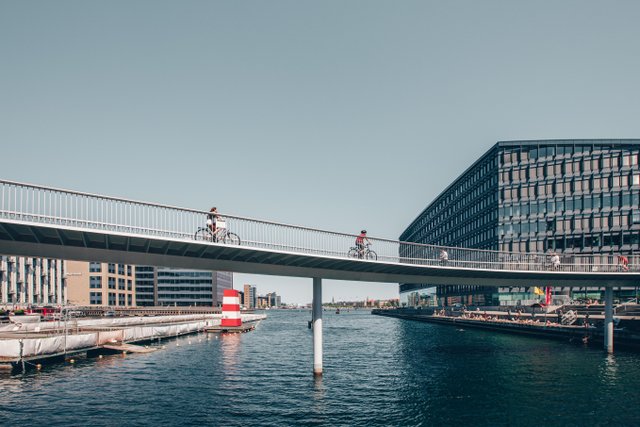
A bicycle bridge in Denmark, Cykelslangen
One example of Scandinavian bicycle infrastructure is Denmark's Cykelslangen, which is a 720-foot bridge for cyclists. Photo courtesy Visit Copenhagen

Sampson says that, through an exploration of bicycling, students will dig into topics such as public health, public policy, sustainability, transportation infrastructure, universal accessibility and urban design, as well as the underlying strategies to address inequity in these systems. She adds that experiencing bike riding in each location — here at home and in Scandinavia — can help students see the biking infrastructure that is in place, use it and evaluate if it may be a good fit for their communities.

Price, who grew up in a military family, has traveled extensively since she was a child. She says that experience informs the way she views the world and she wants UM-Dearborn students to have the opportunity to see life outside of Michigan. “When you travel, you broaden your lens,” she says. Price and Sampson understand that many students cannot take a long trip due to work and family schedules — so they packed a lot into 10 days. “I can show photos and we can read books, but it is more meaningful and powerful for students to actually go and see the similarities and differences between cultures for themselves,” Price says.

In fact, seeing a European city’s biking infrastructure sparked the idea for the course. Price was with her family in Germany when she noticed a thin metal gutter on the sides of city steps in Cologne. Instead of people picking up bikes and carrying them to use the stairs, Price saw riders put their bike tires into the curve on the ground and roll bikes up and down the stairs. “I took pictures so I could show my students. This is the type of thing we talk about in class. It’s a small investment in city infrastructure that can make a big impact,” Price says. “The more I thought about it, the more I wanted students to see European bicycle infrastructure for themselves.”

The professors chose Scandinavia because it is known for its bike-friendly practices. Oslo has a car-free city center and Copenhagen has a cycle superhighway that connects surrounding communities to the city center. While in each place, bike riders will get views of many city sites. For example, in Oslo, there are famous outdoor sculpture parks and a bikeable harbor promenade with a scenic waterfront dotted with sites like Oslo’s Opera House. There is also free time built into the course for city exploration.

In future years, Sampson and Price would like to continue the course by taking students to other international cities to explore infrastructure. “It’s not about making cities better for bikes. It’s about making cities better with bikes,” Price says. “This class is a way we can open doors to give our students access to a new way of seeing the world. Bicycle Urbanism students can learn from other cultures and bring lessons back with them so they can make a difference at home in southeast Michigan or wherever life takes them.”

Interested in going, but not sure about the cost? There are need-based study abroad scholarships that can cover up $4,000 depending on level of need, says Global Engagement Director Scott Riggs. "We have a large pool of scholarships and need-based aid to help cover study abroad expenses,” Riggs says. “Students with high financial need often go for little to no expense." See what amount of scholarship a student qualifies for by setting up an appointment to ask questions and get information regarding a financial aid package.

Story by Sarah Tuxbury