What can Rwanda teach us?

March 24, 2026

Three UM-Dearborn researchers — two professors and a student — traveled to Africa to learn lessons about forgiveness and national healing.

A group of people stand together with happy expressions and their hands raised in the air. The sun is setting in the background, which gives the sky an orange hue.
Professor Paul Draus, right, and student Tamir Bell, to Draus' right, celebrate the end of the day with Rwandan colleagues at Fazenda Sengha, a park located on Mount Kigali in Kigali City. Photo by Anna Müller

When Tamir Bell was a child, he made a list of things he wanted to do with his life. Visiting Africa was at the top. 

“I’ve never done an ancestry test, but I’ve always believed — and still believe — that I have family roots in Africa,” says Bell. “I had a strong pull to go there as long as I could remember. We didn’t have a whole lot when I was growing up, but you still have your dreams.”

A student in the 4+1 Criminology and Criminal Justice program, Bell recently realized this goal by taking part in a research trip to Rwanda with two of his UM-Dearborn professors. Along with Professor of Sociology Paul Draus and Professor of History Anna Müller, Bell traveled to the African country earlier this semester. He says it was an experience of a lifetime. 

Bell’s photos from the trip show local residents laughing and dancing, scenic views of lush green hills, and Rwandan memorial sites where the grounds are adorned with flowers. In addition to capturing these scenes, Bell says he tried walking with a basket of avocados on his head after a lesson from a local. “It’s much harder than you think,” he says with a laugh. 

But sightseeing wasn’t the main purpose of the trip. Bell and his professors were there to learn about reconciliation and healing from people who are actively working to mend their country following the 1994 genocide against the Tutsi people. An estimated 800,000 to one million people were killed and more than 120,000 others were jailed for genocide-related crimes. In 2003, a Rwandan presidential amnesty order accelerated their release.

“Hundreds of thousands of people returned home. Survivors and perpetrators now shared roads, markets, churches and fields. Tensions were inevitable. Communities had to find ways to live with one another in the present while carrying the weight of the past,” Müller says. “How did they do that?” 

To explore that question, the trio met with Rwandans — from families impacted by the genocide to top government officials — to hear stories about how they rebuilt their nation through acts of care and forgiveness. 
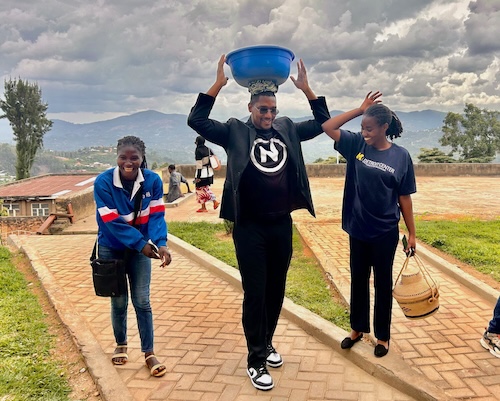
Three people laugh while they walk up a dirt road. The one in the center has a large blue basket on his head. There are avocados in the basket.
Bell, center, attempts to carry avocados on his head. "It's much harder than you think," he says. Photo courtesy Anna Müller

Bell is interested in criminal justice reform that centers around reentry of formerly incarcerated people. Draus and Müller’s research explores themes of trauma and recovery. Müller has published work on the rebuilding of Poland following World War II and Draus, who directs the University of Michigan Detroit Center, explores ways to acknowledge and heal the effects of historical trauma in post-industrial communities like Detroit. 

Draus and Müller first visited Rwanda in 2019 as part of an international conference on reconciliation and healing. There, they met Eric Irivuzumugabe, who survived the genocide by living in a tree for a month. Irivuzumugabe later visited UM-Dearborn. They also met a public health researcher, Samuel Habimana, founder of the Rwanda Resilience and Grounding Organization, who became a close collaborator. Since that time, the UM-Dearborn professors have built connections, partnerships and trust with people throughout the country. 

On the 2026 trip, Draus, Müller and Bell met with residents of reconciliation villages — a concept developed by Habimana’s organizations where perpetrators and survivors of the genocide live side-by-side as neighbors. They attended government-sponsored group therapy and educational sessions designed to help people work through trauma. And they did a lot of laughter yoga, a favorite activity of Bell’s that combines voluntary laughter with yogic breathing. It may sound like a joke, but laughter  is scientifically proven to lower stress, boost endorphins, strengthen the immune system and help people feel more connected with each other. The government pays for Rwandans to attend these sessions. “Instead of the government investing more money in punitive measures like incarceration, they invest in community-building programs," Draus says.

Now Draus and Müller created a four-credit Study Abroad sociology course, Wounded Healers: Lessons of Trauma, Resilience and Healing from Rwanda. The class, which will take place during summer 2027, is a partnership with RRGO and the University of Rwanda’s social sciences faculty. UM-Dearborn professors and students — led by a local guide — will spend 10 days meeting people key to the country’s unity and reconciliation approach, visiting remembrance sites such as the Nyanza Genocide Memorial and seeing the African landscape through a safari at a national park.

“Reading books and articles about the history of Rwanda and its path to recovery since the 1994 genocide did not prepare me for the problem-solving spirit that was everywhere,” Draus says. “We want to give our students the opportunity to see the spirit of Rwanda for themselves.”

The U.S. Department of State lists Rwanda at the same level of safety as traveling to England or Mexico. Interested students can apply on UM-Dearborn’s M-Navigator website. Applying is not a commitment to the program, but it opens the door for students to see if they qualify for financial aid support, which includes scholarships.

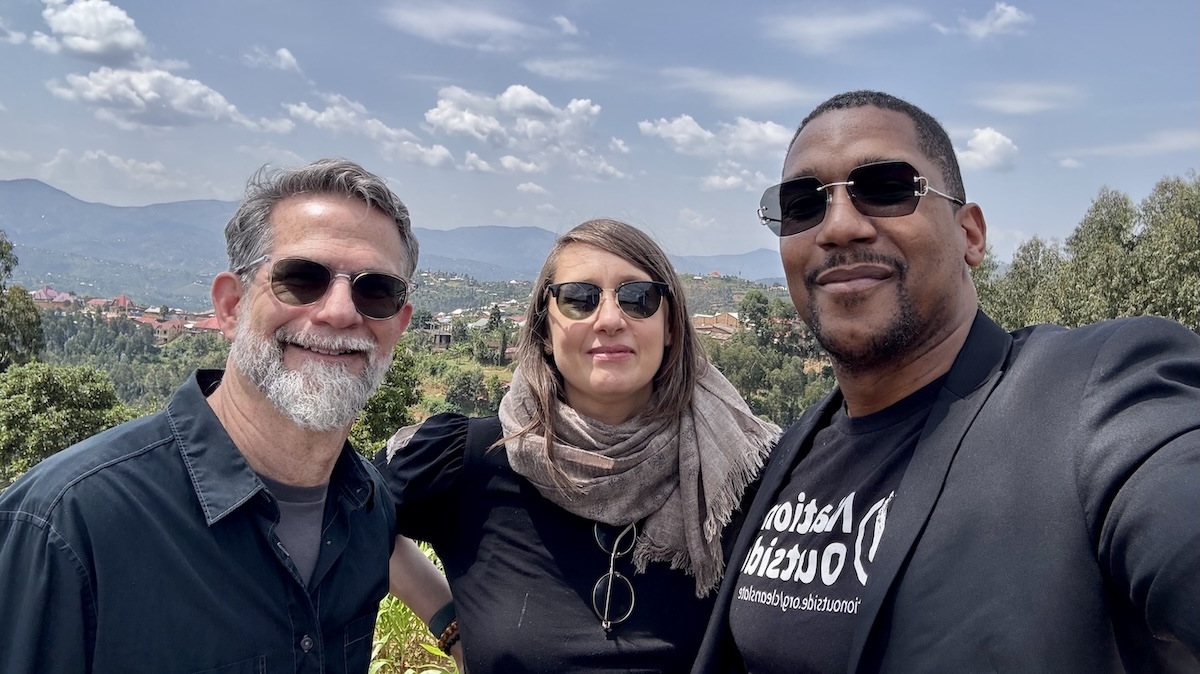
Three people, two males and a female, are smiling in an outdoor photo taken in Rwanda. They are on the top of a mountain with a city and trees in the background.
Draus, Müller and Bell appreciated the beauty of Rwanda's landscapes while there. They stopped in Nyamagabe, a district in the southern province outside Huye. The district is known for its mountainous terrain. Photo courtesy Anna Müller 

Draus and Müller say the practices of the Rwandan people may hold answers to healing deep societal divides here at home and that it’s important to recognize what people are doing to address the conflicts in their nations. At the same time, Müller acknowledges that Rwanda’s steps toward national peace-keeping are not a “one-size-fits-all template” and they may not be right for communities outside of Rwanda. For example, some critics have voiced that Rwanda’s peace-keeping policies are too government-controlled.

“Rwanda is not a lesson that can be transferred neatly elsewhere. But it is a place where people, under specific historical and political conditions, are attempting to live after rupture in ways that are uneven, contested and ongoing. I do not know whether reconciliation is ever complete. I suspect it is not,” Müller says. “But I saw in Rwanda that even in a place marked by immense violence, people continue to create small openings — through conversation, through shared breath, through laughter that at first feels forced and then, gradually, becomes real.”

While in Rwanda, Bell was open at the group therapy sessions about the trauma he experienced as a child. “I’ve been involved with witnessing and seeing a lot of violence my entire life. I grew up with an incarcerated father and my mom, the person who provided me with a stable home, died of cancer when I was 12,” he says. “The people in Rwanda saw me for me. There may have been a language barrier, but we recognized each other’s struggles.” 

Bell also shared with the Rwandan people that he’s a justice system-impacted person. Bell was convicted as a young adult on a non-violent first-offense drug charge and was originally sentenced to 24 to 46 years in prison. He was released in February 2020, after serving 12 years, because of the Fair Sentencing Act of 2010, which reduced prison time for people with felony drug convictions.

Upon his release, Bell wanted to right his wrongs and contribute to making the world a better place. However, seemingly normal things — such as getting a job and finding a place to live — are challenging with a felony, he says. “Prison is said to be a rehabilitation system. But even when people have served their time and are deemed rehabilitated, they are socially stigmatized in many countries. If we want to truly be successful in keeping crime down, we need to find a way to change how formerly incarcerated citizens are viewed,” he says. “These men and women acknowledge the choices they made and the consequences of those choices. They want to give back to their communities and help repair the harm that they have caused.” He now researches reform efforts and explores how the U.S. can incorporate changes into its incarceration system.

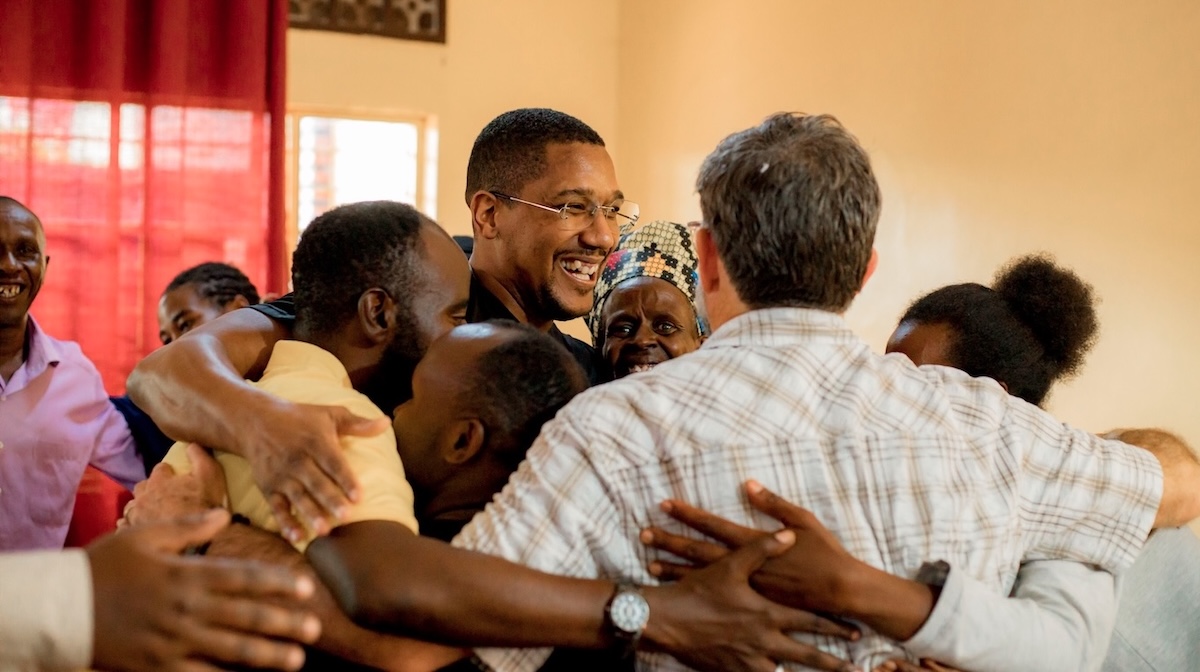
A smiling man with glasses is hugged by a group of happy people. They are celebrating forgiveness and community building.
Bell, center, says meeting with the Rwandan people — he's in the city of Huye here — gave him ideas on how to incorporate human connection practices, like laughter yoga, into the work he does with the nonprofit organization Nation Outside. Photo courtesy Anna Müller 

Bell understands the importance of forgiveness and community contributions when looking at his own life. Through Bell’s support systems — which includes the UM-Dearborn’s SOAR Program, an initiative that supports adult learners aged 25 and older who are returning to college for their first bachelor’s degree — and his own determination, Bell — who was named a 2024 UM-Dearborn Difference Maker — rebuilt his life and is looking to help others do the same. In 2021, he landed a position as a development fellow with the nonprofit Safe and Just Michigan. He currently serves as an assistant director for Nation Outside, which helps formerly incarcerated people acclimate back into society through support and peer mentorship. Bell says he gained a lot of perspective from his time in Rwanda that he can draw on in this role — for starters, he is training to become a certified laughter yoga instructor. 

Even though he’s checked off a big life goal, Bell, 42, says there are others he still wants to realize, including getting married and graduating from college. He will earn his bachelor’s degree in April, followed by a master’s degree in December. He and his fiancee are planning their wedding. Together they have a son, Jamir.

“Life is turning out how I imagined — it’s just not the way I thought it would go. But I’m not complaining,” he says with a smile. “All of my experiences, all of my challenges, got me where I am today. And those, along with the support of Dr. Draus and Dr. Müller, helped me realize that dream at the top of my list: visiting Africa.”

He adds that he now believes that Africa not only plays more than just a role in his family’s past — it’s part of his future too. He felt a kinship to the people he met in Rwanda, from the smiling schoolchildren who thought he was an American sports star to the older adults who shared their stories of pain and transformation. He plans to return.

Story by Sarah Tuxbury