

Much like the vintage sneakers he repairs and lists on Depop, University of Michigan-Dearborn security officer Adam Martinez is enjoying a second life.
Martinez, who went by the nickname Cupid growing up, was born at Henry Ford Hospital on Thursday, February 14, 1985. From an early age he was resolved to pursue a career in public safety, which he suspects had something to do with growing up in Detroit at a time when crime and gang violence were rampant. As a child, he recalls, he wasn’t allowed to play outside with his beloved Tonka trucks, because, his mom told him, it was “too dangerous.”
After finishing high school in Dearborn Heights, Martinez enrolled at age 20 as a police cadet at Wayne State University. After that, he worked various private security jobs in metro Detroit, including several years as a campus safety officer, first at Henry Ford College and then at Wayne County Community College.
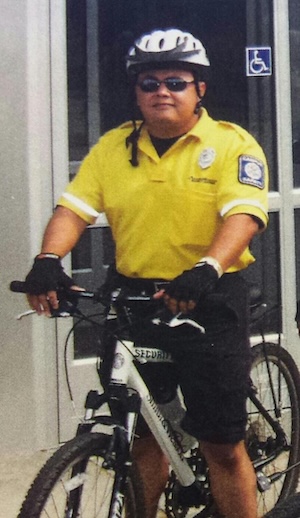
In 2011, he left Michigan for Hinsdale, New Hampshire, where his girlfriend at the time had relatives. Although nervous about moving away from his own family and leaving the Detroit area — the only home he’d ever known, and indeed the only place he’d ever been apart from one trip to Texas as a kid — he decided to give it a shot.
He was grateful to land a safety officer position at Keene State College, having found that the campus environment suited him. But as much as he liked his job, he missed home and struggled to cultivate a community outside of work. The toll of night shifts and the arrival of his daughter in June 2012 didn’t make matters any easier. “Everything just started piling up,” he says. “It was one thing after another. I felt like I never slept at all.”
That’s when the drinking started. “One night of drinking turned into two, turned into three, and then from there, it was just, it was every day,” he says. “It was a way to numb everything around me.” Research shows that alcohol and substance use disorders are significantly more prevalent among law enforcement professionals than the general population. The disparity is linked to the stressful, often traumatic situations that their work entails.
In 2016, Martinez and his partner moved back to Michigan, where he took a job in security for General Motors at the Renaissance Center, in downtown Detroit. A year later, the couple separated. That meant living apart from his daughter and spending more time alone.
Under the weight of it all, he turned increasingly to alcohol. It got to a point where felt he couldn’t function without it. “It was an addiction, but I was in denial,” he says. “I felt like nothing was going to happen to me, and nobody could tell me anything.”
He was, in his words, a “functioning alcoholic” — or so he thought, until one day during a shift his manager pulled him aside for a “chat.” It had come to her attention, she told him, that he might be under the influence. “I broke down,” he says, admitting to her there and then that he had a problem. “That was a huge pill to swallow,” he reflects. “But it was big. I felt better acknowledging it and just coming out.”
He assumed he should clear out his locker, but his manager reassured him he wasn’t being fired. Instead she emphasized what a valuable member of the team he was, and encouraged him to seek help.
In December 2019, Martinez found the church. Despite being raised Catholic, he’d never been one to go to Mass. But his daughter and her mom had started attending First Baptist Church in Pontiac, and they wanted him to join them. He agreed and was grateful for the warm welcome he received from the members, who organized potlucks and family cookouts.
Ultimately, though, neither religion nor being back in Michigan proved a panacea for his drinking problems. If anything, the problems were only getting worse. “Even when I was there, I didn’t feel like anybody could really understand yet because it was big in that church that there was zero alcohol,” he says.
Time passed and the drinking continued. He’d try to get sober, but nothing seemed to work.
One day as he was working out in his room, hoping that exercise might help to turn things around, he felt a sharp though not unfamiliar pain in his stomach. He called his mom — a sure sign it had to be serious, since Martinez was normally one to shrug off such things. “Mom, I need to go to the hospital. I do not feel good,” he told her. “My stomach is hurting so bad.” That’s all he remembers from the conversation before he collapsed.
Our largest organ after the skin, the liver is remarkable in many ways, none more so than in its unique ability to regenerate itself. But there’s only so much damage it can take before it loses its regenerative power. If too much scarring builds up, as in Martinez’s case, liver failure becomes a serious risk, at which point the only treatment option is a transplant.
Martinez vividly remembers the day when eight “white coats,” to use his term, filed into his room on the fifth floor of Henry Ford Hospital — the same building where he’d arrived in this world 37 years earlier. “We have good news and we have bad news,” they announced. “The good news is we can do everything we can to try to keep you comfortable. And the bad news is that your liver enzymes are through the roof right now. They’re at a very, very severe level.”
And then came the kicker: “There’s nothing that can be done.”
On hearing that, “I just broke,” Martinez says. He was given three months to live. The white coats, now just a blur, exited the room, leaving Martinez alone with his mortality.
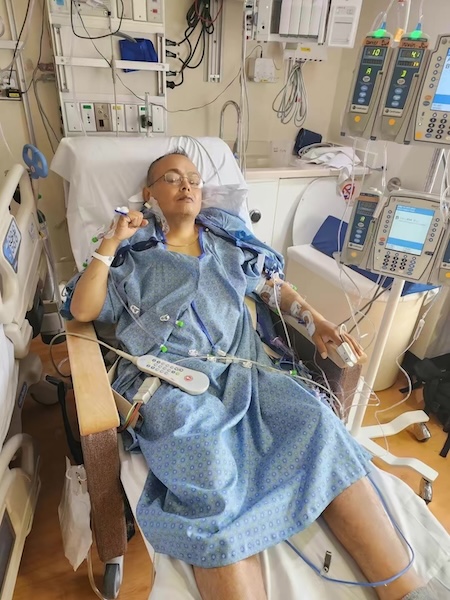
In that moment, all he could think about was his daughter. All the moments he’d miss — birthdays, school plays, graduation — came into focus. “And this was all because of my selfishness, and thinking that the drinking was going to help,” he remembers telling himself reproachfully.
Conversations with family and doctors turned to the more immediate future and to how he’d like to see out his remaining days. “In my mind it became normal for me to think about plans for my memorial,” he recollects. “I was actually picking out my place where I wanted to be laid to rest.”
But just when he was starting to make some kind of peace with his fate, he learned he might in fact be a transplant candidate after all. His body, until then too weak for a transplant, had shown signs of improvement. Nothing was assured, however, and there was a lot of false hope: one day he was a candidate and the next he wasn’t.
Nor was there any guarantee he’d make it to the top of the waiting list before it was too late, since demand far exceeds supply. Still, he knew he was in good hands at Michigan Medicine, which boasts one of the nation’s leading liver transplant programs.
With the exception of his mom, he didn’t tell any of this to his family, for fear of getting their hopes up only for them to receive a phone call one night saying he hadn’t made it.
Eventually he was discharged, but home seemed more like purgatory. Stuck in a holding pattern between life and death, he felt hopeful yet also restless. It was October and Halloween was approaching, so he busied himself putting up decorations on the house — which was no easy feat, since he’d lost more than 40 pounds and could hardly support himself. For all he knew, he wouldn’t still be around to take his daughter trick-or-treating.
He was in the middle of hanging some jack-o’-lanterns when his phone rang. The caller ID read Michigan Medicine in Ann Arbor. “Can you be in the area for a little bit, maybe for an hour or two?” asked a nurse at the other end of the phone.
Martinez was convinced it had to be one of the test runs they’d warned him to expect — where they see how long it’d take him to be at the hospital if a liver were to become available. “Yeah, we can be over there,” he replied. “Is it okay if we hang out in the hospital?” It would be better if he stayed nearby, the nurse advised, because his immune system was so fragile, and the hospital could be a stressful environment.
He and his mom didn’t waste a moment packing the car. They were en route when another call came in. “Are you in the area?” It was the same nurse as before. “Yeah, we’re about halfway,” Martinez replied.
Then, a few minutes later, his phone rang for a third time. “Are you guys close by?” she asked. They were about to get off the exit for the hospital. “Well, I have good news,” she continued. “The person in front of you became ill, and the liver is yours. Come and get it.”
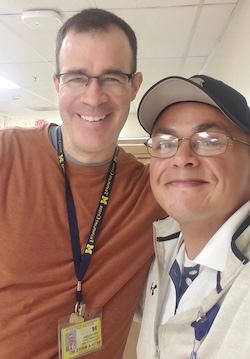
He turned to his mom, who was sobbing behind the wheel. “Mom, it’s over,” he said. “I’m going to live.”
Seth Waits, the surgeon who performed Martinez’s transplant, was left with a lasting impression of his patient. “I remember distinctly with Adam how incredibly sick he was going into it,” he says. “The thing that stuck with me the most was his will to get better afterwards, and his drive towards getting back to normal life. It was as strong as I’ve seen in anyone in a long time.”
Returning to normal life didn’t mean leaving the hospital for good, however. Martinez was so inspired by the staff — from the nurse who’d changed his IV to the valet who’d wheeled him across the hospital when he turned up for his transplant at the wrong entrance — that he applied to work there. After starting out as a guest services liaison, he moved to the safety and security team once his body was up to it.
“I saw him either in the clinic or in the hospital a couple months later when he had gotten his first job here,” Waits recalls. “That was a pretty special moment. When I think of him, that’s what I think of: fully recovered, back to life with all the vim and vigor of a young person who’s doing what they want to do.”
The person to whom he is most grateful, Martinez says, is his donor. “I would absolutely love to meet the family and let them know how grateful I am, and a part of their loved one still lives on,” he says. “To let them know my second chance at life is being used for great things to help save others while I’m here.”
Though Martinez loved working at Michigan Medicine, ideally he wanted to find something nearer to his home in Dearborn, possibly even at UM-Dearborn. He’d seen the campus years earlier while biking around neighboring Henry Ford College. He’d even applied for a couple of jobs with the university at that time, but when he didn’t get them he put it down to lack of experience. Undeterred, he decided to try again, and was offered a position as security officer in August 2024.
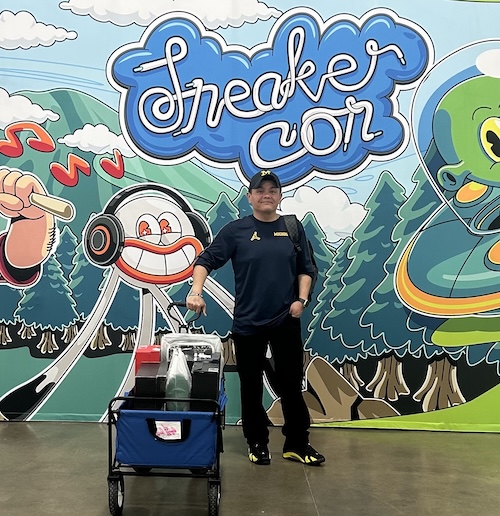
Martinez has been sober since the day of his diagnosis. If he isn’t on campus or spending time with his fiancé and daughter, who is now 14, heMartinez can be found restoring vintage sneakers. What began as a hobby has now become a business, which he’s named Chosen Soles 1022 — the numbers represent the date of his transplant. Though he calls it a business, he doesn’t make any money from it. “I do it for the love of the game,” he says.
He’ll even give shoes away from time to time, if he feels they’d be going to a good home (or pair of feet). And he’ll always throw in extras when he packages up an order — tote bags, trinkets, socks. By his estimate he has hundreds of pairs of sneakers at home, much to the dismay of his fiancé, who, ironically, was the one to encourage him to buy his first.
“Fixing up shoes is calming,” he says. And perhaps, he muses, he sees something of himself in them. “I love seeing an old pair just hanging on by a thread, then bringing it back to life.”
UM-Dearborn’s Counseling and Psychological Services offers substance use resources.
October is National Liver Awareness month.
Article by Alex de Wild. Archive photos courtesy of Adam Martinez.


