Computer science undergrad lands a spot on NASA-linked research team

July 27, 2026

Christian Nwobu is co-developing a system that enables swarms of autonomous space drones to communicate with each other using light.

Close-up photo of a young Black man wearing a blue plaid button-down shirt, holding a small custom quadcopter drone with exposed wiring and green padded feet. He smiles slightly at the camera. In the background, a blue NASA flight jacket with official patches is displayed inside a glass case.
Christian Nwobu's research focuses on autonomous space drones using light to communicate with each other. Photos by Matthew Stephens

Christian Nwobu never envisioned himself conducting research when he began his studies at UM-Dearborn. The East Lansing native began pursuing a degree in computer and information science  after a series of high school coding competitions left him with a penchant for programming and a taste for challenge. But he wasn’t sure where his education could take him.

That changed when Nwobu attended a conference through UM-Dearborn’s STEM Scholar program, which supports students from lower-income families who are pursuing STEM fields like chemistry and engineering. 

Hearing from UM-Dearborn researchers who were putting their ideas into practice in the lab resonated in a way he didn’t expect. “It really showed me how, with the right resources and information, an idea can turn into something that changes the world,” Nwobu says. “I learned that there’s so much power and opportunity in higher education. There are so many ways to get your ideas out there, it just takes a vision and a love for what you’re doing.”

The experience encouraged Nwobu to work his way into the lab of CIS Assistant Professor Xiao Zhang, where he collaborated with older students on a series of projects that used visible light as a means of communication in electronic systems. Today, with a grant from the Michigan Space Grant Consortium, he’s part of a three-member team working on a NASA-linked project in Zhang’s lab. The funding will pay for expenses like travel and equipment, enabling him to take on this research role in addition to his studies.
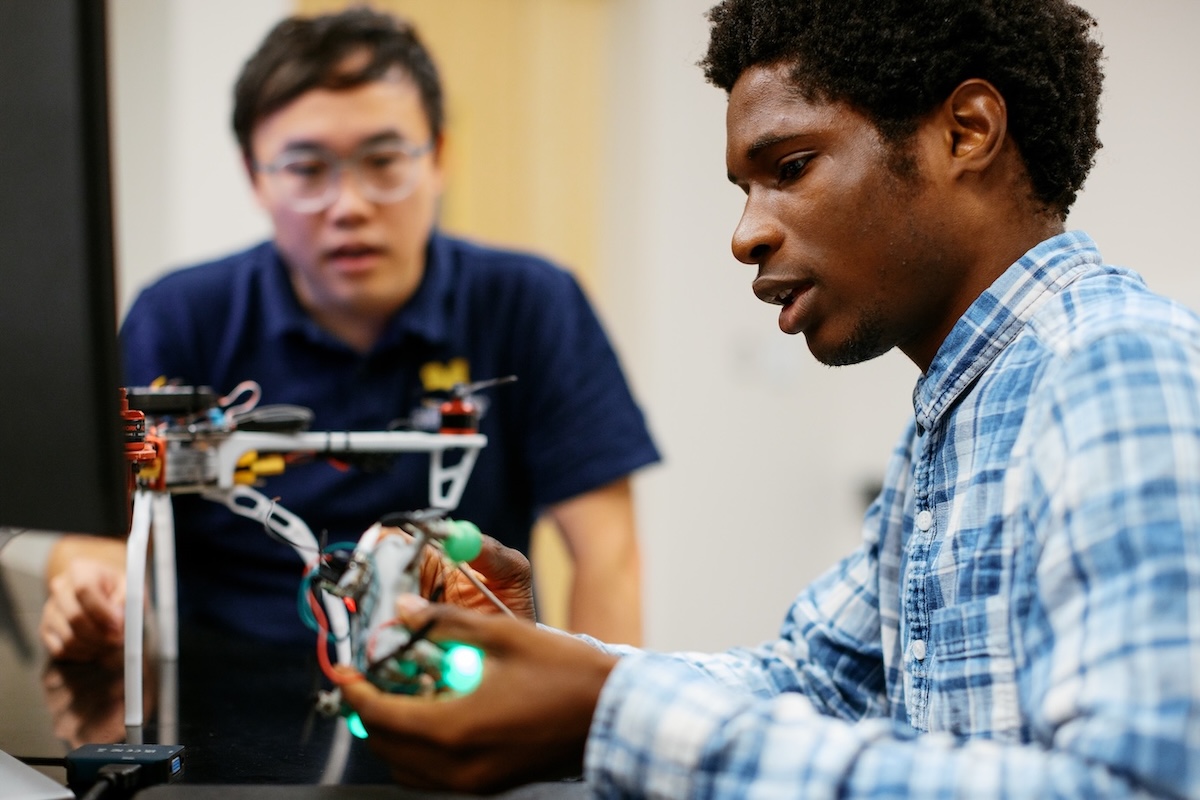
A young man in a blue plaid shirt inspects a small, illuminated drone in a laboratory while a second person in a navy shirt watches in the background.
Christian Nwobu, left, works on a custom drone assembly while collaborating on a research project in the lab with Assistant Professor Xiao Zhang, left.

The team, which also includes CIS PhD student Deniz Ackibas and CIS master’s student Ashwin Sarvadey, is working to develop a new communication system to be used by autonomous drones in space. “I told Professor Zhang how much I love doing research and he helped me find this opportunity that could help support me to do this work,” Nwobu says.

The grant is one of several resources that have helped Nwobu during his time in Zhang’s lab. He also participated in UM-Dearborn’s Summer Undergraduate Research Experience, a faculty mentorship program designed to expose undergraduate students to research-oriented career paths. Nwobu was also awarded an EXP+ grant that enabled him to present his research and hone his communication skills. 

Those skills will be key in the year-long drone project, where Nwobu will play a role in presenting the team’s work to outside stakeholders as well as work on hardware and software implementation. The project will adapt a system that enables swarms of drones to communicate directly with each other using high-frequency flashes from onboard LEDs, interpreted by specialized cameras. The system could enable drones to communicate much more quickly than current technology, which uses a centralized radio station as an intermediary between vehicles.

“You can imagine a flock of geese in the sky, the way they coordinate their movements and fly as a single formation,” Zhang says. “Today’s technology is much too slow to enable that kind of coordination, but our system could make it possible.”

Zhang’s lab has already developed a system that works on Earth. The new project aims to build a modified version that can stand up to the rigors of space, using UV light and a space-hardened communication module. The project’s goal is to have a working prototype by May 2027.

Zhang makes a point of connecting undergraduate students with the resources to gain new experiences and benefit from the opportunities that research experience can open. “I think research experience is very important as a way to help undergraduates see how their classwork can be applied to real-world projects,” he says. “It also gives them a venue to develop other skills, like presenting and communicating their ideas to outside stakeholders in a convincing way. I learned so much from the research work I did as an undergraduate student, and so I try to create those opportunities for my students.”

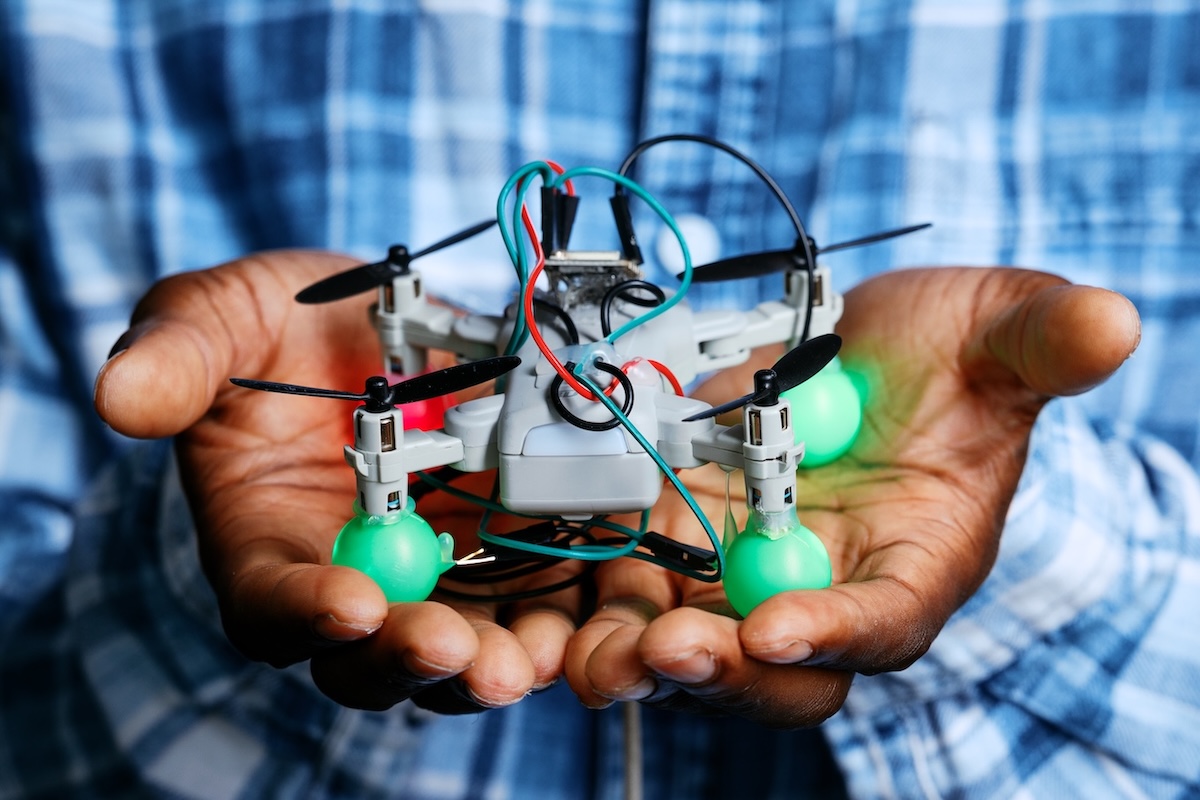
Close-up view of a person wearing a blue plaid shirt holding a small, custom-built drone with open palms. The drone has four propellers, exposed red, blue, and green wiring, and bright green rounded covers on its landing gear.
The project’s goal is to have a working prototype — one that can handle the rigors of space — by May 2027.

Zhang says working with undergraduate students can also help the master’s and PhD students in his lab develop mentorship skills and pass on knowledge like academic tips and career advice. “It’s a lot like a family—like older and younger siblings exchanging knowledge,” Zhang says. “It’s mutually beneficial.”

Nwobu is looking forward to contributing new ideas to the drone tracking project. After its current phase wraps up in 2027, the team hopes to secure funding for an additional year of research that would enable them to adapt their prototype system for use with actual NASA equipment.

Regardless of the outcome of this particular project, Nwobu is confident that his research experience will propel him toward his ultimate goal of completing a PhD in computer science, perhaps at UM-Ann Arbor. He has his eye on some of computer science’s thorniest problems, like finding more energy-efficient ways to train AI models. 

While there are likely to be plenty of challenges along the way, Nwobu is confident he can handle them. And he hopes the success he has achieved thus far can be an inspiration to others. “I wasn’t always good at school, or at thinking outside the box,” he says. “But I hope my experience will show people that if I can do it, they can too.”

Story by Gabe Cherry