Happy 25th anniversary, EIC

April 27, 2026

The Environmental Interpretive Center’s 25-year milestone celebrates the rich history of nature education and stewardship that’s taken place on the land for many years. The staff is hosting an anniversary event on May 16.

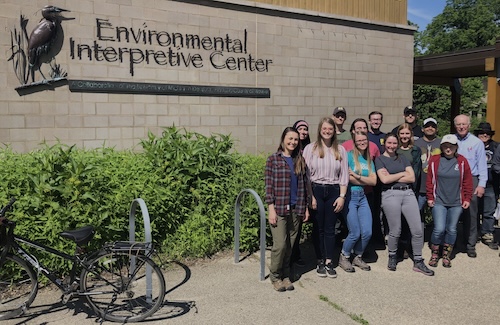
Four people - two males and two females - stand outside of a campus building's floor-to-ceiling windows. The sign in the background reads, "Environmental Interpretative Center."
EIC staff are planning a celebration. Staff include, from left, Richard Simek, Dorothy McLeer, Michael Solomon and Laura Mallard. EIC Program Coordinator Dale Browne, Director Jacob Napieralski and fall Interim Director Natalie Sampson also assisted.

There’s something new to experience every season right outside of UM-Dearborn’s Environmental Interpretive Center. Bright blue indigo bunting songbirds travel from as far away as South America each spring to make a home near the EIC. Mayapples bloom (Clara Ford used to turn their ripened pulp of the fruit into jelly). And great blue herons dip into the water at Fair Lane Lake for fish.

“The diversity of life found within this wonderful natural oasis we have is incredible. I’ve been here for more than 30 years and I learn something new every day,” says Interpretive Naturalist and Environmental Interpretative Trails Manager Rick Simek. “There’s always a reason to get outside and appreciate each season — and spring is a particularly good time to be out.”

This year, in addition to experiencing the flowering trees and returning wildlife, there’s another reason to visit UM-Dearborn’s EIC — its 25th anniversary. 

To celebrate this milestone, the  EIC staff is hosting a day of family-friendly hands-on events on May 16. The festivities kick off with a morning Bird Walk led by EIC Program Coordinator Dale Browne. Following the walk, there’s a midday open house featuring drumming, dancing and storytelling with Anishinaabe artist Hadassah GreenSky, an EIC history talk by Simek and a family music program with educator and composer Andy Jarema, who’s worked as a National Park Service artist-in-residence at Great Smoky Mountains National Park and at Hawaiʻi Volcanoes National Park. Additional activities are an afternoon Stewardship Saturday session, where volunteers remove invasive plants and replace with native plant species, and an evening walk with EIC Program Supervisor and Interpretive Naturalist Dorothy McLeer, followed by a bonfire. Get the details on the EIC’s 25th Anniversary event.
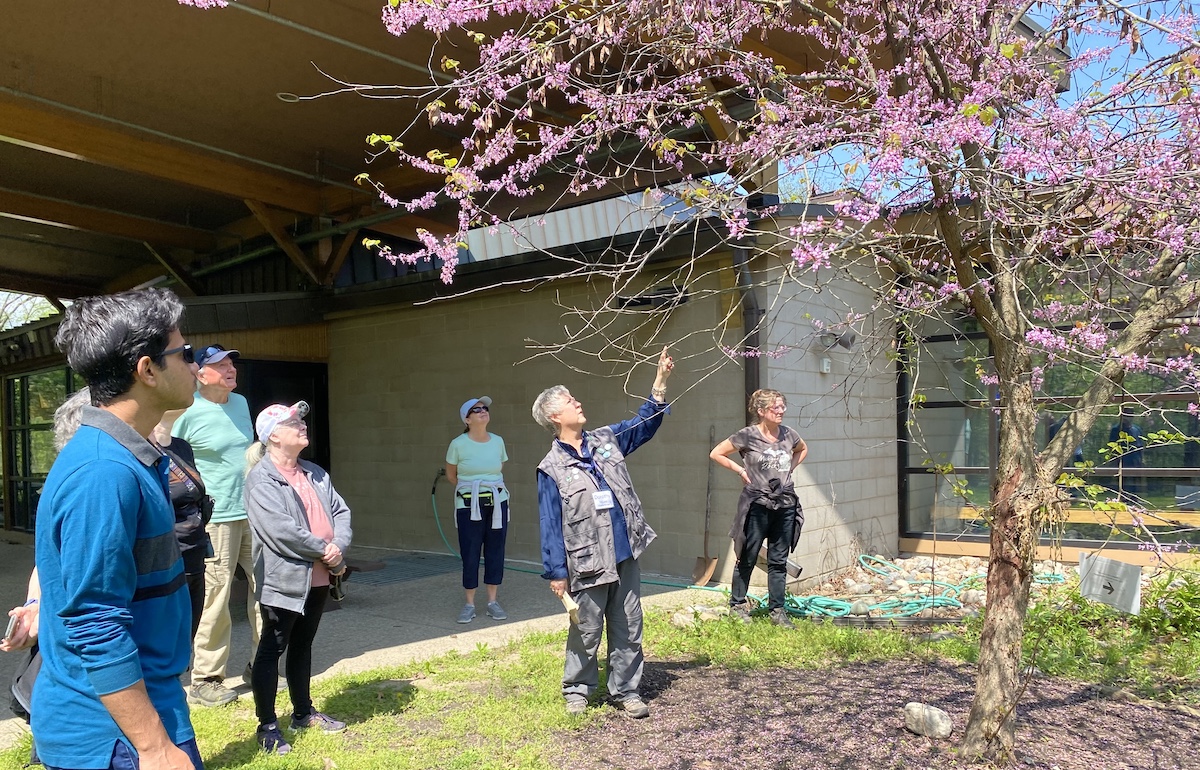
A group of people gather around an Eastern Redbud tree that's in bloom.
There is no missing the eastern redbud tree on the left side of the EIC. EIC Program Supervisor and Interpretive Naturalist Dorothy McLeer, center, said its color grabs attention, but its family history may be even more intriguing. “What does this redbud have in common with sugar snap peas?” she asked during a 2024 trail walk. “They are both members of the pea family. If you look closely, the tree has pea pods.” Photo by Sarah Tuxbury

EIC Director Jacob Napieralski says the free public celebration honors the many ways the community contributes to the center and its surrounding natural area. The environmental preservation work that led to the EIC’s creation offers a rarely shared story of urban environmental stewardship in Wayne County. 

The 120-acre nature preserve surrounding the center, owned by the university and located on the former Henry and Clara Ford Estate, grew out of 1970s advocacy, led by UM-Dearborn faculty and students as well as local residents, to oppose a proposed Hines Drive extension and a re-routing of the Rouge River. 

A black and white portrait photo of automotive icon Henry Ford next to words in green that read "Wake Up Citizens." The image is a part of a brochure that asks people to save the land - which was once Henry Ford's — from development.
UM-Dearborn students started the "Citizens for Henry Ford’s Wildlife Preserve" in 1973 in opposition to a proposed Hines Drive extension, which would have destroyed the land. This is part of a brochure they distributed. Photo courtesy Mardigian Library

The preserve was formally established in 1975. A decade later, The Detroit Free Press declared: “No other urban campus in the nation enjoys a better resource on its grounds for the study of ecology.” Read a story map about the EIC’s history to learn more.

Centuries back, the Anishinaabeg and Wendat peoples cultivated and shared the land and its interconnected waterways, guided by a spiritual responsibility to the Earth. “We value our history and connection to the Ford family, but the site is much more than Henry and Clara Ford’s old property,” explains Napieralski, referring to the fact that Clara and Henry Ford owned the land from 1913 through 1950. “The Environmental Interpretive Center sits upon the foundations of thousands of years of Indigenous history and stewardship — it’s a gathering space that needs to be shared. We want people to come here to experience nature right inside of a major urban area,” Napieralski says.

The EIC and the trails are open to the public. EIC building hours are 9 a.m. to 5 p.m.  Monday through Friday. Trail hours are sunrise to sunset daily.

The the EIC and the surrounding preserve are part of the 202-acre parcel gifted to the University of Michigan by Ford Motor Company in the late 1950s to create UM-Dearborn, where university students conduct hands-on research in their natural science courses, community members hear expert-led environmentally focused talks and where local school children attend field trips.

The 10,000-square-foot center itself was built in 2001 as a way to welcome people to the vibrant and always-changing nature trails. It was the culmination of a 30-year effort by Orin Gelderloos, professor emeritus of biology and environmental studies. Gelderloos taught at UM-Dearborn from 1969 through 2019 and served as the EIC’s first director. Prior to the center’s construction, classes and community events took place on the land, but there wasn’t an official entry point or a nearby classroom space to discuss the day’s findings. Gelderloos wanted a gathering place that anchored the learning taking place there — from faculty research to student-focused courses to public-facing nature program.

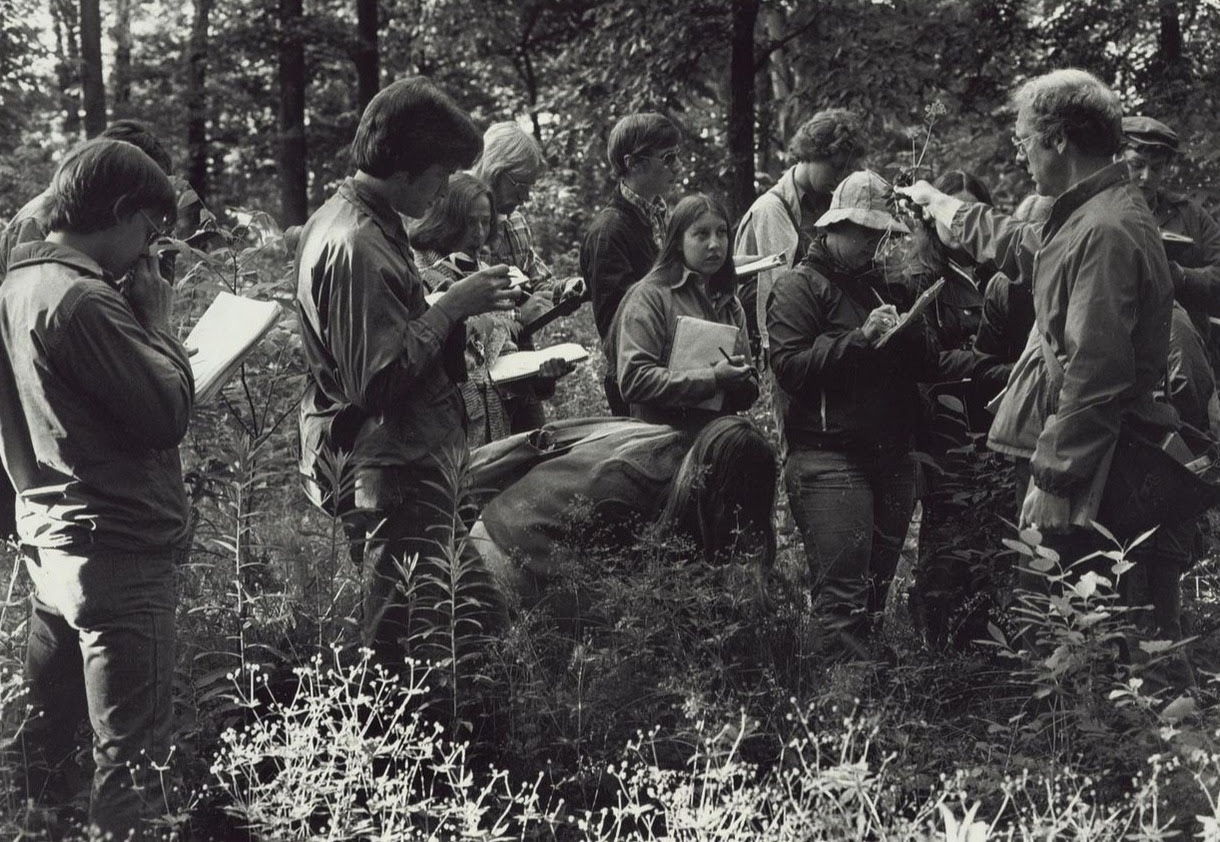
A black and white photo with a group of students, who are holding notebooks, listening to a professor. The students are outside in a forest and learning about plant life in southeastern Michigan
In this June 1978 photo, Professor Orin Gelderloos, far right, takes UM-Dearborn students out foraging on the Environmental Interpretive Trails. In his field biology course, Gelderloos helped students identify plants and, among other things, explain which were safe to eat. On the last day of class, students used the lessons to forage and prepare a meal to share — items typically included cattails, elderberry, mint and more.The class began in 1970 and the food component was added in 1971 when Gelderloos brought in famed botanist and long-time U-M Biology Professor Warren H. Wagner as a guest educator. Gelderloos taught the class until his 2019 retirement. Photo courtesy Mardigian Library

It took time, but by the late 1990s, Gelderloos and others secured funding with the help of the State of Michigan, Wayne County and Ford Motor Company. The building opened in 2001, offering a gateway to the immediately adjacent nature preserve where, at the time, an estimated 30,000 people visited each year.

Today, the EIC and the surrounding Environmental Interpretive Trails, previously called the Environmental Study Area, see approximately 60,000 people annually. “Thanks to the center we were able to grow our reach on the trails. We’re within driving distance of over a million people — we are an oasis and a public service,” McLeer says. “The center gave us a physical presence, classrooms and the always important restrooms.” The EIC welcomes several thousand children a year for their K-12 educational programs alone. 

Young Naturalist Program
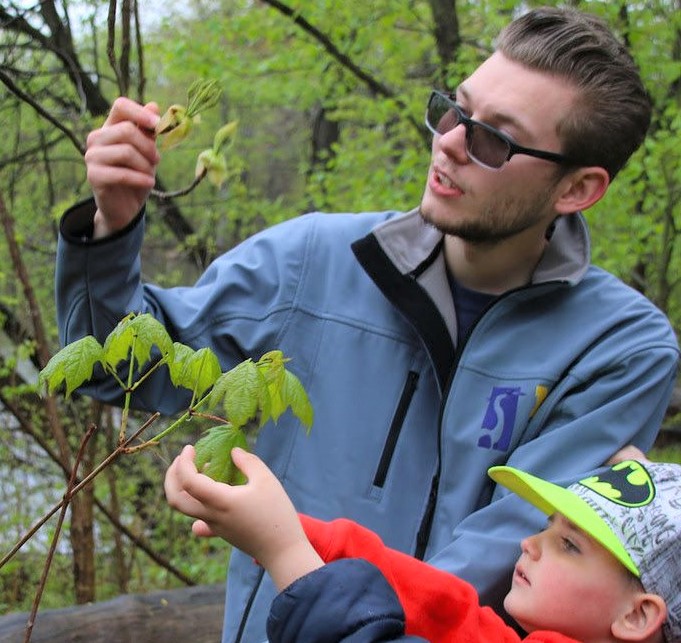
Griffin Bray leads an elementary school field trip group at the EIC in this 2019 photo. Photo by Sarah Tuxbury

McLeer says the center gives people who aren’t used to interacting with nature a transitional place to get acclimated. “I’ve met people — in particular kids, but some adults too — who have never been in a forest. Since it's unknown, there’s some anxiety around it. The building provides a place where they can learn more and look through windows before heading out. Our job is to get people familiar with nature, which helps them become comfortable and curious about the natural world. And that often leads to caring.” She says they continue to look for ways to increase comfort, accessibility and inclusion at the EIC. New multilingual signage in Spanish and Arabic just went up, Indigenous knowledge is incorporated into their education programs and additional EIC study spaces will be added this year.

UM-Dearborn alum Griffin Bray participated in the EIC’s’s Young Naturalist Program at age 9. His experience helped him decide where to attend college. “You know how you learn so much as a kid, but there are a few things that you easily recall? I still remember details from that program. Dorothy shared about how you can identify a sugar maple tree because it looks like there’s a peanut butter color between its raised bark,” he says. “Even as a kid, I could tell that the EIC team was passionate about what they were teaching. They made learning fun and that left an impression on me.”

Bray graduated from UM-Dearborn in 2020 with a degree in environmental studies and is now a lecturer of natural resources at University of Wisconsin-Stevens Point. He teaches college students how to engage with the public when it comes to learning about nature and helps plan educational programming for UW-Stevens Point’s nature reserve. “Everything I do now started at the EIC,” he says. “There isn’t a day that goes by where I don’t draw on the lessons that I learned while there. I even point out the peanut butter appearance on the maple trees to my students today.”

It’s stories like Bray’s that Gelderloos hoped to cultivate when he started his land preservation effort — and Bray is one of hundreds of UM-Dearborn graduates whose naturalist education and training began at the EIC. Others include 2001 alum Jennifer Potts, who is the chief interpretive naturalist and park manager at Crosswinds Marsh in New Boston, and 2018 alum Brandon Thomas, who’s now an interpretive naturalist at Nankin Mills Nature Center in Westland.

A group of students and a professor stand to the right of a light grey-ish beige brick building. The building was a sign that reads, "Environmental Interpretative Center.
Gelderloos taught his last field biology course in 2019 after nearly 50 years. He and his class are pictured outside the EIC on the last day of the Summer I semester in June 2019. Photo by Sarah Tuxbury

Gelderloos realized a center could help in training future generations, who would then go on to educate others. He especially wanted people to understand the importance of the land they live on and use. In a 2015 interview with Reporter, he shared his motivation behind nearly 50 years of environmental teaching. “Southeast Michigan is special. There is no other place like it. Everyone has his or her place in the world. And this is ours,” he said. “It's important to understand the world we live in, and the world we live in here is Southeast Michigan. It has a very rich and wonderful history if we bother to look at it.”

When Gelderloos looked at campus roads, he didn't see a vehicle route. He saw a pathway to the past. Before Evergreen Road, there was the Fords’ soybean farm. Before the soybean farm, First Nations people, the Potawatomi, used Fair Lane Drive as a traveling route. And long before that, a glacial lake covered the entire area. “Many of us only have the most recent memory of time, our lifetime. Believe it or not, important things happened before we got here — and things will continue to happen,” he said.

The EIC staff knows there’s truth to Gelderloos’ words. And looking toward the future, they know those seeds planted many years ago will continue to grow — ensuring that the EIC will remain a vital resource for generations to come.

Want to support the EIC, but can’t make the May 16 event? Consider volunteering or donating to celebrate the EIC’s 25 years.

Story by Sarah Tuxbury. Top photo by Matthew Stephens