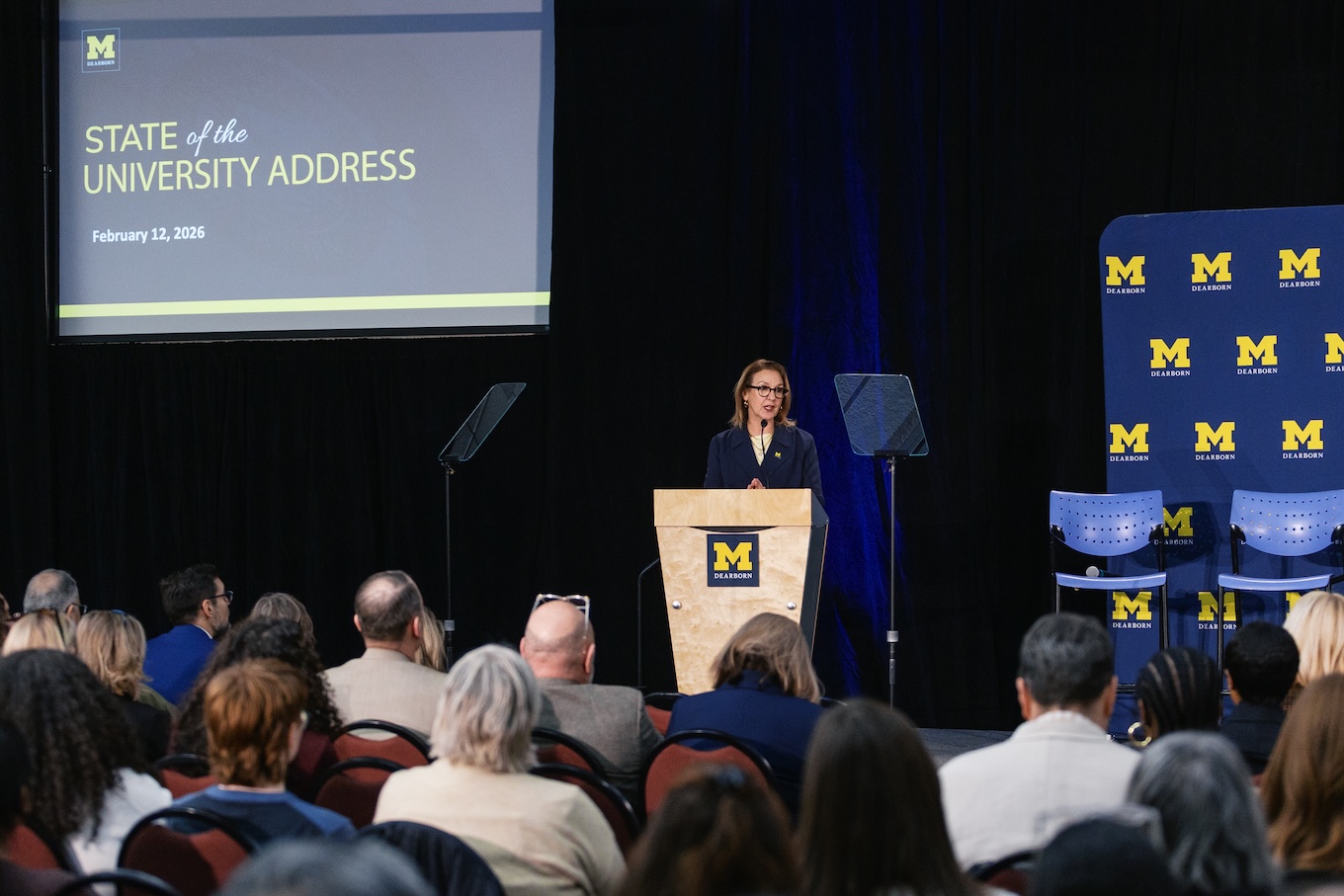
“Now, of course, the future is not all challenges,” Scarlatta observed, before noting that the College of Education, Health and Human Services/Administration Building renovations are on track for summer 2026 completion and that the university will be implementing a $5 million strategic investment from UM-Ann Arbor, which was announced in the fall. She then reflected on her visits to alumni all over the country. “Time and again, they tell me about the impact UM-Dearborn has had on their lives and they share their enthusiasm for what we’re doing now,” she said. “They celebrate all the ways that we are supporting a new generation of students on their journeys, just as we supported them during their years here on campus.”
Scarlatta then turned the program over to several panelists and presenters, with a video celebrating the university’s recent redesignation as a Carnegie community-engaged campus, as well as two videos about student journeys — and the faculty and staff who supported them along the way — in between.
See the videos and watch the entire SOTU event on UM-Dearborn’s YouTube channel.
Straight talk on the 2026-27 budget — and boosting enrollment
Vice Chancellor for Business Affairs Bryan Dadey shared 2026-27 general fund budget projections. Due to a confluence of pressures — including the new international student enrollment decline, a domestic enrollment “cliff” due to drops in Michigan’s college-age population, increased competition as a result of flagship university expansion and increased online offerings, and insufficient state funding — the university anticipates a $6-7 million shortfall next year.
Interim Provost Ghassan Kridli then detailed new initiatives in each college — as well as others that are universitywide — to boost domestic student enrollment and close the revenue gap. In addition to the Great Lakes Scholarship, and Detroit Public Schools and Diploma Equity Project partnerships mentioned by Scarlatta, Kridli discussed efforts to simplify transfer policies, online learning initiatives and additional Accelerated Masters programs, with the first cross-college collaboration expected to be approved this year.
Kridli also pointed to several recent enrollment “wins,” including welcoming the university’s largest-ever first-year classes over the past three years and five new “2+2” teacher training partnerships in CEHHS, which enable community college graduates across the state to continue their education coursework online with UM-Dearborn from their home communities. “Now we're offering programs in the UP, offering programs in west Michigan and south Michigan and north Michigan. This is not something we were able to do before, but with these programs now, we're expanding our reach and reaching new learners,” he said.
Kridli then offered details on the initiatives funded by the UM-Ann Arbor strategic investment, all designed to boost enrollment and promote cross-disciplinary collaboration. These include marketing investments, support for online program development, research seed funding and expanded student programming, particularly around student research.
Kridli concluded by encouraging all faculty and staff to continue to create a welcoming environment for students and serve as ambassadors for UM-Dearborn in the community. “Now what we all do, and what we need to continue to do, is to double down on the things that help us stay connected to our students and support our students. This is what differentiates us from other places,” he said.
Celebrating research, collaboration and student success
Just before the State of the University event last year, UM-Dearborn was classified as an R2 research institution by the Carnegie Foundation for the Advancement of Teaching. This year, Interim Vice Provost for Research Joan Remski spoke with six faculty researchers across three colleges about current projects and their creativity and persistence in securing funding for them — from large federal grants to smaller internal awards. Associate Professor of Industrial and Manufacturing Systems Engineering Zhen Hu and Assistant Professor of Neurobiology Zhi “Elena” Zhang both noted that, through diligence and determination, they were able to leverage internal grants to secure National Science Foundation and National Institutes of Health funding, respectively.
Director of Communications Kristin Palm spoke with staff and students about the recent renovations to the first floor of the Renick University Center and the ways those are spurring new collaborations and supporting student attraction and retention. “Because of these renovations, we're all able to do a much better job at serving the students where they're at,” said Kris Day, director of University Union and Events. “I think about it as, really, the life cycle of a student — a lot of it's contained now within the RUC. We go from recruitment to admissions to orientation, advising, involvement, student employment, academic support, counseling, career services, and even commencement, all of these things are located here. And we're able to help students through every phase of their college career and they are finding their place here.”
Following the event, the campus community headed out into the RUC for the Winter Carnival which featured outdoor firepits, a photobooth to snap selfies with Bruce the Goose, swing dancing to live music and, for the first time in several years, snow.