Fricke made a forecast of his own in 1955 to see if working as an educator made business sense — using the U.S. census and college enrollment data, he looked at the number of Baby Boomers in junior high and compared it to the number of people enrolled in graduate school. “The demand was going to be greater than the supply within five years. The door was open for me to become a professor,” he explains, recalling that moment with a smile. “I didn’t know where I’d end up, but I knew I’d be helping the next generation.”
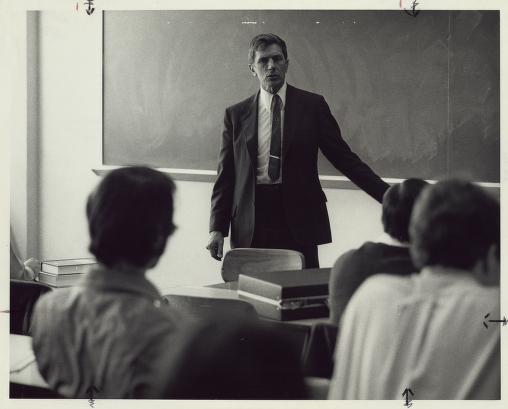
He went back to UM-Ann Arbor for his PhD in finance. He graduated in 1959, the same year the UM-Dearborn campus opened. “Even though I taught the summer after campus opened, the administration included me as one of the 20 original faculty members,” Fricke says. In the early days, Fricke’s classroom had eight to 10 students per section. To teach six sections, the university offered Fricke $3,000 a year, which is about $33,000 in today’s purchasing power. “They knew the salary wasn’t that great, so they told me that they’d throw in paying for my medical expenses if I retired from U-M. I was around 30 at the time and it seemed so far off, but I figured it wouldn’t hurt,” he says. “Well, I’m 97 and going pretty strong. Turns out that was one of the smartest things I ever did.”
Fricke recalls the collaborative spirit among faculty in UM-Dearborn’s early years. Professors from all disciplines worked together and formed close personal bonds. Fricke and his late wife Janet hosted holiday parties attended by faculty and university leaders, and their young sons Karl and Bill played with other faculty members’ children.
“There was a great deal of camaraderie. We were a new campus and our objective was to make it the best possible — that meant that we had to be strong in engineering, we had to be strong in business and we had to be strong in liberal arts. Then, of course, when we got education, we had to be strong in education. We became strong by working together and learning from each other,” he says. “UM-Dearborn was built on this interdisciplinary approach. I’m in financial economics, but it’s good for me to have an understanding about what questions moral philosophers would ask and how they would go about getting answers to their questions. Getting a variety of perspectives is the true meaning of education and we wanted our students to have that.”
Fricke incorporated energy and creativity into his teaching too. He’d bring in a crystal ball to help add humorous elements to complicated concepts like economic forecasting. And when teaching his accounting students about inventory control, Fricke put on a white food service smock and pretended to run a deli counter while the students solved inventory issues he was hypothetically running into. “At the end, I’d pull out a rubber chicken and ask what we could do with the leftover meat. They’d go wild,” he says with a laugh. “Sometimes the concepts can be dull and hard to grasp in the textbook — but once a student sees how it can apply in a real situation, it clicks.”
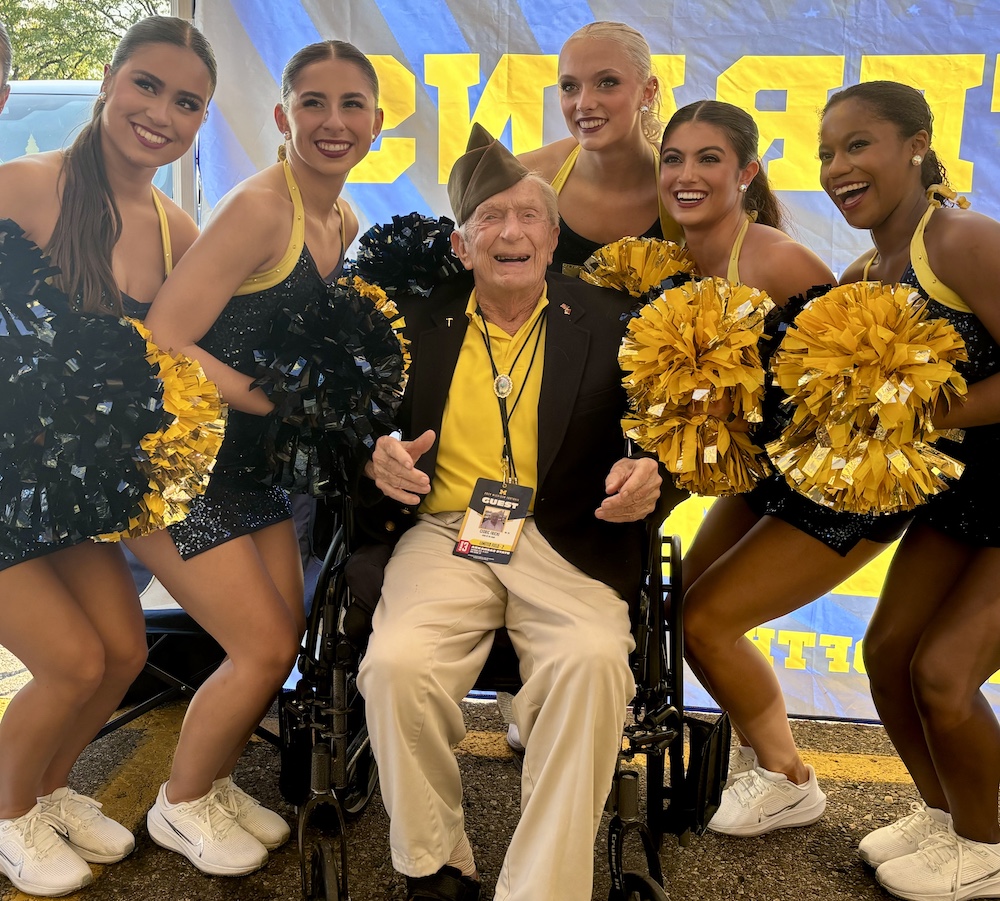
Even today, when reflecting on the past, Fricke looks to the future. He supports 10 UM-Dearborn students each year through the Dr. Cedric Fricke Endowed Internship Opportunity Fund and continues to look for ways to contribute to his field — he’s currently working on a patent for a new financial model designed to reduce taxes on derivatives. Fricke, who uses a wheelchair, also has a bucket list that includes a hot-air balloon ride and adaptive paragliding.
“Keep learning and exploring,” Fricke says. “No matter your age, what you do matters. If you can, help others. This generation needs all the help they can get — just like the boy who left that southwest Michigan farm 80 years ago.”
Story by Sarah Tuxbury