‘They are not standing at the edge of discovery — they are inside it’

March 23, 2026

Associate Professor of Biochemistry Besa Xhabija, a cancer researcher, explores ways to inhibit cancer cell growth. She’s training undergraduates to assist her in making new discoveries.

Two women are in a science lab, standing in front of a microscope.
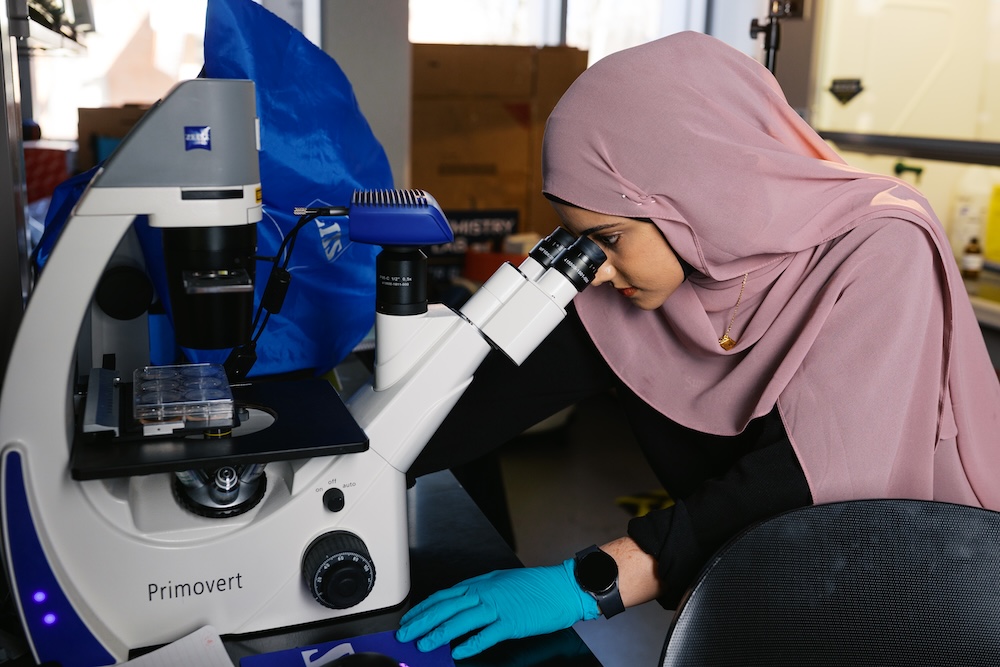
Junior Wiam Almahdi and Associate Professor of Biochemistry Besa Xhabija work together in Xhabija's Cancer Therapeutics Lab. They are exploring how natural compounds may help inhibit tumor growth in cancers like melanoma.

On a recent afternoon Wiam Almahdi, a junior majoring in biochemistry, examined cells through a microscope in Associate Professor of Biochemistry Besa Xhabija’s Cancer Therapeutics Lab. She was looking at melanoma cells to see if Spinosyn A, a natural pesticide found in soil, inhibits their growth. Melanoma is the most dangerous form of skin cancer.

Almahdi wants to be an epidemiologist — that goal began in childhood and was strengthened by the pandemic — and this research experience is moving her closer to her dream profession. “I have learned how a lab operates, how to use the equipment and run tests. I’m becoming more independent and I’m becoming more confident in trusting my decisions and results. I am doing cancer research as an undergraduate. This is not something many people can say,” observes Almahdi, while running an assay —a type of test that measures the specific amount of a type of substance —on the SK-Mel-2 cell line. That cell line, derived from a former patient with melanoma, is often used in research to study how certain types of melanoma grow and respond to treatment.

Almahdi credits this experience to Xhabija, her favorite biochemistry professor. She has taken two courses with Xhabija and has worked in the Cancer Therapeutics Lab for a year. “She is always there to help if I need it and she takes technical topics and makes them easy to understand,” Almahdi says. “In her lab, we are performing tests that are done in industry to make discoveries of our own. She’s also very connected with industry.”

Xhabija collaborates with biochemical research companies like Cayman Chemical, along with clinicians at Michigan Medicine’s Rogel Cancer Center, faculty experts at Michigan Center on Lifestage Environmental Exposures and Disease and researchers at the Michigan Institute for Data and AI in Society. “If you want to work in medical research, Professor Xhabija’s lab is where you want to be,” says Almahdi, while lifting her head up from the microscope.

Almahdi’s brother, Yazan Almahdi, a 2025 UM-Dearborn alum who also trained in Xhabija’s lab as an undergraduate, is now a full-time research technician at the Rogel Cancer Center. He works in the laboratory of Dr. Christina Angeles, a surgical oncologist and nationally recognized physician-scientist leading clinical and translational research in melanoma and sarcoma. “I want to help students build technical skill, scientific reasoning and confidence while introducing them to opportunities they may not have imagined for themselves,” Xhabija says.
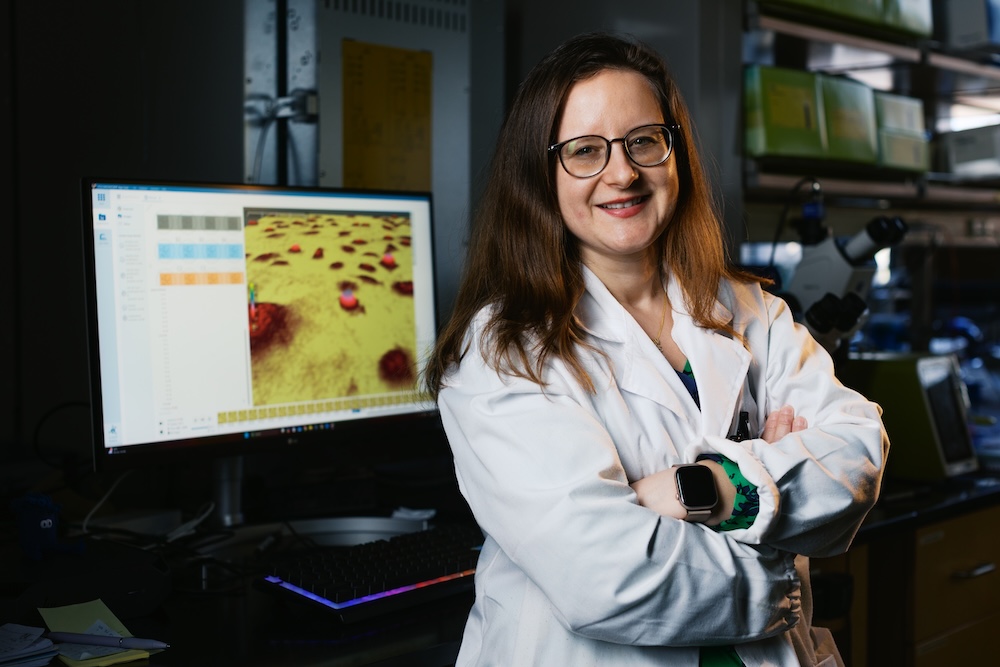
A photo of a female professor in a while lab coat. She is standing in front of a laptop monitor that shows her cancer research.
Associate Professor of Biochemistry Besa Xhabija is a molecular cancer researcher.

A molecular cancer researcher, Xhabija has taught at UM-Dearborn since 2022. Previously, she was an assistant professor at UM-Flint and a visiting professor role in the Systems Biology Institute and Department of Genetics at Yale School of Medicine. Her lab focuses on identifying metabolic vulnerabilities in cancer cells, meaning that she examines how disrupting nutrient pathways can suppress tumor growth. Her current areas of focus include renal cancer, breast cancer and melanoma. Xhabija and her students have published findings showing that targeting key processes in cancer cells — such as how the cells grow and get their energy — can slow the growth of melanoma and renal cancer cells in laboratory studies.

While Xhabija says she has had offers to work in industry, she chooses to teach. She wants to help students like Wiam and Yazan Almahdi reach their goals. “I really enjoy watching students develop confidence in their ability to think critically. Over time, they begin to trust their reasoning and contribute their own ideas. Being part of that development is profoundly meaningful,” she says.

Xhabija's own journey into science has shaped her approach to mentoring students. She knows the importance of having people in your corner and how far that type of support can go. Growing up in post-Communist Albania, Xhabija was drawn to science — she was curious and wanted to figure out how things worked. But she didn’t have access to quality kid-friendly science books in grade school. So her parents would save and go to a specialty bookstore to buy her National Geographic textbooks that had been translated into Albanian. “They were colorful, easy-to-understand and had wonderful photos. But they were so expensive. One textbook would cost one-tenth of my parents' salary,” she says. “I recognized the sacrifices they were making for my interest in science. I made sure to take my time to really pay attention and read what they brought home for me.”

She also relied on an aunt, a university professor in Albania, to help her with more complex topics. Her Teze Mirushi — that’s Aunt Mirushi in Albanian — is gifted at explaining things in an easy-to-understand way. “She shaped how I think about teaching and science communication,” Xhabija says. “If you cannot explain something in a way that people immediately grasp, you do not truly understand it yet.”

After graduating from high school in Tirana, Albania, in 2004, Xhabija moved to Canada for college. She wanted a life outside of Albania, which was in economic and political transition at the time. She excelled in her undergraduate science classes at York University, but struggled in this new world where she was also learning a new culture and working to speak fluent English.

During her senior year, she had the opportunity to take biotechnology classes at the University of Windsor and Xhabija met the professor whom she considers her mentor: Panayiotis “Otis” Vacratsis, an associate professor in the department of chemistry and biochemistry. He later served as her master’s thesis supervisor and what began as a single project evolved into a six-year mentorship that culminated in her PhD.

“I felt lost in my undergrad years. I thought about dropping out, but I knew my parents had so much invested in me. I didn’t know what to do,” she says. “Otis is very good at reading people. He saw I was drowning, but that I was eager to learn. He cared so deeply about the students in his lab. When I felt overwhelmed, he didn’t just push me to keep going — he paused, listened and tried to understand what was behind the struggle. His support rebuilt my confidence and taught me that working through challenges is what makes you more resilient. I wouldn’t be where I am today without him. I always have that in mind and I try to show the same type of care with my students.” While working with Vacratsis, Xhabija found herself increasingly drawn to scientific questions related to disease. “Cancer research brought together rigorous biological questions with clear human relevance,” she explains. “It allowed me to study fundamental mechanisms while also thinking about how that knowledge could eventually improve treatment.”

A female student researcher looks at melanoma tumor growth through a white microscope.
Junior Wiam Almahdi examines melanoma cells.

Through Xhabija’s interactions with UM-Dearborn students, it’s evident that she’s modeling what she’s learned. She answers questions in an easy-to-understand manner. She supervises lab work and is readily available, but often steps back to allow students greater independence. She recognizes student strengths and amplifies them, while also teaching new skills.

Former student researcher Ayah Farhat, who graduated in 2025, made melanoma-related discoveries in the lab that resulted in two first-author publications with her research featured on two journal covers. Xhabija says Farhat is a talented researcher — but building up skills takes time. When Farhat first told Xhabija she wasn’t confident in the hands-on aspects of the lab, they focused on Farhat’s self-identified strengths of critical thinking, data analysis and writing — adding in the physical lab work as Farhat’s confidence increased. “You would never know that she once felt that way. I remember watching her grow into that role, learning to make difficult decisions, defend her reasoning and trust her own intellectual voice,” Xhabija says. “Moments like that remind you that scientific discovery is not only about data. It is also about people realizing their own capacity to contribute meaningfully.” Farhat, who wants to be a doctor, is currently applying for medical school and has had multiple acceptance offers. Many of Xhabija’s former students are now physicians, pharmacists, dentists and researchers. She says it’s important to link classroom training with clear pathways to research and medicine. 

Back in Xhabija’s Cancer Therapeutics Lab, Wiam Almahdi measures the growth and shape of melanoma cells. She wants to work for the Centers for Disease Control and Prevention and plans to be there in 10 years. It may seem ambitious, but keep in mind that she’s conducting cancer research at age 20. “Working in Professor Xhabija’s lab will help me stand out. I am learning so much,” Almahdi says. “She is a great teacher and encourages me to trust my decisions in the lab so that I am confident in doing it in the future.”

Xhabija says that undergraduate research yields dividends far beyond campus — inspiring future scientists and addressing critical health issues that touch every family. 

“These are students who ask questions that matter. They notice patterns others might miss. They develop judgment. Over time, you see something shift. They begin to see themselves differently,” she says. “They are not standing at the edge of discovery — they are inside it.”

Story by Sarah Tuxbury. Photos by Matthew Stephens