

Over the last three years, a rotating team of UM-Dearborn students worked to design, test and integrate an advanced electric vehicle battery pack into a 2024 Ram ProMaster EV as part of an international competition. The final challenge of the multi-stage Battery Workforce Challenge collegiate competition was to spin the cargo van’s wheels using the student-built battery. The UM-Dearborn team did not even come close to this goal.
Then again, only one team — out of an original 12 from the U.S. and Canada selected for the competition — did. It turns out that building a fully functional EV battery on a college campus presents a wealth of challenges, including a need for highly specialized lab space. So, The Ohio State University emerged as the champion, besting not only UM-Dearborn but schools like Clemson University, University of California-Merced and University of Nevada-Las Vegas. Still, the UM-Dearborn “BattChallenge” team members consider themselves winners.
That’s because the point of their journey was not so much their final destination but all that they learned along the way. And what they learned far exceeded what any of them had ever experienced in a college classroom.
Competition mimicked industry environment
“I like batteries. I think they're interesting. I thought it'd be a good opportunity to learn about high voltage battery packs and project management at the same time,” said Duncan Tyree, a PhD student in electrical, electronics and computer engineering who served as project manager for the UM-Dearborn BattChallenge team for all three years.
The competition, which was structured to closely mimic an industry environment, did not disappoint. “I've learned essentially every piece that goes into a battery pack and the project management skills,” Tyree said. “I've done a lot of deliverables for this that you don't see in a classroom ever.”
Tyree was joined by several other graduate students, but the majority of BattChallenge participants — more than 20 each year of the competition — were UM-Dearborn undergraduates. They served as members or leads of units in charge of software, hardware, vehicle integration and marketing. The UM-Dearborn team was the only one selected from Michigan.
Each team also had a vocational school partner. UM-Dearborn’s was the battery technology certification program at Henry Ford College, so several HFC students were part of the team. Some of those students transferred into UM-Dearborn during the program.
Ten UM-Dearborn masters students worked with the team and five completed a masters thesis tied to the project. A group of undergraduates from UM-Ann Arbor completed a senior design project with the team as well.
Program led to internships and full-time jobs
Sponsored by the U.S. Department of Energy, Argonne National Laboratory and Stellantis, the BattChallenge was designed to develop a talent pipeline for advanced mobility technologies. Tyree is evidence of its success — this past summer he interned at Stellantis. He’s one of several BattChallenge alums to intern for the company. And some of those internships have led to full-time jobs.
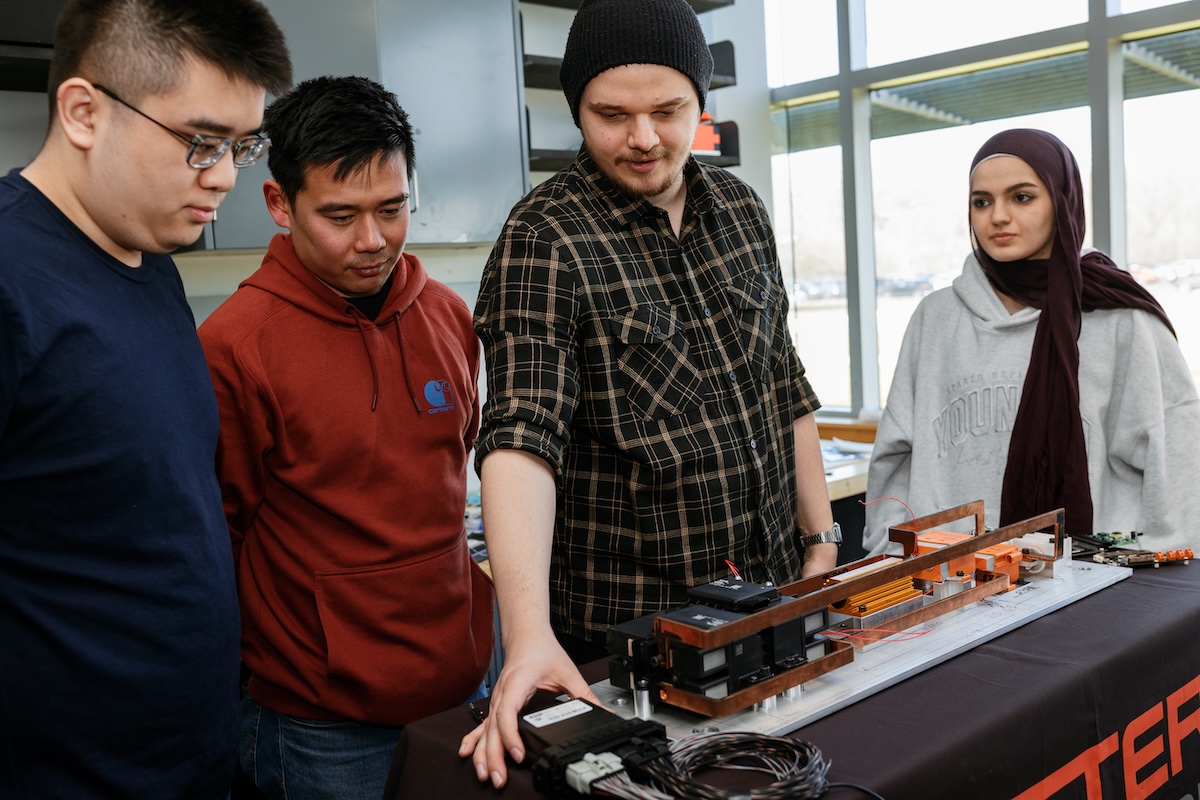
“Overall, the students that participated heavily in the competition were very successful at landing jobs in industry,” said Tyree, who was offered a full-time position at Stellantis following his internship. He will start after he completes his PhD next fall.
Zeinab Saad, who graduated in May with a bachelor’s in electrical engineering, had a position at Stellantis lined up before starting her senior year. She joined the BattChallenge her sophomore year as a member of the hardware team — the group responsible for building the circuit and selecting the battery components. Ultimately, she became the team lead and interned at Stellantis starting the summer after her junior year.
“I was full time in the summer, and then my supervisor asked my thoughts on continuing while I was in undergrad and he also offered me a direct hire in the department starting in June,” Saad explained last spring before transitioning into her full-time role.
“We've been doing hardware-in-the-loop testing. It’s a lot of requirement documentation, MATLAB, so a lot of the stuff that I've learned, I’m applying it to the internship,” she said. Saad is joined at Stellantis by fellow BattChallenge alum Julian Summers-Doniver, who also interned with the company and graduated with his bachelor’s in electrical engineering in 2025.
Caden Do, a senior majoring in computer engineering, translated his experience as the vehicle integration team lead into a summer internship with Yazaki North America, a Tier I auto supplier. Working as a core research engineer intern, he co-developed a proof-of-concept prototype for the company and participated in a customer request for quote, helping to analyze and tear down production wire harnesses — the bundles of wires, cables, connectors and terminals that control a vehicle’s electrical system. Their analysis showed nearly $1.8 million in potential cost savings. Do also developed guidelines for the company’s Maker Cup, an internal innovation challenge.
Because electrical engineering is not his field, Do said he had to really stretch during the BattChallenge. But this, along with concrete skills he developed, helped him excel in his internship. “Funny enough, 90% of the things we did in the program were found at Yazaki,” he said.
The documentation skills he gained through the challenge proved especially useful. “The knowledge I gained allowed me to more easily converse and relate with other engineers and interns working on similar aspects from the program,” he said. “It was really important during the research phase of my work, as I didn’t have to ask about every little thing during the meetings.”
Associate Professor of Electrical and Computer Engineering Xuan Zhou and Azeem Hafeez, an ECE lecturer, advised the BattChallenge team. They collaborated with Jason Siegel, a research associate professor of mechanical engineering at UM-Ann Arbor.
Zhou said some of the lessons learned during the project will be integrated into CECS courses and laboratory exercises, enabling future students to also gain hands-on experience with battery testing, diagnostics, safety and system-level design. The battery cycler, donated by BioLogic, and test platforms secured for the challenge will also be put to use. But it’s the connections the students made that will have the most lasting impact, he said.
“Through this three-year competition, our students got the chance to talk with students from other universities, mentors, employees from Stellantis, people from Argonne National Lab and the DOE,” he said, noting that students met high-level executives like a vice president at Stellantis. “They learned a lot and this experience was precious.”
For Do, the experience opened up new career possibilities. “Now that I’ve had the opportunity to explore the automotive industry, I think I would enjoy making car systems a career or even researching new technologies regardless of the field,” he said. “Ultimately, participating in the BattChallenge allowed me to develop core skills that extend beyond the competition and will benefit me regardless of where I work.”
Story by Kristin Palm. Photos by Matthew Stephens


