Connecting yesterday, today and tomorrow with sweetgrass

October 1, 2025

UM-Dearborn’s 2025-26 Community Read, “Braiding Sweetgrass,” helps weave together Indigenous knowledge and university life.

Two people holding a book are in front of a shelf of books
Student Engagement Librarian Anne Dempsey Moussa and Composition and Rhetoric Associate Professor Michael MacDonald are chairing this year's Faculty Senate First-Year Experience Committee, which leads Community Read programming. Photo by Matthew Stephens.

It is common campus knowledge that UM-Dearborn was built on the estate of Henry Ford, who lived on the land for fewer than four decades. Far less discussed are the groups who coexisted with this land for thousands of years before Ford. UM-Dearborn’s grounds were once home to the Ojibwe, Odawa, Bodwéwadmi and Wendat nations, until the land was appropriated through treaties in the early 19th century.

In acknowledgment of this often-ignored history, and of the importance of considering Indigenous ways of knowing, UM-Dearborn’s 2025-26 Community Read is “Braiding Sweetgrass: Indigenous Wisdom, Scientific Knowledge and the Teachings of Plants” by Robin Wall Kimmerer, a botanist with the State University of New York College of Environmental Science and Forestry and member of the Citizen Potawatomi Nation. The book, whose chapters read like individual short stories, highlights Indigenous wisdom in regard to ecological understanding, traditional medicine, sustainable actions and more.

“The overall thesis is to be conscious about how you interact with the land. We live in a society that focuses on excessive consumption without giving back. The author’s storytelling throughout the book reminds us about the importance of reciprocity, gratitude and moderation. If you take only what you need and support one another, the Earth will continue to provide for you and future generations,” says Student Engagement Librarian Anne Dempsey Moussa, who was on the book selection committee. “The book’s message is universally human with Indigenous and Western scientific knowledge woven together to provide a framework.” Throughout the book, Kimmerer explores how Indigenous practices can inform and transform people’s relationships to the land in areas from gardening to scientific practice, teaching and learning, and conscious resource use. 

Sweetgrass is a sacred plant in Indigenous culture that attracts positivity, promotes healing and fosters feelings of kindness and love. Drawing from Potawatomi teachings, Kimmerer gives reverence and appreciation for the life-giving power of all plants. She writes about how she addresses the plants in her garden, names them and asks for their permission to harvest. With harvesting, Kimmerer only takes what is needed and shares the gifts from the plant with others. “The Indigenous canon of principles and practices that govern the exchange of life for life is known as the Honorable Harvest,” Kimmerer writes. “They are rules of sorts that govern our taking, shape our relationships with the natural world, and rein in our tendency to consume — that the world might be as rich for the seventh generation as it is for our own.”
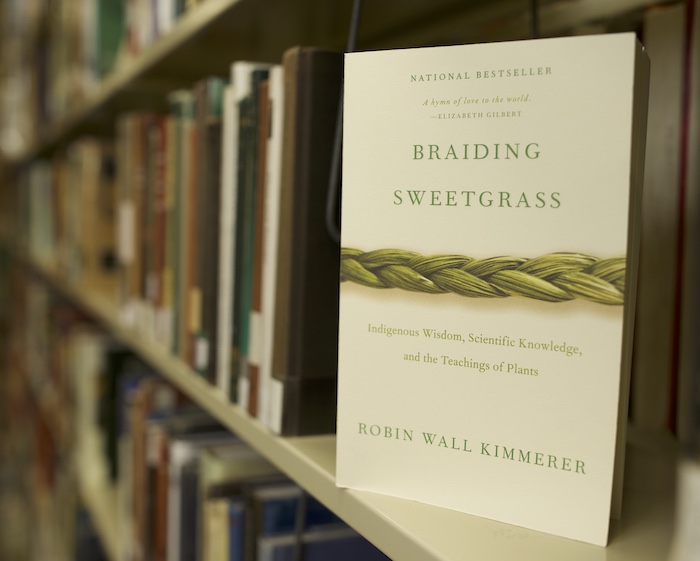
The cover of the book "Braiding Sweetgrass"
UM-Dearborn's Community Read "Braiding Sweetgrass" is available for free online and at the Mardigian Library. Photo by Matthew Stephens

There will be a Community Read Discussion with Interim Chancellor Gabriella Scarlatta around “Braiding Sweetgrass” on Oct. 6, 11 a.m. to 12:30 p.m., at the Environmental Interpretive Center. The event will focus on two chapters of the book: "Asters and Goldenrod" and "The Honorable Harvest.” The public is invited.

Composition and Rhetoric Associate Professor Michael MacDonald, who was also on the book selection committee, says the topics in the award-winning book touch on a range of subjects that are relevant to the UM-Dearborn community, like natural sciences, environmental science, philosophy, engineering, history, cultural studies, corporate social responsibility and sociology. And there is long-standing work at the university that connects to themes in the book. Students can learn how to grow and harvest plants by volunteering to work in the Community Organic Garden and help supply the Student Food Pantry with vegetables (gift economy), UM-Dearborn community members in need can get food and hygiene products from the Student Food Pantry, where many student patrons later become volunteers (reciprocity), and the public can learn about the natural world through the programs offered at the Environmental Interpretive Center (relationship to place and Earth).  

Faculty looking for ideas on how to teach the book in a classroom can visit the “Braiding Sweetgrass” teaching resources website. It gives advice on chapters to read in class, potential student activities and offers a UM-Dearborn sustainability map that shows how campus spaces can be connected with lessons from the book. MacDonald notes the chapters are a quick read and can easily be incorporated into classroom lessons. For additional information, reach out to [email protected].

Getting outside and connecting with the land 

The Community Read complements several new and updated projects around campus that honor Indigenous traditions, including Native gardens, an interpretive trail focused on medical uses of trees, Anishinaabe art and a land acknowledgment. 

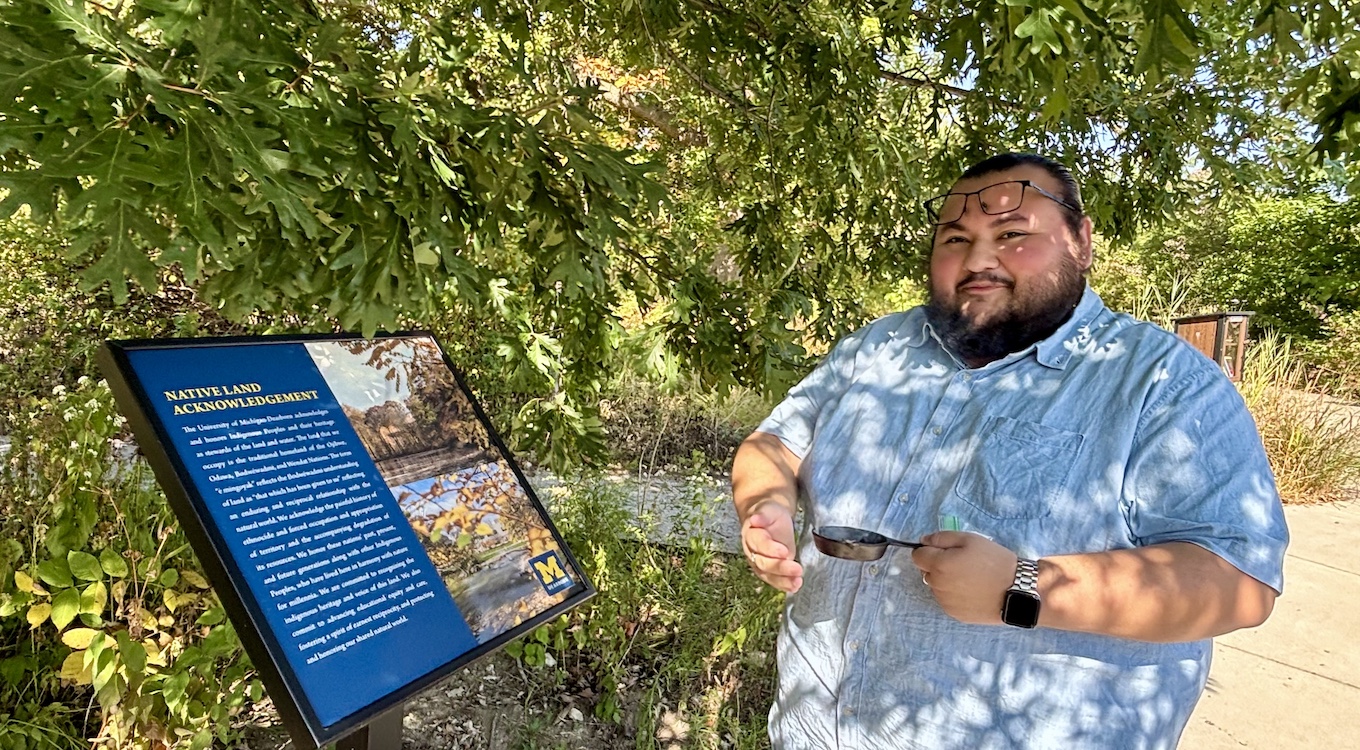
A man holding a small pan burns white sage in an outdoor area of campus.
Eastern Band of Cherokee member Adon Vazquez, a Dearborn Heights resident, recently performed a smudging ceremony at the Environmental Interpretative Center and included the new land acknowledgement sign. Photo by Sarah Tuxbury

“This year’s Community Read is an ideal choice for this moment in time at the university. We have been working behind the scenes on a number of Indigenous-focused initiatives for years and we are now bringing many of those forward. These are sincere efforts to change the way the land’s history is told,” Professor of History Martin Hershock explains. “Instead of the narrative being dominated by the car industry, we’ve worked with members of various tribal communities and will continue to partner with them in an effort to reframe the land’s history. With the book choice, I believe there is something mystical going on that brought all of these threads together.”

To gain a better understanding of Indigenous knowledge, Hershock says people should open their hearts and minds to different “ways of knowing,” referring to the methods people use to acquire, interpret and justify knowledge. "While Western culture emphasizes rational or empirical approaches, many other traditions and cultures give weight to, for example, ancestral knowledge or spiritual intelligence. They may emphasize oral traditions and stories as much as data and scientific facts," Hershock says. "When we recognize this diversity of knowledge in each other, we may become better thinkers and problem solvers, more empathetic people and we can better understand others’ perspectives."

Martin Hershock
Professor of History Marty Hershock

Hershock says the goal is to ensure the lessons in “Braiding Sweetgrass” are more than just words by incorporating Indigenous ways of knowing into university life. “Saying you are going to do something in an attempt to rectify the past is one thing,” he says. “But actually working to repair relations with Indigenous people in a way that prioritizes their wisdom and insight is another.”

To publicly demonstrate this, UM-Dearborn community members have worked with Native peoples to develop a land acknowledgment statement. Sault Ste. Marie Tribe of Ojibwe members Julie Roddy, a former UM-Dearborn professor who is now the endowed chair of criminal justice and behavioral health at Northern Arizona University, and Ariel Roddy, Julie’s daughter and a UM-Dearborn alum, worked with Hershock, Professor of Psychology Marie Waung and retired Associate Professor of Anthropology Brian McKenna on the land acknowledgment for nearly a year. “The land acknowledgment is an attempt to make our invisibility tempered and to correct injustices of the past. It won’t cure everything, but it is a welcome start,” says Julie Roddy. The statement welcomes visitors to the EIC’s front pollinator garden. Eastern Band of Cherokee member Adon Vazquez, a Dearborn Heights resident, recently performed a smudging ceremony at the new sign, burning white sage to cleanse the space of negative energy. “When you smudge a space, it becomes a blank slate so a fresh start can happen,” Vazquez explains. “It’s important to make sure your space has good intentions or is open to accepting your intentions and teachings. It’s all about leaving a space better for the next person, the next generation.” Vazquez also smudged the EIC’s trailhead, interior spaces and rain garden areas.

Just a short walk from the land acknowledgement sign, The EIC’s “Hidden Benefits of Trees” trail provides interpretive signage that illuminates the medicinal and material benefits of trees that the First Nations discovered. For instance: boiled husks from the nuts of the black walnut tree were used to make yellow dye for fabrics and the inner bark of the black cherry tree was made into a tea that alleviated symptoms of colds, fevers and labor pain by First Nations peoples like the Chippewa and Potawatomi. 

While the trail is not new, it needed updating. The trail signs, which were initially installed in the early 2000s, were unreadable. As part of a project-based learning service project, students in Hershock’s “Native America” course updated the trail information by interviewing Indigenous land experts, Little River Band of Ottawa citizen Shiloh Maples and Cherokee descendant Nickole Fox. “This is another way to integrate more of the Native point of view and Native traditions into our consciousness,” Hershock says. 

U-M’s Inclusive History Project helped fund this work as part of an ongoing project focused on engaging directly with Indigenous peoples to formally recognize their contributions to the area, along with learning and integrating Indigenous traditions and oral histories into university life. Through this project, led by Hershock and Professor of Geology and EIC Director Jacob Napieralski, the EIC will also commission work from Anishinaabe artists, including Jamie John, a tribal citizen of the Grand Traverse Band of Ottawa and Chippewa Indians. He will create a wall mural in the EIC classroom later this academic year.

Teaching the next generation

Through another project coordinated by Hershock, Anishinaabe seed keeper Maples planted a three sisters garden outside UM-Dearborn’s Natural Sciences Building earlier this year. The garden incorporates a traditional Indigenous agricultural practice of companion planting corn, beans and squash. 

Maples — who protects and preserves Indigenous and heirloom seeds — is also a UM-Ann Arbor School for Environment and Sustainability intermittent lecturer and doctoral student. She chose the plot space and gifted the seeds for the garden. The Bear Island corn is an Anishinaabe variety and the beans are from the Odawa tribe. The squash grew from seeds Maples received while working at American Indian Health and Family Services. “These are very old seeds that were rediscovered in the early 2000s during an archaeological dig and have not been grown outside of the Indigenous areas they originated,” Hershock says. “When seeds are planted every year, some are also saved and gathered after harvest to expand the plant’s region and share its knowledge. We can all learn from plants.”

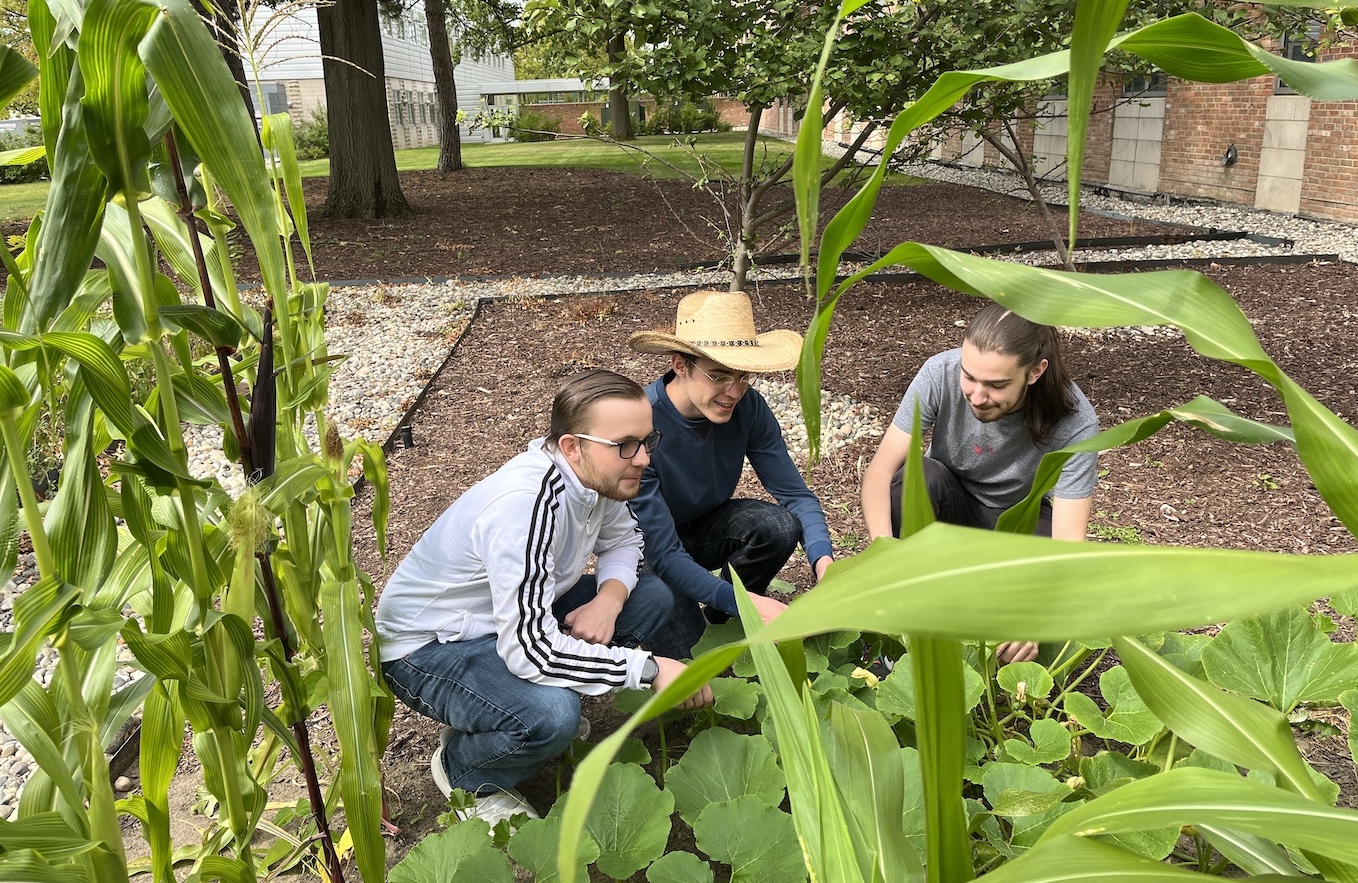
Students in Associate Professor of Chemistry Simona Marincean’s “Medicinal and Aromatic Plants” course spend Wednesday afternoons in the garden.
Students in Associate Professor of Chemistry Simona Marincean’s “Medicinal and Aromatic Plants” course spend Wednesday afternoons in the three sisters garden. Photo by Marilee Benore

Students in Associate Professor of Chemistry Simona Marincean’s “Medicinal and Aromatic Plants” course spend Wednesday afternoons in the garden. Daniel Winder — a UM-Dearborn senior who plans to become a doctor — examined the plants during a recent biochemistry class. “Fertilizers and pesticides can have detrimental effects on our health and on the plants and animals around us,” he says. “This agricultural method doesn’t use those. Why haven’t I heard of it before? And why, as an educated Western society, aren’t we using it?” Students are currently reading the “Braiding Sweetgrass” chapter “The Three Sisters” to help them understand how these plants successfully grow together. 

Hershock also coordinated the planting of a medicinal garden, which is located only steps away from the three sisters. It includes Indigenous sacred plants like sweetgrass, tobacco and prairie sage. Marcincean’s students will study here as well. 

Marincean says she incorporated “Braiding Sweetgrass” into her classroom because it’s important to share different cultural perspectives alongside Western scientific knowledge. Not only does this offer a more holistic understanding of a topic, it also gives students an opportunity to learn about the knowledge and practices of the people who lived on the land where their university is now located.

“It’s important to be cognizant about the heritage and the rich history of the grounds on which UM-Dearborn stands,” she says. “The history is rich thanks to the people who have carried the land’s message and passed it down through generations. The garden is growing well thanks to this knowledge. I believe it will help us grow too.”

“Braiding Sweetgrass” is available at no cost as an unlimited-access e-book and on Libby through the Mardigian Library. There are also hard copies available through filling out a book request form. The Community Read is organized by Faculty Senates’s First Year Experience Committee.

Story by Sarah Tuxbury