

For most undergraduate students, summer is a time to relax, travel, or complete an internship. But, for eight student mathematicians, it's an opportunity to explore questions that don't yet have answers here at UM-Dearborn.
This summer, students from institutions across the country, including Princeton University, Colorado State University, Georgetown University, Hamilton College and the University of Michigan-Dearborn are participating in a National Science Foundation-funded Research Experiences for Undergraduates (REU) program, working alongside CASL faculty mentors on research at the forefront of mathematics.
"Math is really like art or music," said participant Felix Santiago of Princeton University. "There's creativity involved."
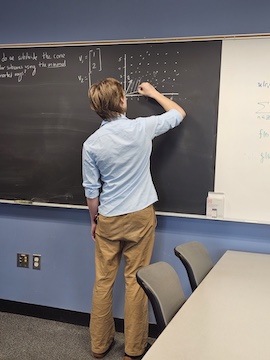 Over an eight week period this summer, the REU student participants collaborated in small research groups, tackling problems that span artificial intelligence, computational imaging, and pure mathematics, gaining firsthand experience in mathematical discovery, all while exploring the creativity and fun involved in math.
Teaching AI to solve geometry
One research team, led by Professor and Associate Dean of CASL Yunus Zeytuncu and co-mentor Alperen Ergur who teaches Mathematics and Computer Science at the University of Texas at San Antonio, explored the intersection of pure mathematics and artificial intelligence.
Working with students Felix Santiago (Princeton University), Ameen Hussain (Colorado State University) and Garrett Rhoads (Hamilton College), the team is combined discrete geometry with reinforcement learning to develop new ways for AI to solve complex optimization problems.
Rather than simply training artificial intelligence to recognize images or generate text, the researchers are teaching algorithms to navigate highly complex mathematical spaces. Specifically, their project bridges discrete geometry and reinforcement learning, aiming to teach AI algorithms to efficiently "smooth out" complex geometric singularities, a notoriously difficult optimization problem in higher-dimensional spaces.
"Much like DeepMind's AlphaGo learned to navigate the near-infinite combinations of a Go board to find the optimal moves, we want to train a reinforcement learning agent to navigate the tree of geometric subdivisions of a cone to solve our math problem," Zeytuncu explained.
By combining classical algebraic geometry with modern machine learning tools, these three undergraduate researchers are not only getting hands-on experience with advanced computational techniques but are actively contributing to open questions in the mathematical field right here at UM-Dearborn.
Restoring images through mathematics
Associate Professor Aditya Viswanathan led another team investigating applied mathematics through computational imaging.
This dynamic group brought together local and national talent, featuring Nicholas Yamine (UM-Dearborn) and Toby Shu (Georgetown University). The team looked at the intricate mathematics of signal processing and data-driven inverse problems to develop innovative new tools for image deblurring. Their work translates abstract mathematical theory into scalable computational algorithms capable of reconstructing higher-quality images from corrupted data, a critical, high-level problem with wide-ranging, real-world applications ranging from medical imaging to scientific visualization.
“Blurry images are a surprisingly common problem, from the Hubble Space Telescope's early, flawed photos to ultrasound scans to a picture you'd sharpen in Photoshop, " said Viswanathan. “Our project explores mathematically rigorous ways to characterize that blur and reverse it, and when it's better to use newer AI-powered methods instead”
Exploring the foundations of mathematical theory
Further enriching our vibrant summer research community, Professor John Clifford guided a dedicated team of researchers focused on functional analysis and operator theory. This cohort highlights our own rising, homegrown talent here at UM-Dearborn, students Greg Yeghiyan and Caleb Cadez. Together, they investigated the Berezin range of operators on Hilbert spaces, a highly theoretical area of mathematics that explores the geometry and behavior of complex mathematical structures.
While abstract, the work contributes to the broader mathematical foundation that supports advances across numerous scientific disciplines and continues the strong tradition of rigorous mathematical discovery cultivated right here on the UM-Dearborn campus.
Learning through discovery
Beyond the mathematics itself, the REU program provides students with an experience that mirrors graduate-level research. Participants collaborate closely with faculty mentors daily. They also 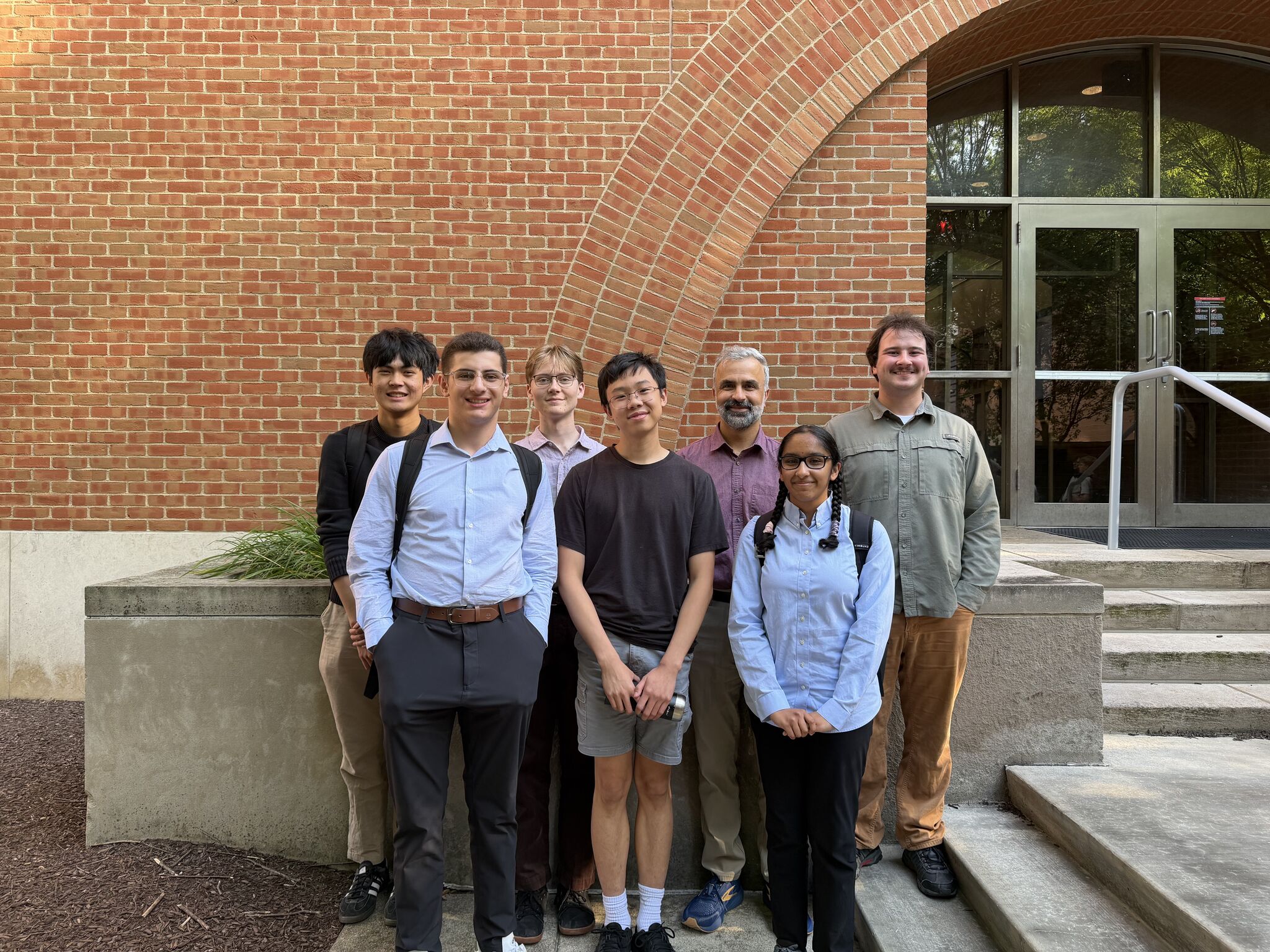 present their findings at conferences, such as SUMMR at Michigan State recently and the upcoming Young Mathematicians Conferences at Ohio State University - continuing their work beyond their time here on campus. Much of this involves the process of exploring questions that have no known solutions.
For many, that's what makes mathematics exciting.
When asked about the future of mathematics in the age of AI, student researcher Garret Rhoads said, “There’s really a lot we don’t know, which is why we (as humans) are so important in the process of using machine learning techniques to explore mathematical ideas.”
For faculty and students alike, the summer represents more than a research opportunity, it's a chance to build collaborations across institutions while demonstrating the power of undergraduate research at UM-Dearborn.


