

Most parents are well-versed in the fingers-crossed moments that accompany the battery of health screenings occurring shortly after the birth of a baby. Among the most universal is a hearing screening, which is typically performed before a newborn even leaves the hospital. Devin McCaslin, a U-M professor of otolaryngology and clinical director of communication sciences and disorders at Michigan Medicine, says the urgency in screening for hearing loss is indicative of just how important this sense is to the brain’s development. Undiagnosed hearing issues can seriously impact developmental milestones that occur in the earliest years of a child’s life, especially those related to speech, language, and certain cognitive and psychosocial abilities. By detecting problems early on, medical experts and the child’s family can proceed with a variety of interventions that can significantly improve childhood and a person’s long-term outcomes.
Hearing loss is actually relatively common in infants: It’s the number one congenital disorder, with approximately one out of 1,000 babies born with total or near-total hearing loss, and another two to three per thousand born with partial hearing loss. But hearing issues aren’t the only disorders of the ears. Our ears also play an extremely important role in our movement and motor development. Home to a set of complex sensory organs known as the vestibular system, the inner ear is continually sensing the movement of our heads, and the brain uses this information to help us balance. In adults, problems with the vestibular system manifest as dizziness and vertigo. And in very young children, whose brains are still developing, McCaslin says problems with the vestibular system could have large impacts on a child’s ability to develop typical gross and fine motor function.
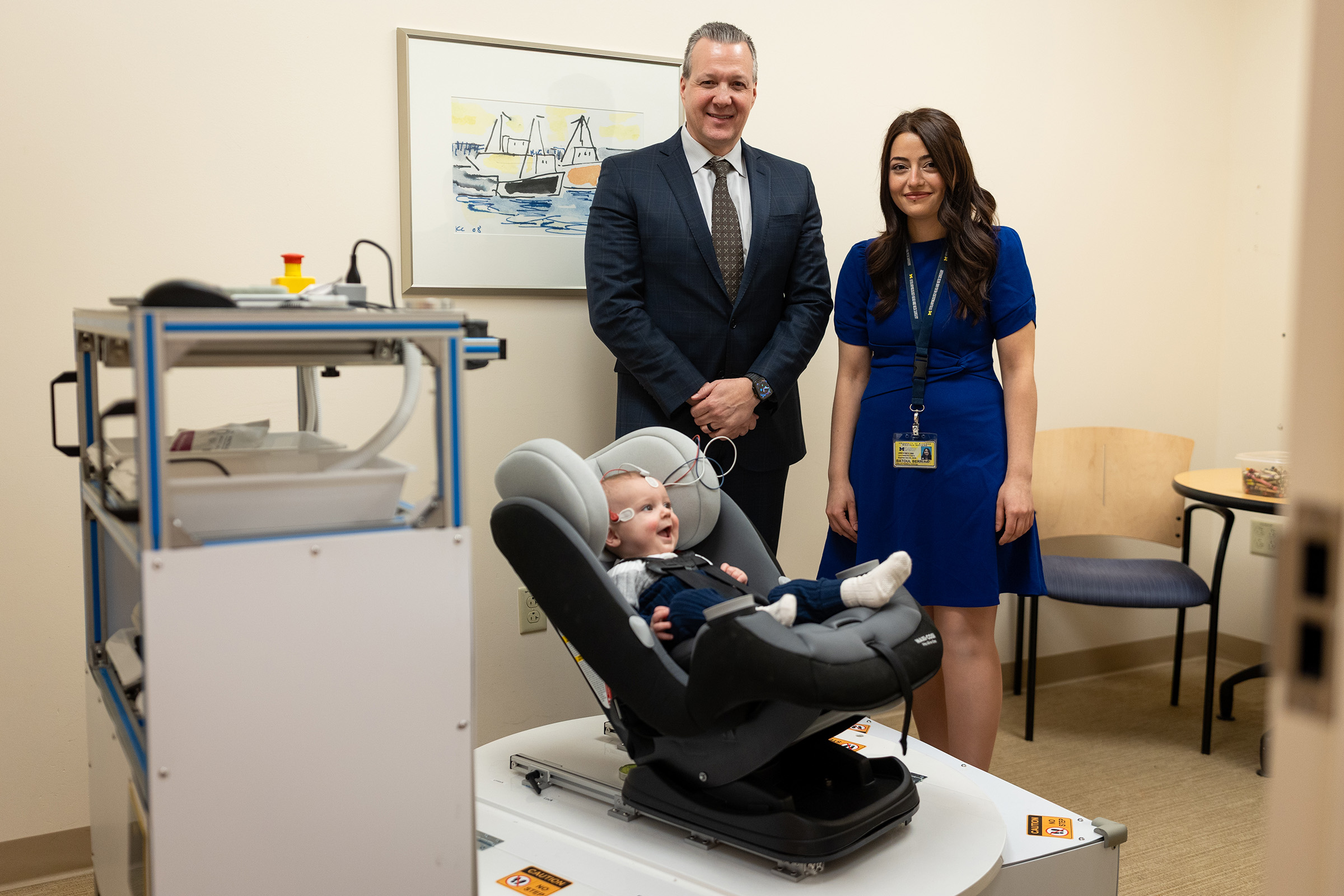
But just how big an impact undiagnosed vestibular issues can have on children — and even how common vestibular issues are — is still unknown. Batoul Berri, a pediatric audiologist at C.S. Mott Children’s Hospital and a colleague of McCaslin’s, says, unlike with hearing issues, there currently is no reliable way to detect vestibular disorders in infants using rotational chair testing, a commonly used modality for assessing vestibular function. Berri says this is largely due to the limits of existing technology and a lack of normative data in this population. In rotational chair testing, an adult patient sits in a specialized chair in a dark room, the head is stabilized, and then special goggles record eye movements as the chair swivels in different directions at different speeds. “We’re essentially looking at the eyes to tap into the vestibular system,” Berri says. “If I turn my head to the right, my eyes should go to the left, and vice versa.” But Berri says this same procedure doesn’t work for very little babies. For starters, you can’t strap goggles on a 1-month-old and simply ask them to hold their heads very still while tracking something with their eyes. It’s not even safe for very young babies to sit upright.
Given these constraints, McCaslin and Berri thought a rotational chair that was designed and built specifically for infants was their best shot at diagnosing infant vestibular issues. So McCaslin reached out to his longtime colleague Michelle Petrak, the director of clinical research at Interacoustics, a Denmark-based company that specializes in manufacturing equipment for diagnostic audiology and balance assessments. She liked the idea, and Interacoustics engineers and the U-M team began discussing designs for a prototype, building off the technology the company uses for its adult chair. Interacoustics provided funding for the project — as well as some critical hardware, software and in-kind support from Lead Software Engineer Lasse Kjaersgaard and others on their engineering team. When it came to building the chair, McCaslin says he got a little help from Armen Zakarian, the interim dean of UM-Dearborn’s College of Engineering and Computer Science. “I was discussing the project with Armen to get his advice on the feasibility of the project, and Armen said, ‘I think I have the right person for you,’” McCaslin remembers. That person was Kas Kasravi, a clinical professor of industrial and manufacturing systems engineering at UM-Dearborn, who is the college’s go-to expert for product development and patents. McCaslin reached out to Kasravi, who recruited three undergraduate students from the Human-Centered Engineering Design program, as well as Shawn Simone and Monica Somand from the Manufacturing Systems Engineering Lab and Associate Professor Georges Ayoub to help with the project.
Berri says she sort of expected they would share some of their design ideas with the UM-Dearborn team and then they’d get to building something pretty quickly. Instead, Kasravi led everyone through a very methodical process rooted in a thorough needs assessment of the medical team. For example, adult rotational chairs, bolted to the ground, have a whole room dedicated to them. But Berri and McCaslin wanted the infant version to be mobile, so it could be wheeled in on a cart and tucked into storage when not in use. That presented some immediate engineering challenges. “If we were asked to build a chair for infants in one room, it would have been easy,” Kasravi says. “Once a chair starts moving, you get some axial wobble. If it’s bolted to the ground, you’re OK. When you have a mobile device, that can create a whole suite of problems.”
Slowly but surely the team worked through the product development process: discovering needs and ranking their importance, balancing them to find the sweet spot between competing needs, coming up with engineering solutions for these needs, reassessing their approach as they collected feedback and, ultimately, building the chair. It’s not overstating things to say that the UM-Dearborn team of faculty, staff and students blew away everyone’s expectations. “One of the comments that came from the Interacoustics side of the fence is that we had signed an agreement for them to build a prototype of a baby rotational chair. And we had an expectation that it would look like a prototype,” Petrak says. “People are just mesmerized and amazed — it’s so much more than that. It’s so exquisite and perfect. It looks like a finished product. I don’t know how they got there.” Berri notes the methodical needs-based design process also left her with all kinds of bells and whistles that she never anticipated — like cubbies for storing the stuffed animals she uses to charm the babies and a laptop stand that’s “designed exactly for a person of my build.”
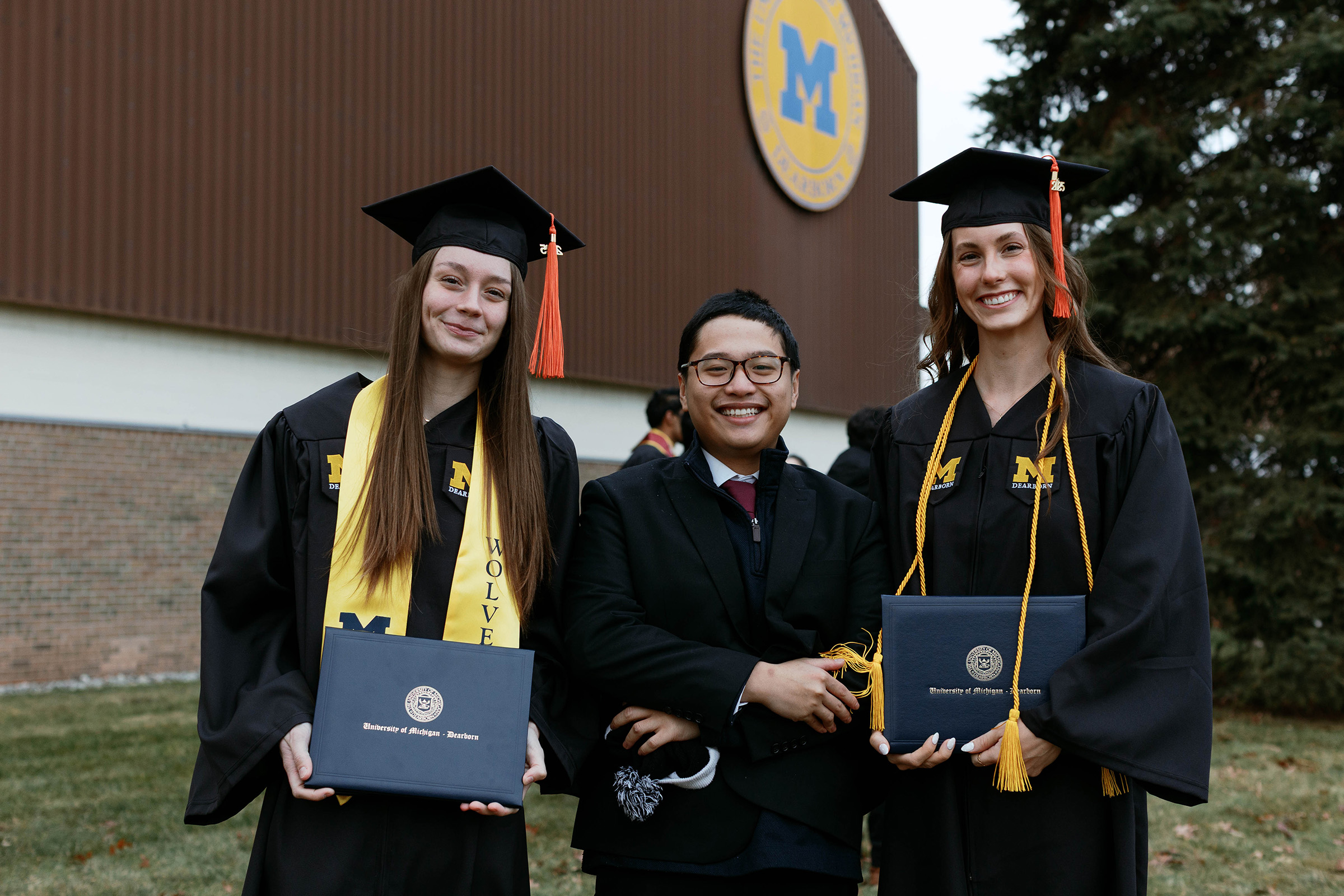
Kristin Maust, Zack Tran and Violet Vidosh, the three UM-Dearborn students from the product development team, say working on a project like this was extremely worthwhile — both educationally and personally. Engineering education has a reputation for being heavy on theory, and practical engineering expertise, including how to work with professional experts, often isn’t developed until a person is in the workplace. Vidosh, who graduated in December and has started a job as a program engineer at Ford Motor Co., says she already sees parallels between the rotational chair project and the work she’s doing now at Ford. “I think it was especially helpful to be able to work with people who are professionals at their jobs. It’s not like we were working just with other students. We had people giving us tasks that were real and they really knew what they were doing. That has a completely different feel to it,” Vidosh says. All three students say it was also meaningful to have a project that was so directly connected to human needs. Indeed, it’s hard to imagine a more satisfying assignment than one that helps babies and their families.
Petrak says the team has now filed a patent for the infant rotational chair, and Interacoustics plans to support the next phase of Berri and McCaslin’s research in this area. Berri is currently using the chair to collect baseline data on vestibular function in healthy infants. She’ll then begin screening babies from the NICU, as well as those with known hearing issues, as children with hearing loss often have vestibular issues. McCaslin says one outcome of the research could be a future in which infant vestibular screenings become as routine as hearing tests. “We don’t even know how prevalent vestibular issues are because we don’t screen every kid, and up until this point, we haven’t had a way to do it in babies,” McCaslin says. “We know from kids who are older, where we can screen the vestibular function, that their motor milestones, like walking and crawling, are delayed in kids who have abnormal vestibular systems. But by that time, the brain is already far along in its development. So our idea is by detecting problems early on, we can pursue interventions that can get things on track the best we can, similar to how we do for hearing. We know very well what the cost of having hearing loss is if you’re not diagnosed quickly. We need to investigate all the same questions with vestibular impairments. We’re literally at the genesis of this work.”
###
Story by Lou Blouin. Photos by Matthew Stephens


