

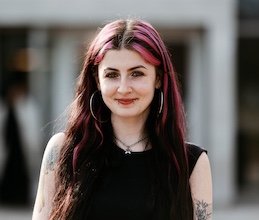
 Blog post written by Hunter Amo
Being a first-generation college student often means learning the system while already moving through it. As a first-generation student myself, I fully understand the pressures of being the first one in your family to navigate university life—and it’s not easy. It feels like you are running in a giant race and everyone else got a head start. A small relief, though, is that you aren’t alone. Around 44% of UM-Dearborn students are first-gens, and we are all going through the same nerve-wracking experiences that you are. We are transfers, commuters, workers, and caretakers, often all at once.
Like most of you, I arrived at college with only the knowledge of what I wanted it to be, but very little understanding of what it actually is. I had to learn the lingo as it came: credits, FAFSA, orientation, SAI. I smiled and nodded when walking along campus tours with fellow students, but spent late nights googling questions that I was too afraid and embarrassed to ask. I carried this dreadful sense of urgency at all times. Pick a college. Get the degree. Find a job. I soon learned, though, that college isn’t a direct pipeline to a solid resume—it’s an opportunity to learn, grow, and become a new person entirely.
Still, that sense of urgency, confusion, and being behind isn’t unique to me. It’s something that many other first-gen college students have to carry on their shoulders. Whether it shows up in navigating financial aid, questioning what college is for, or making decisions without your parents' guidance, these feelings form a shared experience. Though we may have different stories, the pressures are similar. And one of the earliest places these shared experiences take shape is in choosing a college.
This is so not what the brochures said
For many first-generation students, the college journey begins at what I like to call the “touring phase.” Roadtrips to new cities, walking around campuses without knowing exactly what to swoon over, and being fed random, rehearsed facts by tour guides that you aren’t quite sure what to do with. Standing there, it’s easy to wonder how anyone is supposed to choose. How do you decide if a place is the right fit for you when you’ve never seen anything like it before? When you don’t know what questions to ask, or which ones matter?
Some families are college families, through and through. They arrive with context: college traditions, familiar terminology, and stories that make the process feel manageable. Not you, though. Parents and guardians may be just as unsure, trying to absorb information alongside you, but not able to make sense of a system that they never entered themselves. On one occasion, I drove three hours to tour a university with my mother and left after the first half of the orientation session, all because it took us thirty minutes to find the right building. With a lack of guidance or obvious signage, we got lost twice. After what felt like an eternity, I looked at her, when everyone was grouping together to go on a tour and said, “Nah.” We quietly snuck away and then laughed in the car.
I’ve found that it’s okay to not know what to look for. I’ve transferred schools three times in my life—jumping from a university three hours away from home to community college and back to university, but now as a commuter. The key is placing trust in yourself. Check out the programs that universities offer and see how they align with your future career goals. Browse through their clubs and student organizations. Compare and contrast dorm room blueprints. Above all, keep in mind tuition prices and distance from home. Or, if you’re like me, judge a college based on how navigable it is. Choosing a college seems like a more difficult decision than it actually is, so don’t worry. If one university doesn’t work for you, there are always other options to choose from. Though our paths as first-gens are nonlinear, they are still valid.
Where is my "FAFSA for Dummies" book?
As first-generation college students, we are exactly that: the firsts. We don’t have family members and role models to help nudge us along, because they have never walked this path before. So, first-gens quickly learn to make choices without fully knowing their outcomes. Without examples to follow, first-generation college students are navigating unknown territory. It’s easy for us to feel unsure, even when we are doing well. The lingering pressure of getting the most out of our college experience claws at our throats; expectations set by ourselves and others can be exhausting. And don’t get me started on financial aid.
Financial aid is a major area of hesitation and confusion surrounding college, especially for first-gens. Suddenly, numbers and tax brackets start to hover over our educational goals. With the weight of grants, scholarships, and student loans, we are forced into a financial situation that seems to have no room for error, which only makes us more stressed, even when we are doing all the right things. While these worries are isolating and rarely spoken about, they are silently shared by many of us.
Can we skip to the lifelong career, please?
College is more than a transaction. Many first-generation college students arrive on campus and think that the university needs to justify itself immediately. I remember feeling like an outsider in elective classes that had nothing to do with my major, but were needed for a degree. Sometimes I get frustrated, after building up these huge expectations in my mind, because I wasn't exhausting myself to get a piece of paper that says “B.A.” on it. I thought I was somehow a shame to my family because I was taking “Introduction to Sociology” instead of “Class that lands you a job A.S.A.P.”
Learning something that doesn’t seem directly useful to your career isn’t a waste of time, energy, or money. First-generation college students are slow to realize that education fundamentally changes how we think, not just the amount of money we will someday earn. Within our families, this sometimes causes friction—as an English major, I frequently get asked, “What job will you get with that degree?” And though I get annoyed, I have to remind myself of where my family is coming from. My parents and grandparents grew up in trade schools or went straight from high school to a pension. They have a distinct mindset shaped by the promise of a steady path. Their framework was grounded in survival—mine was slowly expanding in ways neither of us could fully see yet.
What I’ve come to appreciate most is that this tension is something many first-generation students recognize. The difference between what college looks like on paper and feels like in reality is something that we come to experience firsthand. It shapes the way we think and understand the world around us. The degree itself is important, yes, but the process of learning how to discover our own interests and grow independently is just as crucial to our career paths. For first-gen students, that transformation often feels invisible to others, and yet it defines our college experience.
My final words
If I were magically transported back in time to that daunting “touring phase,” as I was telling you all about, there are many things I would do differently. Invest in stocks, for one, but also find my younger self and tell her that things are going to be alright. There is no right or wrong answer to choosing a school. And just because I’m majoring in English doesn’t mean I can’t have fun in some non-English classes. I would take my younger self by her freckly face and say, “Listen, kid, you are literally paying to go to school, and you need some electives, just take the pottery class and be happy about it.” And younger me would love that pottery class, uncaring if anyone dared to question the validity of her education, only because some of her classes didn’t directly translate into a six-figure career.
Looking back, the challenges I faced—touring, financial aid, classes that didn’t feel useful—were all part of a larger process of learning and self-discovery. I realized that college isn’t four years of torture, followed by a degree. It’s a fountain of fulfillment. For first-generation college students at UM-Dearborn, these experiences are shared, shaping who we are today and who we will become tomorrow.


