

FOR IMMEDIATE RELEASE
October 28, 2026
Contact: Kristin Palm | [email protected] | 313-593-5542
The University of Michigan-Dearborn has been named to a new national consortium to accelerate the transition of battery energy storage solutions from discovery to domestic manufacturing.
The effort, led by the U.S. Department of Energy’s Pacific Northwest National Laboratory, is known as the Battery Manufacturing (BattMan) Accelerator. Jie Xiao, the Boeing Martin Professor of Mechanical Engineering at the University of Washington and a Battelle Fellow at PNNL, will serve as the accelerator director. “Breakthroughs in battery science must be matched by our ability to manufacture them at scale,” said Xiao. BattMan will bring together national laboratories, universities and industry partners to address critical barriers in scaling next-generation battery technologies. The accelerator will focus on lowering manufacturing costs, speeding up development from the lab to commercial scale, and boosting U.S. leadership in energy storage manufacturing.
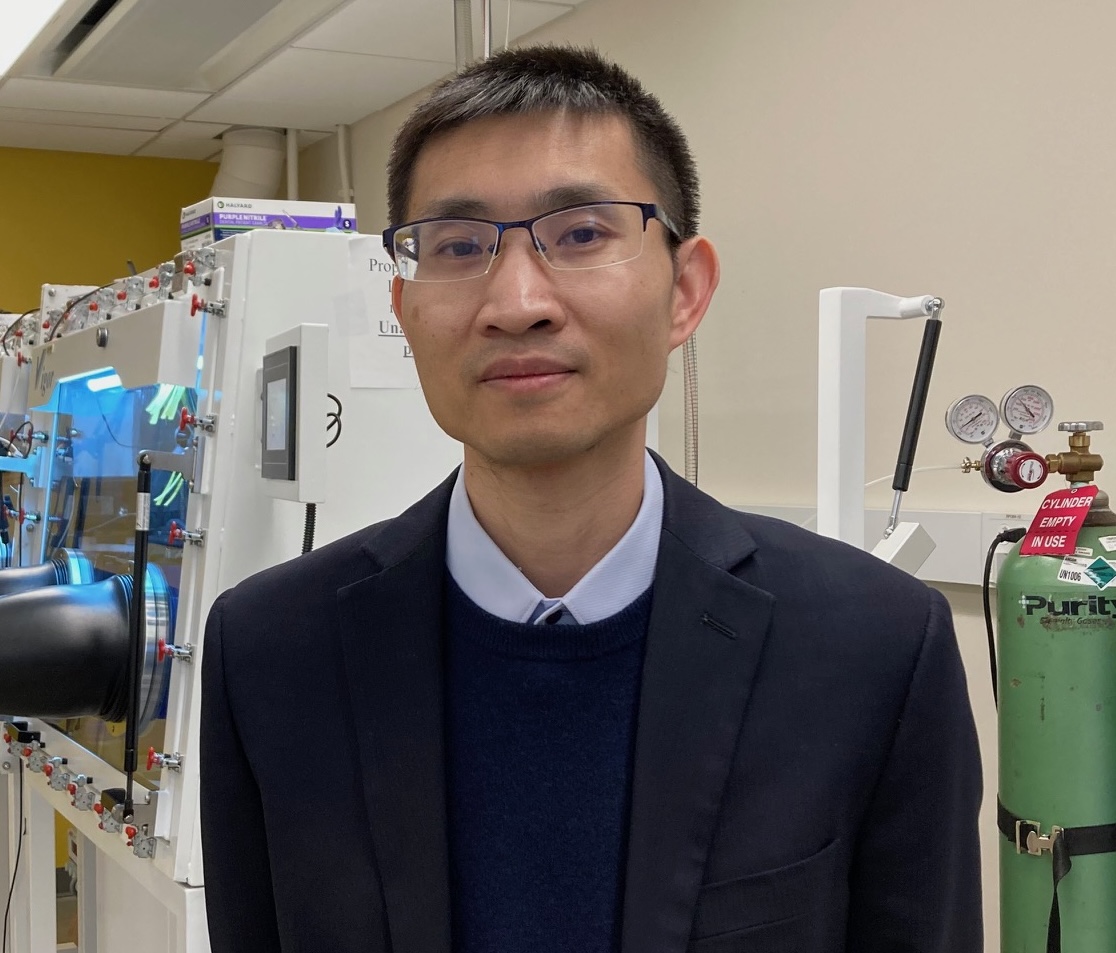
Associate Professor of Mechanical Engineering Lei Chen will serve as the co-principal investigator from UM-Dearborn. Chen is also affiliated with the electric vehicle center (EVC) at University of Michigan. He noted that the accelerator’s goals align closely with EVC’s efforts to advance battery safety, sustainability and manufacturing efficiency, and to train the next generation of EV engineers.
“As we become increasingly reliant on stationary energy systems, continued advancements in battery manufacturing will be integral to keeping the U.S. at the forefront of innovation and competitiveness,” Chen said. “This consortium brings together the technologies, data and partnerships needed to accelerate market-ready solutions and quickly scale them for Michigan’s auto industry and many other sectors.”
Chen’s research contributions will focus on super intelligence-driven modeling and computational simulations for battery manufacturing. In addition, he will be developing and teaching a course on super intelligence for battery manufacturing to help train the future workforce in this critical area.
UM-Dearborn is one of five university partners in the consortium. The others are Arizona State University, Binghamton University, University of Alabama and University of Washington. Argonne and Oak Ridge National Laboratories are also partners. DOE announced the consortium earlier today.
The accelerator is actively establishing collaborations with companies within the battery and materials manufacturing sector.


