
Guide to Informational Interviewing
Informational Interviewing Guide
An informational interview is an opportunity to connect with someone who is currently working in your field of interest to gather information about that particular occupation/career, provide some basic information about yourself, and ask for advice and guidance from the person. It's not the same as a job interview, and it's not an opportunity to ask the person for a job - it's about expanding your network, getting first-hand information about a potential career field, and maybe even finding out about career paths you didn't even know existed!
These people can help you:
- understand the skills, experiences, and type of education you will need in order to excel
in a particular field - learn about the realities of working within that field, industry, specific position, or
organization - create connections for future opportunities
Who should you talk to about careers? You may not know someone who is specifically in your field of interest, but you might know someone who knows someone! The psychologist Stanley Milgram called this the theory of Six Degrees of Separation. It is the idea that all people on average are six, or fewer, social connections away from each other. So, who in your life can you
reach out to?
Think about the people listed below, and don't forget to create your LinkedIn profile and join the UM-Dearborn Job Club.
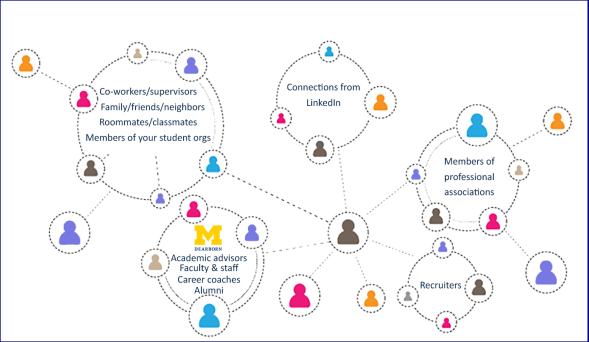
While these people may be happy to help you, you need to make the first move. In today's world, reaching out via email or LinkedIn are probably the most common ways of making that connection. Don't forget to start with personal connections - for example, ask a professor if they know someone in a particular field, and if so, if they would introduce you to that person.
When crafting your message, share who you are, how you found out about them and ask for a short conversation and their preferred method of meeting.
Introductory Message Example
Subject line for email: Informational Interview Request from a UM-Dearborn Student
Hello [title such as Dr. or Professor if known and last name or first name last name],
My name is [your name], and I am a junior studying Psychology studying at the University of Michigan-Dearborn. I noticed on the UM-Dearborn Alumni Group on LinkedIn that you work in the field that I am interested in pursuing. I am wondering if you have 15-30 minutes for a short video chat or phone call? If so, could you provide some dates and times that work for you and I will set that up? If not, do you know anyone who might have time to speak with me about [your field]?
Thank you for considering.
Sincerely,
[Your Name]
Now that you’ve secured the informational interview, it's time to get ready! Reflect on what you would like to learn from this experience, and formulate questions to get the most out of the conversation. Since you requested this, you need to be ready to drive the conversation - remember, this is an opportunity to not only learn more about your field, but to make a networking connection. You want to make a good first impression!
Know yourself: be prepared with a short introduction of who you are, what you are studying, and why you are interested in the field the person is in. This is also known as an "elevator pitch" - if you need help getting started, check out this guide.
Know the field: the point of this interview is to learn more, but you should know the basics of the career field/position of the person meeting Use tools such as My Next Move or the UM-Dearborn’s Mardigian Library College Life & Career Databases to research.
Know your goal: you're meeting with this person to learn more about their field/career path. Be ready with questions that will meet the goal of why you wanted this meeting
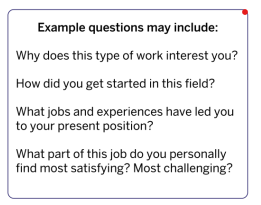
The day before the meeting, email to confirm the date, time, and location/Zoom link, etc. If the meeting is in person, confirm that you know exactly where you are going. For virtual meetings, be sure to double-check that everything - camera, sound, software - works as you expect. Also
be sure to set up your environment as best as possible: no window behind you, camera at eye level, simple background, good lighting, etc.
On the day of the interview:
- Dress appropriately, just as you would for a job interview
- Have your list of questions ready
- Start the conversation by thanking them for their time and use your brief introduction/elevator pitch to reiterate the purpose of the meeting
- Keep in mind that you need to guide the conversation, but also allow the conversation to flow naturally and encourage the interviewee to do most of the talking
- Be conscious of time. If you are getting close to the amount of time that was originally agreed upon, thank them for the opportunity and be respectful of their time. Afterwards, send a thank-you email or card to express your appreciation of their time, just as you would after a job interview.
Example Thank You Message:
Subject line for email: Follow-up from our recent meeting
Dear [Person's Name],
Thank you for meeting with me today to talk about [their work, their field, industry, etc.]. I now have a much better understanding of a possible career field in [the field discussed] utilizing my [name of major] Degree. It was helpful to hear the educational path you took in order to achieve your position. I have decided to [apply for XX position, graduate school, pursue XX, reach out to someone they recommended, etc.]
I appreciate you taking the time to meet, and would like to thank you again for your time and advice. If anything comes up that you think would be helpful, please let me know.
Notes you took during the interview
If they gave you permission to keep in touch, be sure to do so by updating them occasionally on what you are doing. Be sure to ask how they are as well! Best,
[Your Name]
Keep a record of who you've talked to in case you want to follow up later. Include
- The person's name, contact information, date of the information interview and follow up
- Source for each person - who connected you with them, where did you find them