

Artificial intelligence and nature may seem like an unlikely pairing. But UM-Dearborn students are bringing them together to help people identify birds, monitor wildlife, support community conservation and make the outdoors more accessible — all while gaining the practical skills needed to prepare them for the workforce.
Meriam Harissa and Jodi Joven, two recent College of Engineering and Computer Science alums, created a new technology that makes it easier for wildlife enthusiasts — including those with visual impairments — to engage with wildlife. With their senior design team, they built Robin, an AI-powered app that identifies birds and provides information about the species.
Throughout the project, Harissa says they weren’t just studying machine learning or software development. The project taught them how to better collaborate, solve real problems and build technology that people can use.
“Working on Robin was incredibly valuable in preparing me for my career,” says Harissa, who graduated in 2025 with a bachelor's degree in software engineering and now works at Ford as an over-the-air technical test management engineer. “There were many moments throughout the project when we had to step outside of what we already knew, learn something new, experiment and continue working through challenges.”
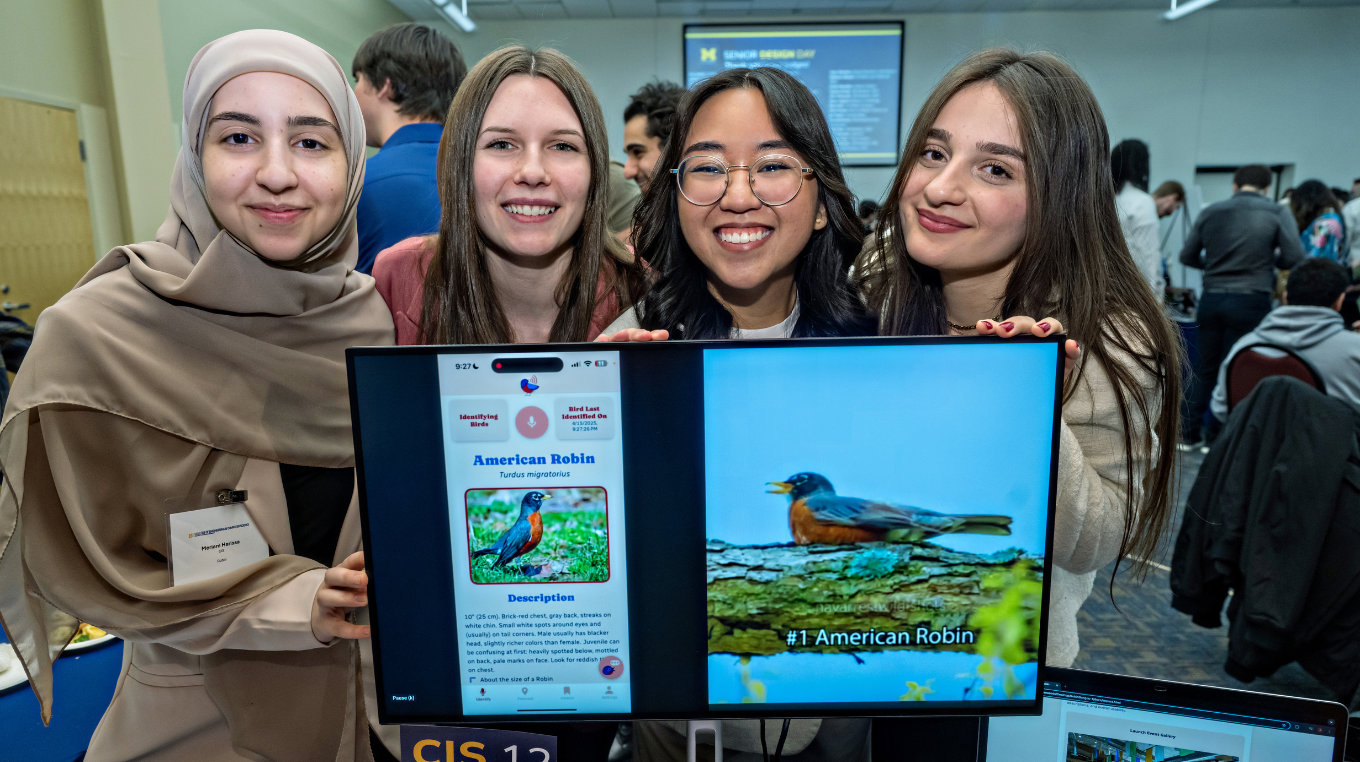
By the time the project was complete, Robin had grown from an early prototype into a publicly available app in the Apple App Store, earning multiple awards along the way. “Real people use and rely on what we built, and that's exactly what I do now as an engineer: write and ship code that people depend on,” says Joven, who earned her bachelor’s degree in computer science in 2025 and now works as a software engineer at Rocket.
For Associate Professor of Computer and Information Science Zheng Song, that's exactly what practice-based learning is meant to accomplish. Song watched the Robin team grow as they communicated with partners, such as the Environmental Interpretive Center, and guided the app from an early prototype to a finished product. Joven demonstrated leadership in user experience design, he says. While Harissa showed talent in machine learning and potential for doctoral study.
Another team guided by Song developed Bird Eye, an Internet of Things prototype that combines microphones, cameras and AI to monitor bird activity in natural areas. The system is designed to work alongside environmental experts by identifying birds, capturing images of species the AI struggled to recognize and helping improve future AI models. Song also worked with students on Frog Watch, an AI-powered app that aims to help volunteers from Friends of the Rouge modernize their annual frog survey.
For Song, projects like these help students see AI differently. “A lot of students initially feel like, ‘What I’m learning is theory, but I don’t know how it can be applied.’ Then, all of a sudden, they realize, ‘Oh, my work can actually make a real-world impact.’ I see that shift happen a lot, and it becomes a powerful motivator for them,” he says.
While much of the public conversation around AI focuses on what the technology might replace, Song encourages students to think about who it can help.
“AI is already becoming part of our daily lives, and that will continue to grow in the near future. Many of us already use tools like ChatGPT to polish our writing or improve emails, but AI will soon become much more capable. It has the potential to support many aspects of our everyday lives,” he says. “Everyone should have the opportunity to benefit from these rapid advancements.”
While textbooks struggle to keep up with advances in AI, practice-based learning gives students opportunities to experiment with emerging tools as they appear. “I feel like it’s a great supplement to what we’re teaching,” Song says. “Students get the opportunity to learn what is new and what is at the forefront of the field, and that knowledge can help prepare them to find jobs.”
Song serves as one of the faculty advisers for the Artificial Intelligence Club, which last year hosted AI4All, a campus initiative that introduces students from every discipline to practical AI applications. The series, which returns this fall, aims to help students from all majors understand how AI can be a tool for solving problems in their own fields with workshops exploring AI in health care, education, accounting, career readiness and the environment.
Story by Kathryn Bourlier Kronner, photos by Michigan Photography


