
Lab Sustainability
UM-Dearborn’s Sustainable Labs Program aims to increase awareness of sustainable lab practices and design programs that make it easier for lab personnel to participate.
If you have questions or ideas for lab sustainability initiatives, please contact Facilities Operations’ Sustainability & Energy Team at [email protected].
Pipette Box Recycling
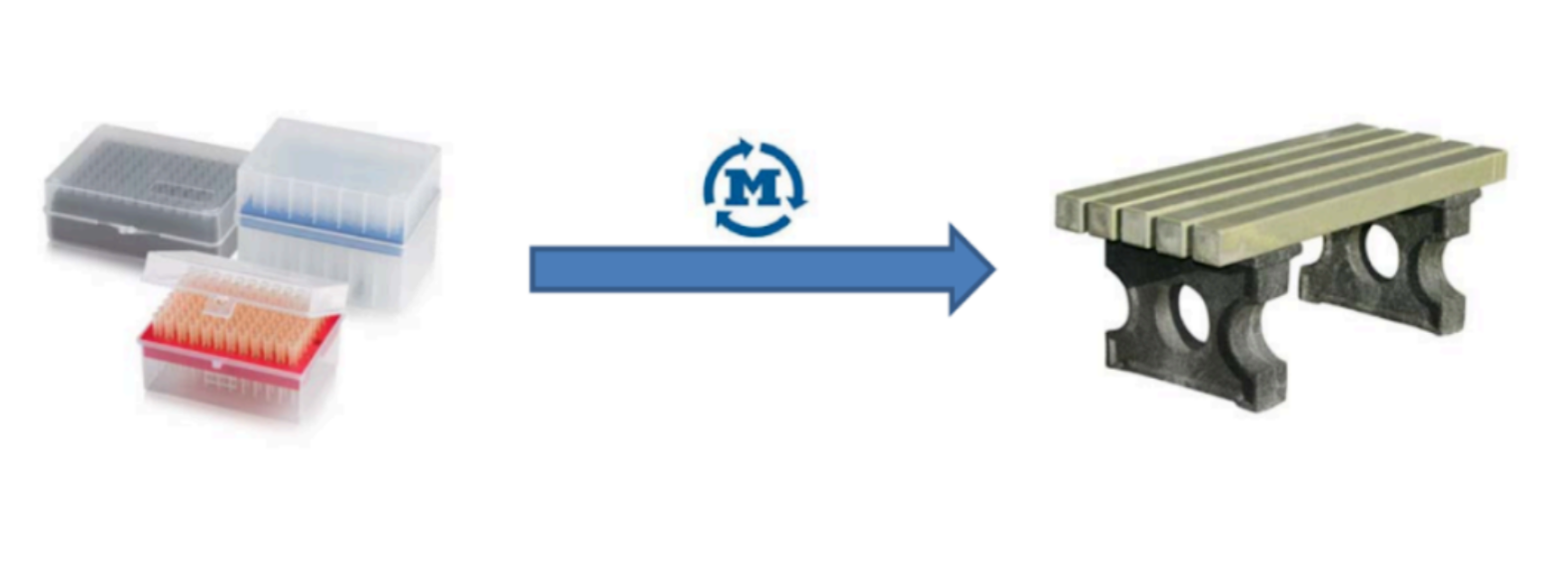
UM-Dearborn Natural Science labs can now recycle empty, uncontaminated pipette tip boxes. This free pilot program provides pre-labeled shipping boxes to store in your lab as a collection bin for empty pipette tip boxes and box inserts.
- Fill out this Google Form to express your interest, then pick up the pre-labeled shipping box from the Chemistry Dispensary (room 2036 on the second floor of the Natural Science Building).
- Fill the shipping box with empty and uncontaminated pipette tip boxes only (NOT the pipette tips themselves).
- Follow standard NSB shipping procedures
- After the boxes have been shipped to Thermo Fischer’s recycling partner, the boxes will be remanufactured into Wood Plastic Composites (WPC). WPC is a material used to create products like park benches and outdoor furniture.
Foam Recycling Pilot
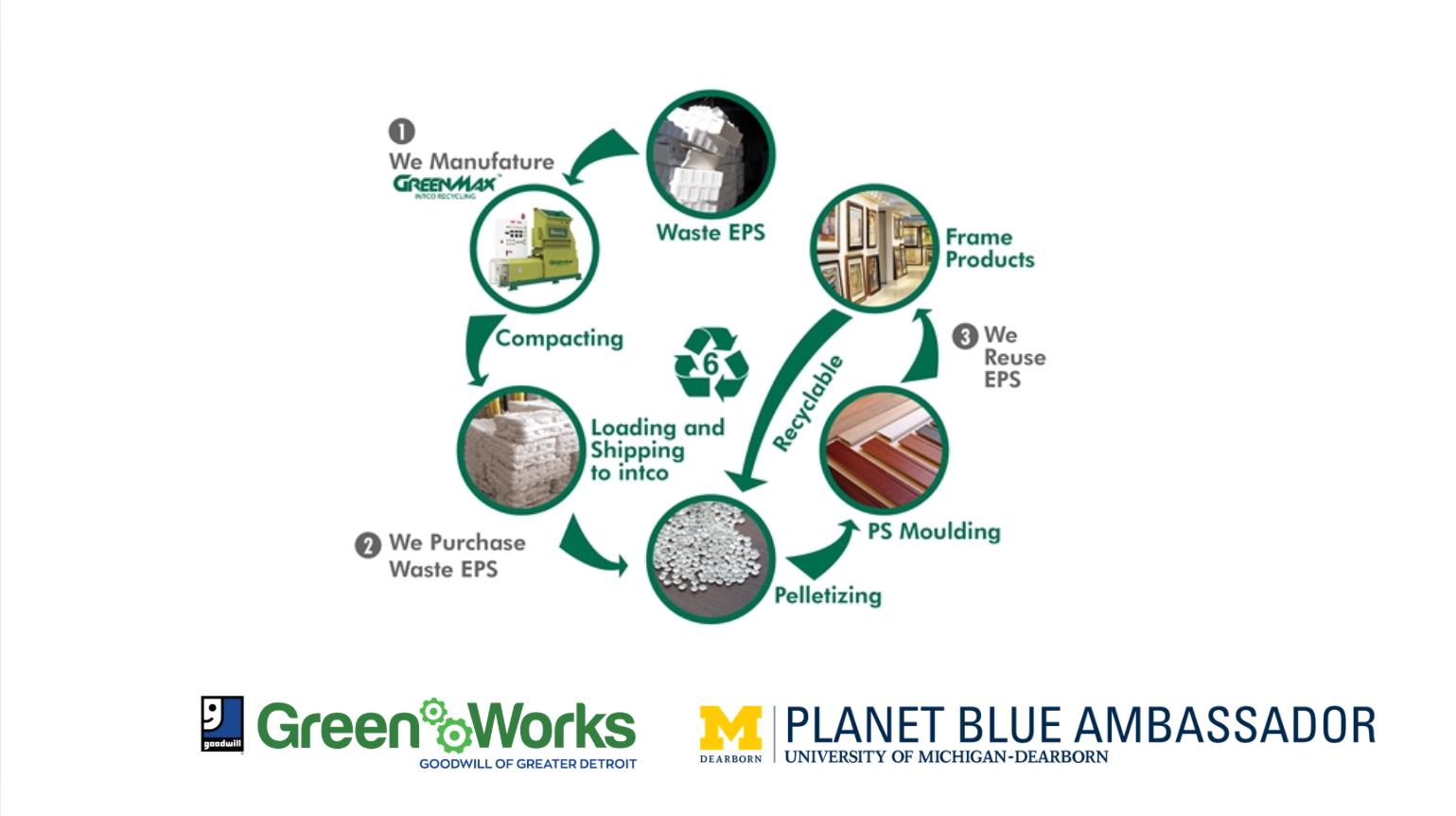
Image Credit: Goodwill GreenWorks
Expanded Polystyrene (EPS), or foam, commonly recognized by the brand name Styrofoam, has many beneficial qualities in lab settings. The downside is that most single stream recycling programs do not accept foam.
After observing few opportunities to reuse EPS within UM-Dearborn’s labs, and limited opportunities to recycle it in the area, several UM-Dearborn departments came together to pilot a special foam recycling program in partnership with GoodWill GreenWorks.
You can drop-off foam for recycling at the following locations:
- Natural Science Building service drive near the exterior dumpsters. Please place your items in the designated rolling bins, not the dumpster.
- Natural Science Building, 1st floor room 1035
- Engineering Lab Building, 1st floor near room 1544
Natural Science Lab Collection Sites
Natural science laboratory personnel can dispose of unwanted Expanded Polystyrene (EPS) materials in the central collection totes located on the west side of the Natural Science Building near the dumpsters. From inside the Natural Science Building, you can access this central drop-off location using the exit door to the right of the Greenhouse on the first floor. After you place your EPS materials in the totes, the Facilities Operations Sustainable Operations Intern logs the volume and weight of the materials, then delivers the materials to the Goodwill drop-off on Michigan Ave.
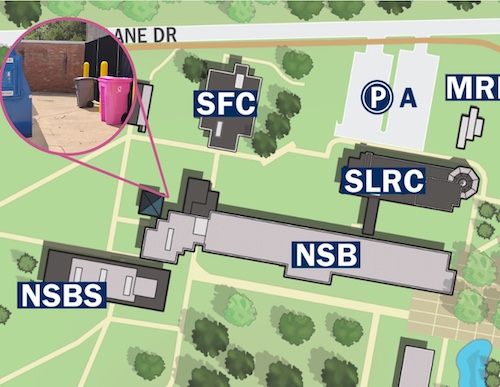
Map of central EPS drop-off spot located behind the Natural Science Building.
Engineering Lab Collection Site
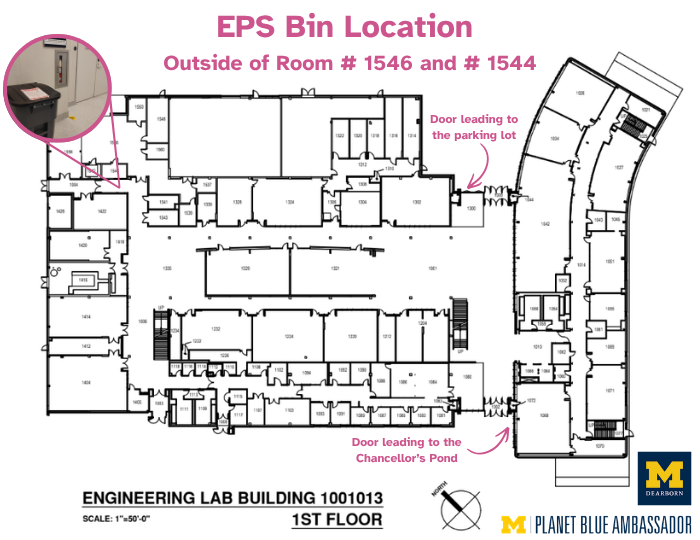
Engineering laboratory personnel can dispose of unwanted Expanded Polystyrene (EPS) materials in a collection tote located on the north side of the Engineering Lab Building, near the shipping and loading dock (between rooms #1543 and #1544). After you place your EPS materials in the collection bin, the Facilities Operations Sustainable Operations Intern logs the volume and weight of the materials, then delivers the materials to the Goodwill drop-off on Michigan Ave
National Freezer Challenge | January 5 - June 1, Annually
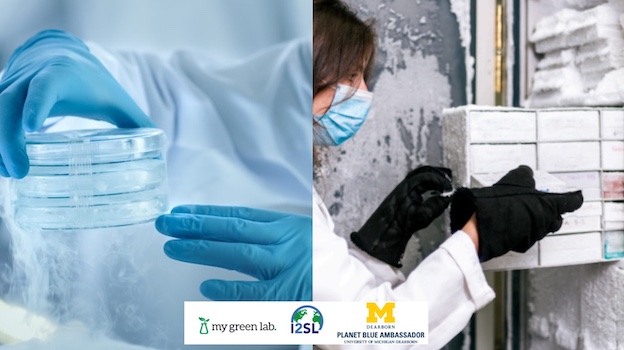
Want to enhance your lab's sustainability with minimal disruption to your current lab workload? The International Freezer Challenge, hosted by My Green Lab and the International Institute for Sustainable Laboratories, hosts a free, flexible, and annual competition that promotes efficient cold storage management in teaching, research, and industry labs. This challenge is for any lab on the University of Michigan-Dearborn’s campus, and is highly encouraged for the Natural Science and Engineering research labs.
- International recognition for your sustainable lab and research efforts!
- Learn and operationalize best practices for freezer management.
- Reduce freezer energy use and costs.
- Receive recognition for helping UM-Dearborn reach its carbon neutrality goals.
- Help undergraduate researchers gain leadership & project management skills.
- Earn points toward a My Green Lab Certification.
Any research or teaching lab on campus that has a freezer can sign-up and participate in the Freezer Challenge anytime between January 5th and June 1st, 2026. There is no disadvantage to registering after January.
Participating labs have a score sheet on MyGreenLab’s website tracking their efforts to optimize cold storage practices. These items are estimated to take lab personnel only two to three hours per month to complete, and there are no penalties for not completing them.
As pulled from the Official Rules, the challenge essentially follows these steps:
- Set up your lab on the platform
- Select actions for the Freezer Challenge
- Work with lab personnel to complete actions
- Motivate your team to participate
- Complete an accurate score sheet
As a Freezer Challenge participant, you can complete some or all of recommendations listed below. You do not have to complete everything on this list to participate or to earn awards. See the Official Rule Page or My Green Lab Webpage for more information.
Preventative Maintenance
- Full Defrost of Freezers
- Clean Filters, Coils, Intakes
- Brush Frost from Cabinets & Door Seals
Materials Management
- Remote Monitoring Systems
- Update Inventories
- Discard Unneeded Samples from Units
- Record the number of samples discarded (if known)
- Transition to Higher-Density Sample Formats
- Do units have racks to increase storage capacity?
Temperature Tuning
- Adjusting ULT Freezer Set Points (not required but recommended if this is possible while still preserving samples!)
- Samples moved to warmer temperatures
- Identify the total quantity of samples or other items that you moved from a colder storage temperature to a warmer storage temperature, across all the cold storage units for which you did this.
Retirements & Upgrades
- Retirement of Cold Storage Units Without Replacement
- Method of Disposal
- Energy Efficient Upgrades
Cutting-edge Practices
- Sharing Cold Storage Space
- Barcoded Inventories
- Trialing Room Temperature Sample Storage
- Implemented Room Temperature Sample Storage for Reagents & Kits
- Adopted RTSS for Lab Materials