
Writing Awards
The University of Michigan-Dearborn Writing Awards promote and recognize excellence in writing among undergraduates.
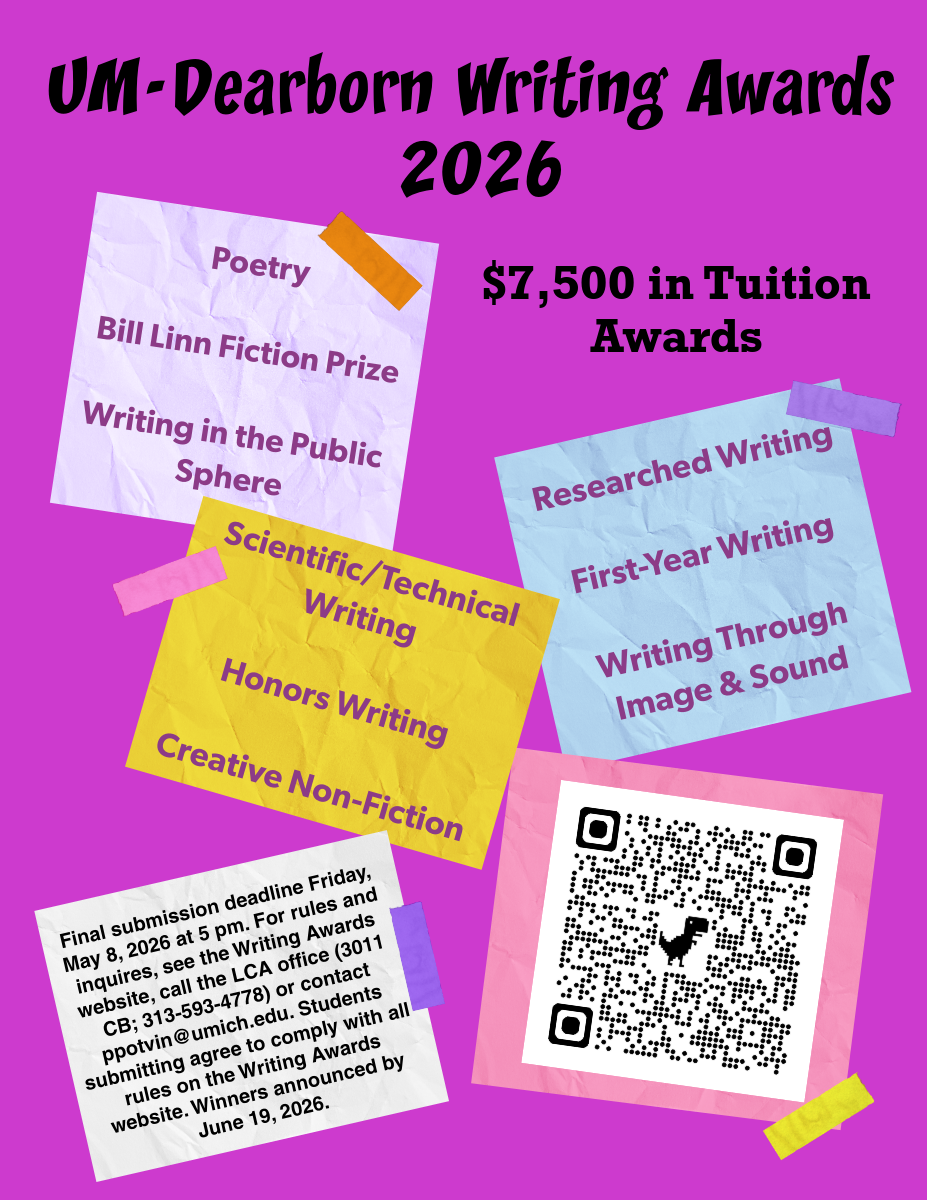
Awards will be made in the following categories:
- Poetry
- Bill Linn Fiction Prize
- Researched Writing
- Creative Non-fiction
- Writing Through Image and Sound
- Writing in the Public Sphere
- First-Year Writing
- Honors Writing
- Scientific/Technical Writing
$7,500 in total awards. Awards are made possible by the Office of the Provost and the UM-Dearborn Annual Fund.
The Bill Linn Fiction Prize is funded by the family of Professor Bill Linn as a tribute to his love of literature and teaching. The family hopes award recipients treasure their gift of writing and use it to enrich the lives of others.
Final submission deadline Friday, May 8, 2026 at 5 pm. For rules and inquiries, see the Writing Awards website, call the LCA office (3011 CB; 313-593-4778) or contact [email protected]. Students submitting agree to comply with all rules on the Writing Awards website. Winners posted by June 19, 2026.
Rules subject to update
Eligibility
If you're an undergraduate enrolled at the University of Michigan—Dearborn for at least six hours during the Summer 2025, Fall 2025, or Winter 2026 semesters, you’re eligible to enter the Writing Contest.
You may submit work in up to three categories but only one entry per category. You may not submit the same entry in multiple categories. Winning a first-place award in a category makes you ineligible to enter that category in subsequent years.
All entries must be your original work; for collaboratively-created projects, include the names of all authors/creators and detail the contributions of each individual on the entry form.
Entries may not have been previously published (except in student publications).
Final submission deadline is Friday, May 8, 2026 at 5:00 p.m. Winners will be posted by June 19, 2026.
Awards will be reviewed and approved by the University of Michigan-Dearborn. In the case of debts owed to the University, awards will be applied to outstanding balances.
Required AI Disclosure: You are required to disclose specific AI use in your writing. If you fail to accurately disclose your AI use, you risk forfeiting your award.
Award winners in the Bill Linn Fiction Category agree to have their work shared privately with the Bill Linn family.
Categories
Poetry: May be of any length. Up to 3 poems as a single entry
Bill Linn Fiction Prize: Up to 30 double-spaced pages; one story per entrant
Creative Non-fiction: Up to 30 double-spaced pages; one essay per entrant
Honors Writing: Writing completed for any Honors course, including COMP 110 & 220
First-year Writing: Writing completed in COMP 105, 106, 227, 270 & 280
Researched Writing: e.g., the critical essay or other researched writing making use of secondary and/or primary sources; up to 30 double-spaced pages
Writing Through Image and Sound: E.g., Web-based writing, digital films with scripts, music and scores, projects that incorporate both text, sound, and/or visual elements
Writing in the Public Sphere: Writing completed in Academic Service-Learning courses, service learning or community-based writing projects, projects related to advocacy or activism, writing about current events
Scientific / Technical Writing: Writing completed in COMP 270, researched projects and/or investigative reports in engineering and natural sciences
Manuscript Format
To ensure objectivity, you must invent a Pen Name. A pen name is a fictitious name that is not your legal name. Your legal name can only appear on the entry form. Neither the judges nor the administrators of the contest will know your identity until the winners have been determined. Type your pen name only on every page of your manuscript.
Each written manuscript must be typed, double-spaced, and uploaded using the online submission system. Label your file with the title only (or titles, for poetry) of your manuscript, ex. Tom's Left Foot.doc.
For multiple media projects that include sound/pictures and/or video that exceed data uploading restrictions, submit a link to your work online via Word document and follow the regular submission process.
Submission
If you would like to enter the writing contest, make your submission by using this form: 2026 UM-Dearborn Writing Awards
Congratulations to the winners of the 2026 UM-Dearborn Writing Awards
Special thanks to our UM-Dearborn judging panel and external judges:
Lauren Cabrera, Jon Haller, Reb Livingston, Tony Luckett, Kyhl Lydndgaard, Esther Okonkwo, PF Potvin, Alicia Schaeffer, John Taylor
Researched Writing
First Place: Zeinab Farhat, “Cultural Identity in College: Comparing First-Generation and Non-First-Generation College Students ” (tied for 1st place)
First Place: Sararose Morabito, “826 Valencia: A Community Literacy Case Study ” (tied for 1st place)
Second Place: Zachary Esper, “The Danger of U.S. Pesticide Exports and Regulation ”
Honorable Mention
- Sara Baalbaki, “The Impact of Sleep Deprivation on College Students’ Academic Performance ”
- Rasha Al Maliki, “The Impact of Parental Divorce on Childhood Trauma ”
Science/Technical Writing
First Place: Jennifer Winston, “Commentary: A Discussion of Language and Ethics ”
Second Place: Resul Ilmammedov, “UM-EMBED: An Open-Source Modular Embedded Systems Platform for Engineering Education”
Writing in the Public Sphere
First Place: Lola Sudderth, “Heat as Punishment in Prisons: An Analysis of Interests, Ideas, and Institutions ”
Second Place: Salma Talha, “Feminist Rhetorical Criticism Essay: Legally Blonde Movie”
Third Place: Aya Saleh, “Stories from Our Elders” (tied for third place)
Third Place: Madilynn Vaughn, "Writing Center Autoethnography: Literacy, Access, and Intergenerational Educational Mobility" (tied for third place)
First-Year Writing
First Place: Lea Hydous, “Where Peace and Distance Meet ”
Second Place: Zaina Zwendwa, “Protecting the Hands That Feed Us: A Deep Dive Into the Use of Pesticides ”
Third Place: Sandri Juliani Méndez Pinales, “Who Gets to Eat Steak”
Honorable Mention
- Kathryn Arnold, “Traffic in America”
Margaret Delaney, “Archival Adventures ”
Honors
First Place: Kendall Newman, “Cure Detroit’s Healthcare System”
Second Place: Maria-Yoana Vasileva, “The (Unwalkable) Path to Understanding Westland, MI”
Third Place: Jennifer Winston, “Is Privacy a Luxury or Necessity?”
Honorable Mention
Triana McEachren, “The Anatomy of Commonwealth v. Yasipour ”
Writing Through Image & Sound
First Place: Salma Talha, "Zine Magazine Feminist Advocacy Project"
Second Place: Wren Snyder, "A Preventable Sin"
Third Place: Veronica Cham, "The Anniversary"
Honorable Mention
- Saumya Aurora, "The Fairest Nonverbal Communication of All"
- Navya Sarapadi, "Interstellar: The Space Saga"
Bill Linn Fiction Prize
First Place: Amo Hunter, "Meat"
Second Place: Roan Buehner, "No, Really, I Can Breathe Underwater"
Third Place: Grand Shearer, "Teeth"
Honorable Mention
- Veronica Cham, "Pharus Grove"
- Maria-Yoana Vasileva, "The Rebirth"
Poetry
First Place: Mackenna Shaw, “All I Know Is…”
Second Place: Zarsha Sultan, "What We Carry Through the Dark"
Third Place: Madilyn Vaughn, “Magic in the Sky”
Honorable Mention
- Zanab Al-Bedany, “a honeyless spring”
- Dominic Gomez, “26 springs”
Creative Non-Fiction
First Place: Karen Fischer, “How to Procrastinate”
Second Place: Wren Snyder, “Studio Nights”
Third Place: Zeinab Farhat, “Illness Narrative ”
Honorable Mention
- Sayush Dalal, “Belief in Faith”
Hannah Tial, “Check Your Privilege ”