

For UM-Dearborn student Lilah Korkomaz, doing research once felt a bit like chasing a unicorn. She always dreamt of it since her high school years, but actually seeing herself as someone capable of doing research was another matter.
Even after joining Professor of Chemistry Krisanu Bandyopadhyay’s lab, there were moments when she questioned whether she really belonged there. Not because of the lab, which she notes gives her and her classmates true “ownership and freedom”, but because of the difficulty of the work and finding her place in it.
Then came a graph. Simple as it sounds, that graph fought back against the imposter syndrome Lilah was feeling in her chemistry studies. Korkomaz remembers staring at the results of an experiment and realizing that what she was seeing came from work she had done herself. She had helped uncover something that wasn’t simply an answer waiting buried in a textbook.
“I can do this. I can discover,” Korkomaz remembers thinking.
It’s a moment she still returns to when research gets difficult. “When I have hard times and I’m ready to take a backseat, I remember that exact moment, that I actually did it,” she said. “I can discover big things, and I am fully capable. ”
For Korkomaz, who is on the pre-chemistry track, the experience of discovering something that had previously stalled out in the lab has resulted in what she describes as a “180- degree” change in her confidence in her studies and, more importantly, in herself. It’s also an example of what undergraduate research can look like in CASL at UM-Dearborn.
Students aren’t simply learning about discoveries made by other scientists, reading textbooks, and listening to lectures. They’re being given the opportunity to make discoveries themselves in real-world applications that matter.
More than a lab exercise
Much of Bandyopadhyay’s research focuses on surface chemistry and nanomaterials, including an ongoing project exploring copper nanoparticles.
Copper is relatively inexpensive and abundant and has potential applications in areas including catalysis, sensing and energy technologies. But there’s a challenge, copper nanoparticles oxidize easily. Think of the green tint copper jewelry can sometimes leave on your skin, according to Bandyopadhyay and his student researchers, it’s the result of the metal reacting with oxygen, moisture and other substances around it. Much like road salt can accelerate corrosion on a car during a tough Michigan winter, exposure to the surrounding environment can change and degrade a material over time. The challenge for the research team is figuring out how to protect the copper from those reactions so it remains stable and useful.
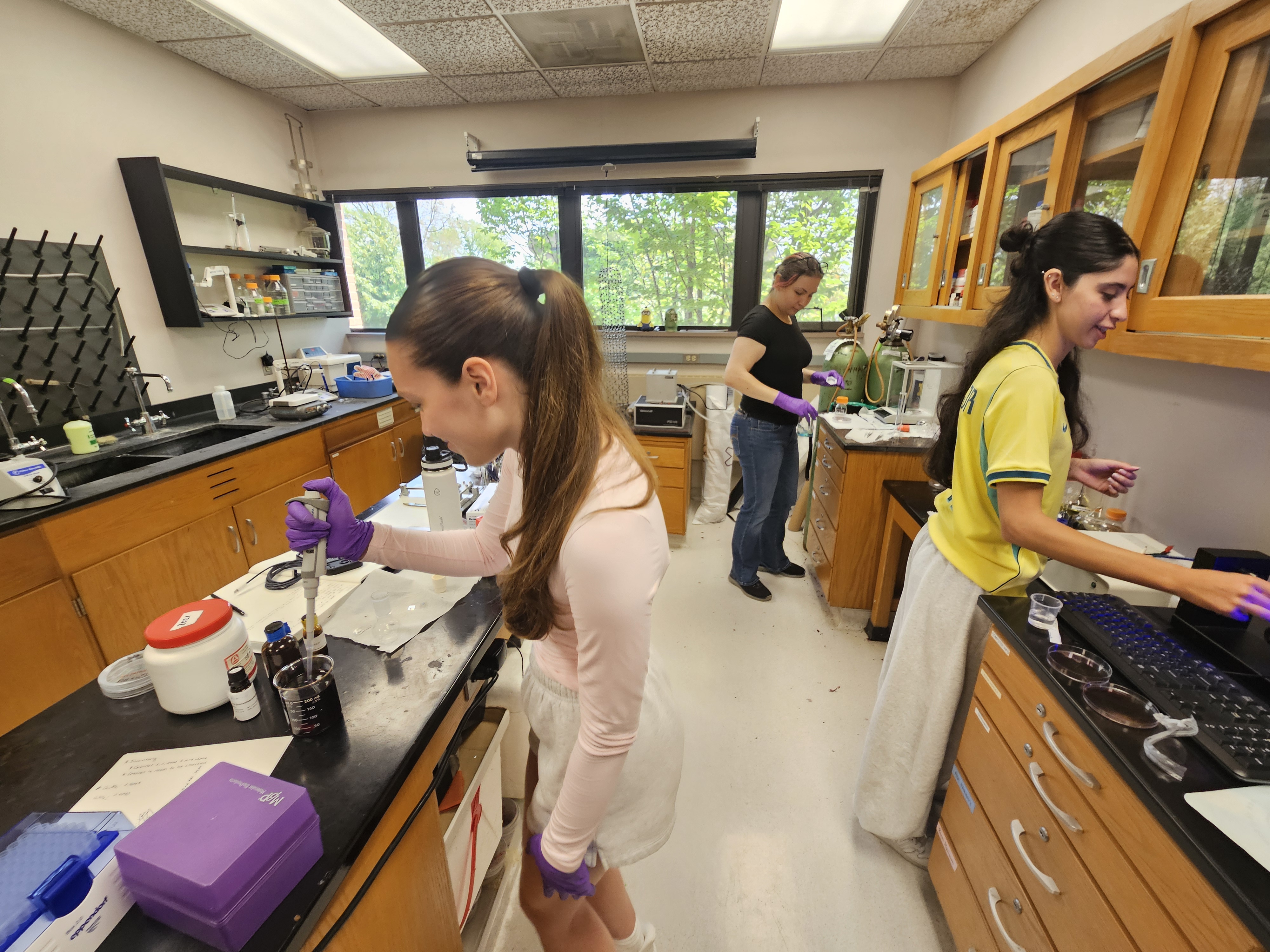
The team, comprised of Korkomaz, Aya Farhat, and Sara Demiraj who is also working on a drug delivery project, is investigating ways to overcome that problem by chemically modifying surfaces with molecules that can capture copper ions (much like a glue) and then generating nanoparticles directly onto those sticky surfaces. By changing experimental conditions, the students’ study how surface chemistry affects the formation, stability, oxidation and electrochemical properties of the nanoparticles. Ultimately, the work contributes to a better understanding of how materials can be designed at the molecular level for useful catalytic and sensing applications.
For the students, that means working with sophisticated research methods, including UV-visible spectroscopy, electrochemistry, atomic force microscopy and X-ray photoelectron spectroscopy, while confronting something that doesn't always happen in a classroom laboratory…they don't know exactly what the answer is going to be. And that sometimes leads to the best discoveries.
“One of the most rewarding aspects of working with these students is watching them transition from learning laboratory techniques to beginning to think like independent scientists,” Bandyopadhyay said. “They are learning to ask why something happened, not simply whether an experiment worked in the lab. ” This is what helps develop critical thinking skills. They are questioning the work they do – its application and how they can move it forward in different ways toward better outcomes.
When classroom chemistry becomes real
That distinction is an important one to student researcher Sara Demiraj. A behavioral and biological sciences student studying neuroscience, Demiraj has always enjoyed biology and understanding how life and its many systems connect. Chemistry didn't initially hold the same appeal, but research changed that for her.
Being able to take concepts she learned in her courses and actually use them to solve problems in the lab made the subject more interesting. Instead of learning a concept on paper, she could see why it mattered.
The team draws upon principles students encounter in general chemistry while investigating the conditions needed to produce stable copper nanoparticles. They experiment with variables such as pH and different chemical environments, adjusting their approach based on the results they observe.
That ability to apply coursework to an unanswered question is what makes research such a powerful form of learning for Demiraj. It has also given her increasing responsibility. After initially learning from more experienced student researchers, Demiraj is now helping train other students and taking a leadership role in the lab. This cycle, a concept that the Natural Sciences Department finds crucial in student learning, means knowledge is shared and passed from one group of undergraduate researchers to the next, helping the students connect and grow at the same time.
The students say that peer mentorship makes a difference, because a fellow student who has already worked through a problem or used a technique in the lab can sometimes explain it from the learning perspective best to those who are also learning.
At the same time, Bandyopadhyay remains available when the team needs guidance. His approach, the students say, is to provide a path forward without just giving them the answer. He is a student favorite, and for good reason. Not only does he see the value and intelligence in all his students, but he learns from them as well. Whether it is about the importance of makeup and concealer while traveling with his team to the American Chemistry Society poster session or the persistence and intellectual curiosity in his research students, he feels giving his students the space to learn and grow matters.
The freedom to figure it out
That autonomy is impactful. Students have significant ownership over their projects, from determining when they work in the lab to discussing results and troubleshooting problems together. Team members regularly share discoveries through their group chat, and Bandyopadhyay checks in with them while they work, in addition to scheduled group meetings.
Some students are in the lab three or four days a week during the academic year and two or three days a week during the summer. Over time, individual experiments become part of a much larger body of work, where one student's findings inform what another student tries next in the lab.
“Research rarely follows a straight line,” Bandyopadhyay says. “Our students have encountered unexpected results, redesigned experiments, and learned new techniques to understand what they are seeing. That persistence and intellectual curiosity are exactly what we want undergraduate research to develop.”
Student researcher and ACS Chemistry major Aya Farhat experienced one of those moments of discovery while using UV-visible spectroscopy to analyze the team's copper nanoparticles. Researchers can use this technique to pass light through a sample and examine how the material absorbs it. Seeing the copper-related signal the team had been working toward, a peak around 600 nanometers, provided tangible evidence that their approach was working.
For the average person, it simply looks like a slide under a microscope hooked up to a computer. But Farhat now can easily explain how her work then generates an important graph and what those lines and peaks on it reveal in their research. Pointing to the graph, she showed exactly where the team hoped to see a peak, evidence that the copper nanoparticles they were working to create were actually there.
Those moments come only after plenty of trial, error and adaptation. Farhat notes, “When something doesn’t work in the lab, it’s not about the failure, but about why it failed and what we should try next. ” She knows she has the space to explore those questions, and also a great team to bounce ideas off of.
This is the kind of understanding that comes from doing the science yourself, not just learning about a graph in a textbook, but generating the data, interpreting it, and understanding what it means for the next step.
For Bandyopadhyay, that's exactly the point.
The students aren't completing predetermined exercises with known outcomes. They're contributing to an active research program where their results shape future experiments and potentially contribute to presentations and publications.
“I am especially proud that our undergraduate students are working on questions that are part of our active research program,” Bandyopadhyay said. “The data they generate can contribute to scientific presentations, publications, and the next generation of experiments in the laboratory.”
From UM-Dearborn to a national stage
Soon, that work will go on the road. The students are preparing to present their copper nanoparticle research at the American Chemical Society national meeting in New Orleans in March, where they'll share their work through a research poster with scientists and students from around the country. It's another step in the learning cycle that sometimes begins with a student simply wondering whether research is something they're capable of doing.
For Korkomaz, the answer to that question looks much different today than it did when she first entered the chemistry lab. She thinks often about the transition, from looking up to other student researchers, like her mentor Evelyn Diakiw (‘26 B.S., Biochemistry), and wondering whether she could ever do that herself, to then generating results of her own and making a groundbreaking discovery.
“I think about it every day, how far I have come,” she says.
That's part of the power of undergraduate research at UM-Dearborn. Students learn the techniques and science behind a field, but they also learn something that can be harder to teach in a classroom. How to approach the unknown with curiosity, trust their own abilities, work through the uncertainty and imposter syndrome and recognize that their ideas and work can contribute to something bigger.
They learn that they can discover, and how powerful it is to believe in themselves while doing it.
For Korkomaz, Farhat, and Demiraj, the lab has given them something just as important as knowledge - the freedom to try, fail, adapt, question, and realize that they are perfectly capable of finding the answers themselves.
Help make discoveries like these possible. Support hands-on learning and undergraduate research at CASL by contributing to the CASL Student Research Scholarship fund, providing students with the opportunity to collaborate with expert faculty to tackle real-world challenges across our programs at CASL.


