

What does a strong economy look like? For Professor of Economics and Social Sciences Dept. Chair Natalia V Czap, the answer goes beyond GDP, productivity and growth. It also requires asking a more human question: Are people really feeling good and functioning well?
That question is at the heart of Wellbeing and Policy: Evidence for Action, a book co-edited by Czap alongside University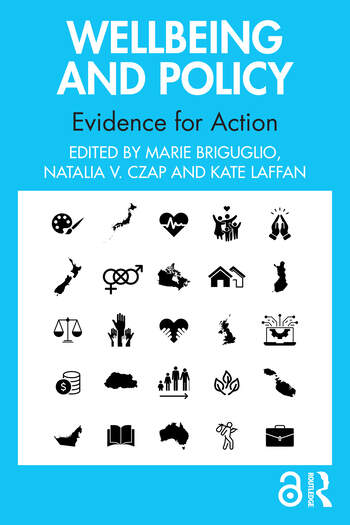 of Malta Professor Marie Briguglio and London School of Economics' Kate Laffan. In its first year, the open-access book has generated more than 57,000 chapter uses through publisher Routledge, reaching 240 institutions across 47 countries. The Publisher reports that these figures are significantly above average, with total readership higher if platforms like OAPEN, Open Research Library, and DOAB are taken into account. Main users include major universities and government entities. The volume brings together 41 researchers and practitioners from 18 countries to examine how evidence about wellbeing can inform policy in areas ranging from health and income to housing, work, the environment and digital technology. In addition to being a co-editor, Natalia co-authored chapters on introduction and environment. Another UM-Dearborn faculty member, Associate Professors of Economics, Hans Czap contributed by co-authoring chapters on environment and health.
Now Natalia is bringing that international collaboration directly into the UM-Dearborn classroom. This semester, she is teaching ECON 340, Happiness and Wellbeing: Practice and Policy, a new course she designed with Wellbeing and Policy serving as its core text.
“GDP and growth rates tell us how an economy is performing, but they don't tell us how people are doing. Are people actually flourishing? I believe that question is too important to leave out of an economics education,” Natalia said. “I want my students to understand what gets lost when we ignore the human drive for wellbeing — and to leave my classroom equipped to advocate for that within the organizations and policy spaces they'll go on to shape.”
The book was designed to help bridge the gap between research and practice. It brings together international perspectives and also includes accessible resources for policymakers looking to translate evidence into action. The open-access format means that research isn't limited to those with institutional subscriptions or the ability to purchase the book.
Natalia credits UM-Dearborn's Open Education Committee with helping make that accessibility possible by funding a portion of the open-access costs.
“I'm deeply grateful to the Open Education committee for funding a third of the open access costs, shared between the three of us as co-editors. Seeing the return on that investment has been incredible — this isn't just benefiting our students at Dearborn,” Natalia said. “That's the whole point of open access: knowledge shouldn't stop at a Paywall.”
For Natalia, teaching wellbeing is about more than introducing students to a growing area of economic research. It's also about preparing them for their own lives and careers.
“As an economist, I want my students to succeed not just in their careers, but in their lives,” she said. “That means giving them more than the technical tools of economics — it means teaching them how to think critically, recognize the biases that derail good decisions, and reason efficiently through complex problems.”
As many of those students prepare for careers in a knowledge economy where their minds will be among their most important tools, Natalia wants them to understand how taking care of their own wellbeing fits into that preparation, too.
“Wellbeing isn't a soft add-on to a good education,” she said. “Research shows that happier people are more productive, more creative, and live longer, healthier lives. That's what I want to set my students up for.”
Access to the full volume is available online.


