Armenian Research Center

The Armenian Research Center (ARC) houses resources on all things Armenian.

ARC Mission and Goals

ARC's primary mission is to serve students, the academic community and the public, both in the U.S. and worldwide, by facilitating research and publications on all aspects of Armenian history, society and culture.

The ARC

  • adds a multicultural and international perspective to the educational process on and off campus;
  • aims to help students better understand the world and define their proper role in it;
  • provides the metro Detroit community, and particularly the Armenian-Americans, with valuable learning resources, educational materials, outreach programs, and helps to serve local cultural needs;
  • supports innovative research in Armenian Studies by providing classes, scholarships, resources and publication opportunities to students and scholars both nationally and internationally;
  • organizes Armenian Studies conferences and exhibitions to advance its mission to serve the academic community in the U.S. and worldwide.

Upcoming

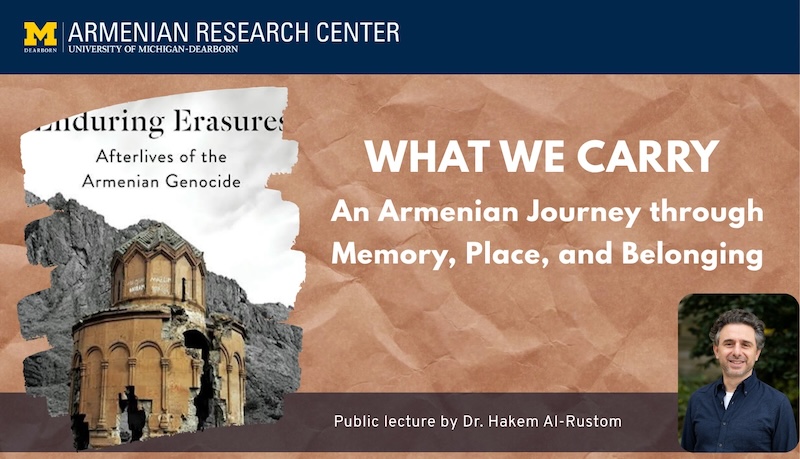
University of Michigan-Dearborn Armenian Research Center event graphic. “What We Carry: An Armenian Journey through Memory, Place, and Belonging,” a public lecture by Dr. Hakem Al-Rustom. The design features the book Enduring Erasures: Afterlives of the Armenian Genocide, an image of a ruined Armenian church, and a portrait of Dr. Al-Rustom.

What We Carry: An Armenian Journey through Memory, Place and Belonging
 

Tuesday, September 15, 2026 @ 7 PM

Speaker: Dr. Hakem Al-Rustom

AGBU Alex & Marie Manoogian School
22001 Northwestern Highway
Southfield, MI 48075

What do Armenians carry with them when home exists partly as a place, partly as a memory, and partly as something lost? In this personal and illustrated lecture, Dr. Hakem Al-Rustom reflects on how his own life and travels led him to study Armenians whose lives connect Turkey, France, and the wider diaspora. Through family histories, research encounters, and photographs of churches, neighborhoods, cemeteries, and other community spaces, he will tell stories of people who have preserved a relationship to places from which they or their ancestors were separated. The lecture explores, in accessible terms, how memory and belonging endure across borders and generations--and how Armenians continue to make meaningful lives in the presence of loss.

Dr. Hakem Al-Rustom is an anthropologist and historian whose work focuses on Christians in and of the Middle East, particularly Armenians in Turkey and France. He is the author of Enduring Erasures: Afterlives of the Armenian Genocide (Columbia University Press, 2026) and co-editor of Edward Said: A Legacy of Emancipation and Representation (University of California Press, 2010). Dr. Al-Rustom has taught anthropology and history at the London School of Economics, the American University in Cairo, and the University of Michigan.

Books will be available for purchase at a discounted price -- cash only.
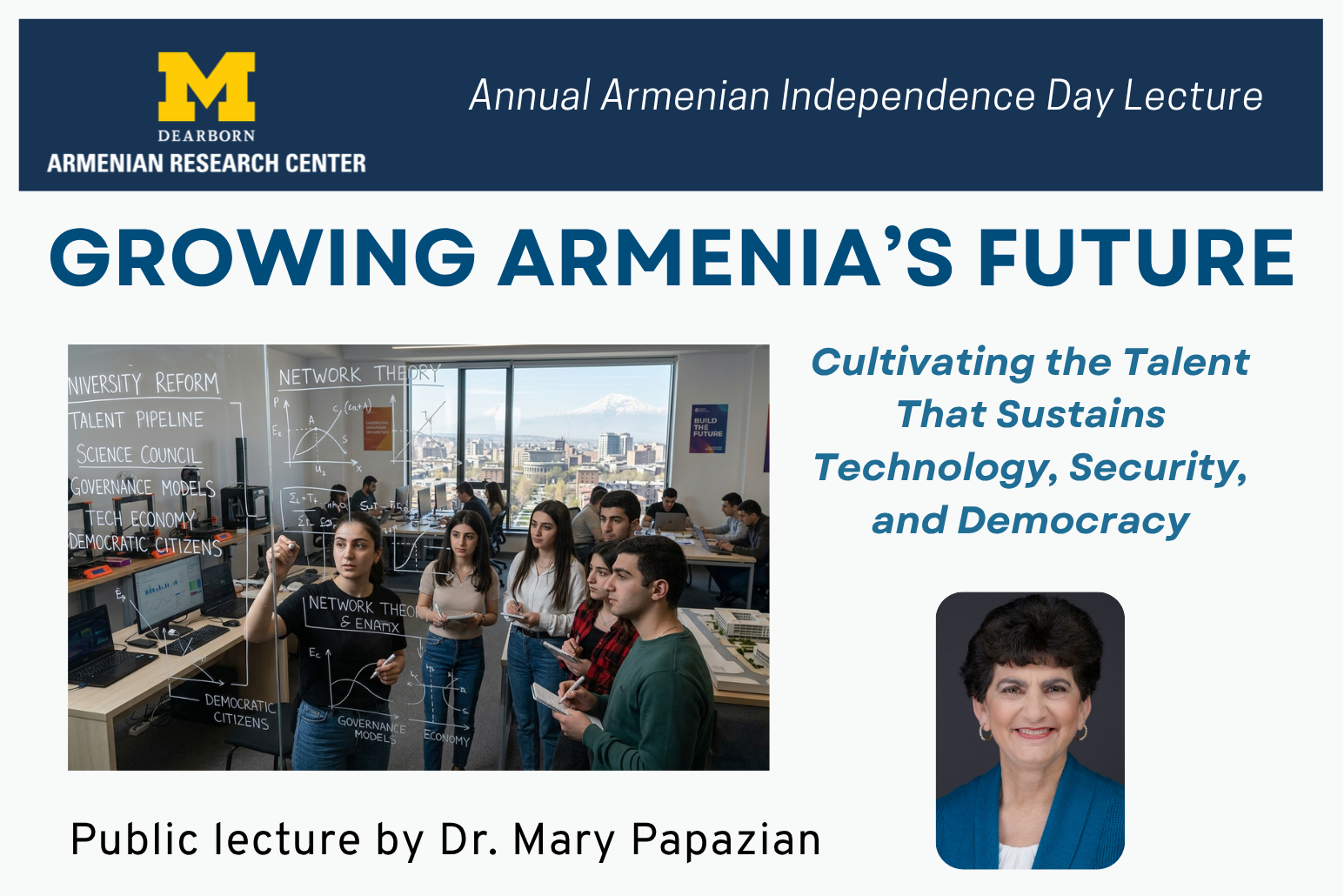
Promotional graphic for UM-Dearborn's Annual Armenian Independence Day Lecture titled "Growing Armenia's Future: Cultivating the Talent That Sustains Technology, Security, and Democracy," featuring speaker Dr. Mary Papazian.

What We Carry: An Armenian Journey through Memory, Place and Belonging

Annual Armenian Independence Day Lecture

Thursday, October 22, 2026 @ 7 PM
Speaker: Dr. Mary A. Papazian

St. John Armenian Apostolic Church | St. Vartan Room
22001 Northwestern Highway
Southfield, MI 48075

The talent of Armenia’s people is a major resource the country can multiply, and achieving that takes deliberate work. Armenia’s push to build a technology economy, defend itself, and ensure the survival of its young democracy all draw on that same resource, which must be cultivated through schools, universities, teacher training, and governance reforms. With cultivated talent, Armenia can build the technological capacity that increasingly defines modern security and develop the educated citizens its democracy needs to endure. Dr. Papazian’s talk will draw on her work with universities, governance structures, ministries, and science and technology councils in Armenia. She will show where that cultivation is taking hold, why the pipeline still leaks, and what work remains to ensure Armenia’s future success.

Dr. Mary A. Papazian is a distinguished Armenian-American higher education leader and a leading advocate for Armenian scholarship and science. She serves as Chair of the Executive Board of the Armenian Society of Fellows, Chair of the Advisory Board of the Foundation for Armenian Science and Technology, a member of the Prime Minister of Armenia's Council on Science and Technology, a trustee of Haigazian University in Beirut, Lebanon, and a board member of the National Association of Armenian Studies and Research (NAASR).

A former two-time university president who led San José State University and Southern Connecticut State University, she now serves as Senior Fellow and Senior Consultant at the Association of Governing Boards for Universities and Colleges, Senior Education Advisor at CodeSignal, and a Global Fellow at the University Design Institute at Arizona State University.

Her service to the Armenian community has been honored by His Holiness Catholicos Karekin II, the Armenian Ministry of the Diaspora, the Knights and Daughters of Vartan, and the Khachatur Abovian Armenian State Pedagogical University.

ARC office hours

Our In-person office hours are:

Monday-Friday, 9:00 a.m. - 5:30 p.m.

For further information and inquiries please contact Mr. Gerald Ottenbreit, Jr. at [email protected] or call the ARC at 313-593-5181.

Location, Address and Parking

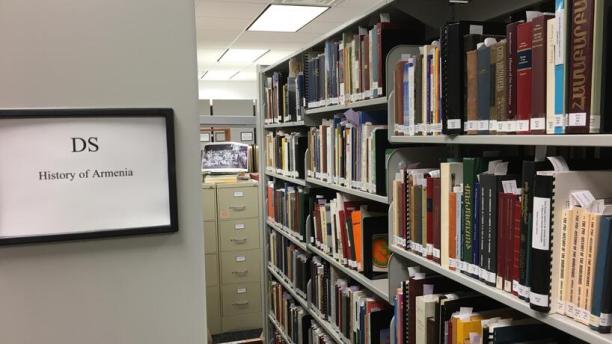
The Armenian Research Center is in 4030, on the fourth floor of the Mardigian Library (4901 Evergreen Rd, Dearborn, MI 48128). Consult the UM-Dearborn illustrated campus map for the location of the Mardigian Library (ML) building.

Visitor parking is marked on the campus map by VP.

Our mailing address is:

Armenian Research Center

4901 Evergreen Rd.
Dearborn, MI 48128