
Lectures and Public Outreach Events
Komitas and Armenian Music: Interactive Workshop
Led by: Dr. Tatevik Shakhkulyan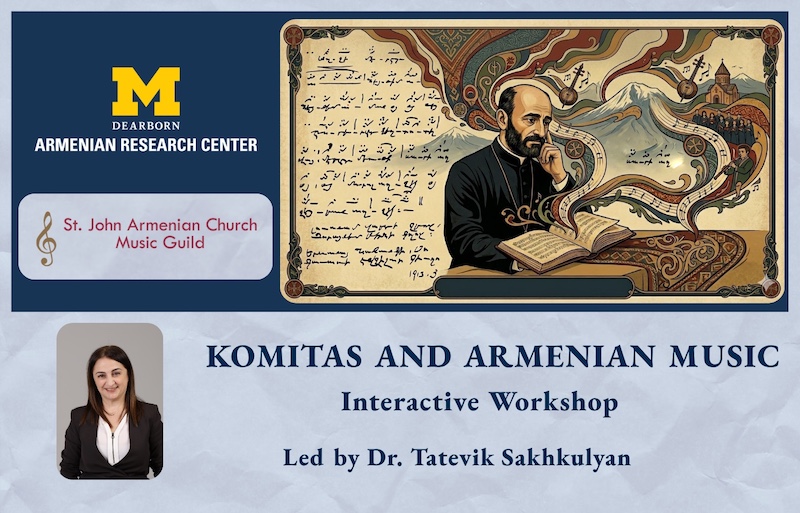
Tuesday, May 19, 2026
This interactive workshop explored Armenian music through the work of Komitas, the founder of the Armenian national school of music. Through listening, discussion, and singing Komitas’s songs together in many voices, participants were introduced to Armenian musical traditions in an engaging and accessible setting.
The workshop was led by Dr. Tatevik Shakhkulyan, an ethnomusicologist specializing in Armenian musical traditions and the legacy of Komitas.
Between Tradition and Transformation: Contemporary Tendencies in Armenian Folk Music
Wednesday, May 20, 2026
Speaker: Dr. Tatevik Shakhkulyan
This talk explored the changing nature of Armenian folk music, tracing its journey from songs tied to everyday work to contemporary musical life in Armenia and the diaspora. Drawing on her fieldwork, Dr. Tatevik Shakhkulyan shared stories of songs that were forgotten, rediscovered, and transformed over time, reflecting on their connection to the legacy of Komitas, founder of the Armenian national school of music.
Dr. Tatevik Shakhkulyan is a Senior Researcher at the Institute of Arts of the National Academy of Sciences of Armenia and teaches at the Yerevan State Conservatory. She also develops educational programs at the KAYT Cultural-Educational Hub and is the author of both scholarly and accessible works.
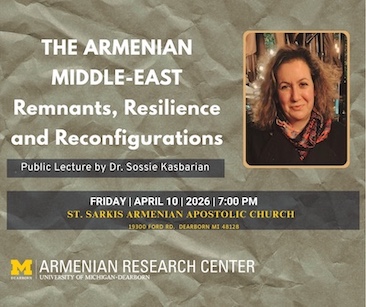 The Armenian Middle East: Remnants, Resilience and Reconfigurations
Friday, April 10, 2026, @ 7 PM
Speaker: Sossie Kasbarian
This talk examined the contemporary Middle East through the prism of the Armenian diaspora. Dr. Sossie Kasbarian situated the Armenian experience of displacement, refugeehood, reconfiguration, and resilience as central to a transnational Middle East. The lecture also explored changing practices and identities among Middle East Armenians through their own narratives and reflections, highlighting broader insights from the Armenian diaspora experience.
Dr. Sossie Kasbarian is the Dumanian Visiting Professor in Armenian Studies at the University of Chicago and Honorary Senior Research Fellow at the University of Stirling. She earned her doctorate from the School of Oriental and African Studies (SOAS), University of London, and has held positions at the University of Edinburgh, SOAS, the Graduate Institute (Geneva), Lancaster University, and the American University in Cairo. She has published widely on the Armenian diaspora, Middle East politics, and migration studies, and co-edited The Armenian Diaspora and Stateless Power (2023) and Diasporas of the Modern Middle East (2015). She is co-editor of Diaspora – a Journal of Transnational Studies.
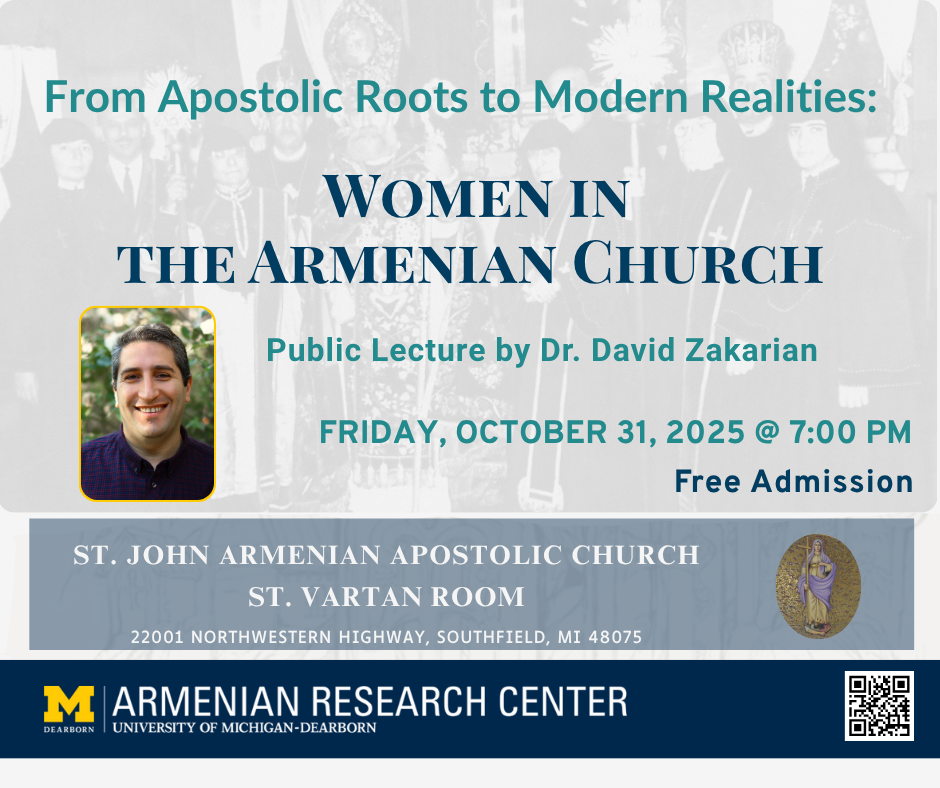
From Apostolic Roots to Modern Realities: Women in the Armenian Church
November 3, 2025
What role have women played in the story of the Armenian Church? This talk by Dr. David Zakarian took on a journey from the dramatic first accounts of Armenia’s conversion to Christianity in the early 4th century—where women appear as powerful symbols of faith and sacrifice—to the ways their presence and voices have shifted over the centuries. Along the way, it examined how history, tradition, and changing realities have shaped women’s place in the church, and what this means for today.
Dr. Zakarian is the Haig and Isabel Berberian Endowed Chair of Armenian Studies at California State University, Fresno. He holds a DPhil (PhD) in Oriental Studies from the University of Oxford, where he was also a British Academy Postdoctoral Fellow between 2017 and 2019. He is the author of Women, Too, Were Blessed: The Portrayal of Women in Early Christian Armenian Texts (Brill, 2021) and co-editor of Armenia through the Lens of Time (Brill, 2022). He has published extensively on the representation of women in early Christian Armenian literature, as well as on medieval Armenian manuscripts.
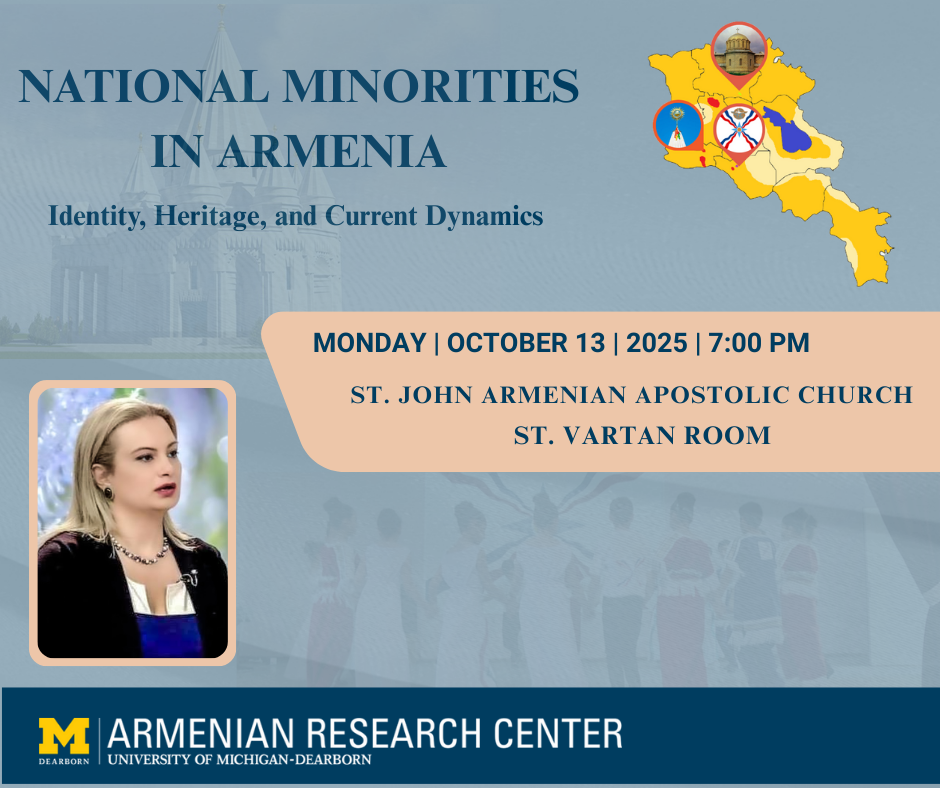
Annual Armenian Independence Day Lecture
National Minorities in Armenia: Identity, Heritage, and Current Dynamics
October 15, 2025
Dr. Anahit Khosroeva's talk explored the multifaceted lives of Armenia's national minority communities, tracing their historical contributions and examining the ongoing challenges of cultural preservation in contemporary Armenia. It further considered the complexities of identity formation within a post-Soviet society, highlighting both the remarkable resilience of these communities and the vulnerabilities they continue to face.
Dr. Khosroeva is an ethnic Assyrian historian and genocide scholar born in Armenia. Her research focuses on the history of Armenian, Assyrian, and Greek genocides perpetrated in the Ottoman Empire between 1894 and 1923. An advocate for genocide recognition and prevention, Dr. Khosroeva has published and presented extensively worldwide in multiple languages and advances accountability through international human rights law.
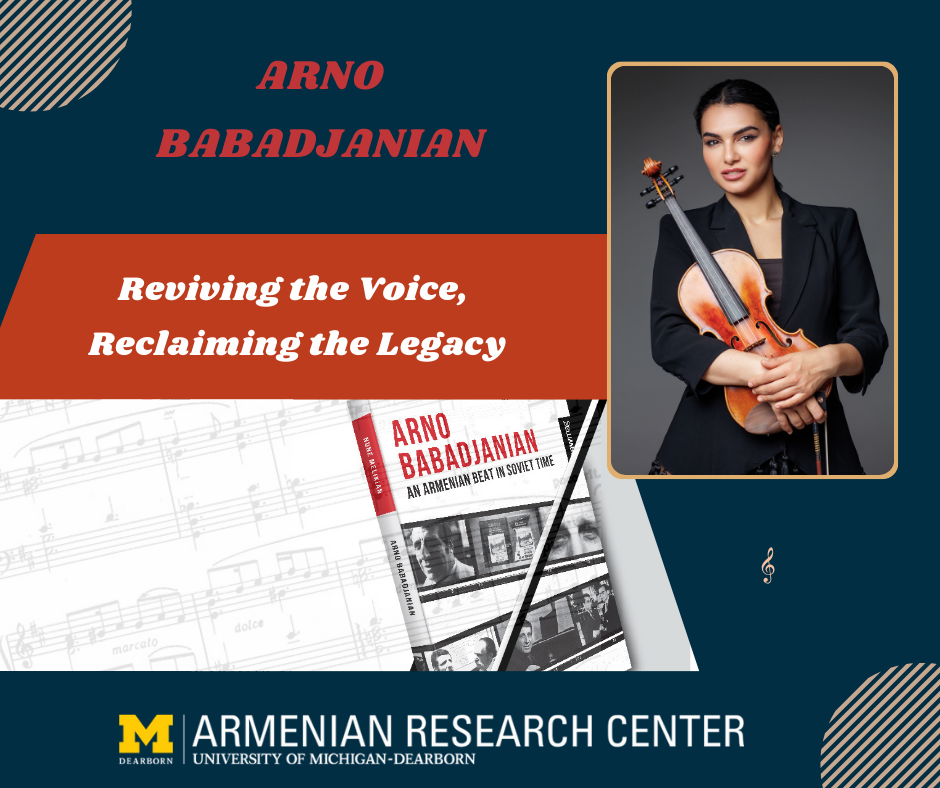
Dr. Nune Melikian Revives the Legacy of Composer Arno Babadjanian in Dearborn
September 17, 2025
Dr. Nune Melikian, acclaimed violinist and scholar, presented a lecture at St. Sarkis Armenian Apostolic Church on the life and work of Armenian composer Arno Babadjanian (1921–1983).
Dr. Melikian’s talk featured her newly published first English-language book on Babadjanian, accompanied by rare, never-before-seen photographs from the Arno Babadjanian International Foundation and a comprehensive list of his works. She explored the challenges faced by artists in the Soviet era and discussed why so little information about Babadjanian is available outside Armenia and Russia.
An internationally recognized performer, Dr. Melikian has appeared at Lincoln Center, Walt Disney Hall, and the United Nations Headquarters. She is the only Armenian woman violinist to debut at Carnegie Hall’s Stern Auditorium with a symphony orchestra. Dr. Melikian currently serves as an Adjunct Lecturer at Yeshiva University and as a faculty member at the Kaufman Music Center’s Special Music School in New York.
Film Screening – My Sweat Land and Q&A with Producer Sareen Hairabedian
May 9, 2025.
Film Producer: Sareen Hairabedian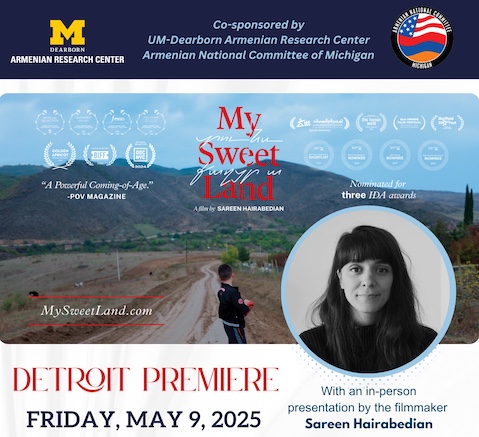
My Sweat Land follows the life of an 11-year-old Armenian boy over three years, beginning in his village in Nagorno-Karabakh and continuing in a refugee camp in Armenia. The film offers an intimate look at the challenges faced by children dealing with conflict and displacement.
The screening was followed by a Q&A session with Producer Sareen Hairabedian, moderated by Dzovinar Hamakortsian from the Armenian National Committee of America.
The screening was co-sponsored by the Armenian National Committee of America.
Food, Place, and Identity: A Photo Journey of Armenian-American Transnational Connection
December 13, 2024
Speaker: Dr. Inna Mirzoyan
During the 2020 war in Nagorno-Karabakh, the global Armenian Diaspora rallied—organizing protests, raising funds, lobbying Congress, and spreading awareness online. Armenian Americans, including those from later generations, felt a deep call to action, driven by a strong sense of identity and connection to their heritage.
Drawing on data from fieldwork conducted in Yerevan and Glendale, CA, in 2021-2022, Dr. Inna Mirzoyan discussed how younger generations of Armenians are redefining their identity and connection to their homeland. It further explored the factors driving activism across generations. Through powerful photos submitted by participants in her research, Dr. Mirzoyan uncovered how symbols of food and place played key roles in maintaining ethnic identity, even in times of crisis.
Independence and Cultural Heritage in Armenia
November 11, 2024
Speaker: Dr. Nzdeh Yeranyan
Dr. Nzhdeh Yeranyan explored how Armenia’s cultural heritage institutions, previously shaped by Soviet ideology, were transformed following the collapse of the USSR. Focusing on “independence” and “nationalization” as processes, he discussed how these institutions adapted to new socio-political realities, and analyzed the challenges they faced during this transition. He also offered insights into other post-Soviet cultural developments in Armenia.
Armenians in Michigan: A Visual Journey Through the Armenian Diaspora Survey, Part 1
November 21, 2023
Speaker: Dr. Vahe Sahakyan
- In which ways do Armenians in Michigan define their identity?
- Which aspects of Armenian culture are important in Armenian self-perceptions in Michigan?
- What are the biggest challenges to the Armenian community in Michigan and which activities are needed?
Explore answers to these questions and much more in an engaging presentation by Dr. Vahe Sahakyan on the findings of the Armenian Diaspora Survey in Michigan. Through a visual exploration of select charts derived from the survey data, the presentation will focus particularly on the experiences of the third and further generations of Armenians who have made their homes in Michigan and across the United States.
Imaginations of Syunik and Armenia since the Second Karabakh War
November 29, 2023
Speaker: Nareg Seferian
Towards the end of 2020 and into 2021, following the Second Karabakh War, the inhabitants of the province of Syunik in southern Armenia unexpectedly found themselves facing new borders with Azerbaijan. Spaces that had not been frontiers for decades suddenly had to accommodate armed forces flying three flags - Armenian, Azerbaijani and Russian - while dealing with blocked transportation networks and disrupted economic activity. How do the Armenians of Syunik perceive their new geography? What is the place of Syunik in Armenia and in the world? Drawing from fieldwork conducted in the autumn of 2021, Nareg Seferian presents the changing dynamics of Syunik and Armenia as they navigate through the trauma and shock of the war and its aftermath.
The 'Armenian Question' Before and Since the Treaty of San Stefano in 1878
December 7, 2023
Speaker: Gerald J. Libaridian
For a long time in their history, Armenians have internationalized their plight by seeking aid and salvation from the Great Powers of the West. The lecture will explore the origins of that dominant pattern that was initially labeled the 'Armenian Question,' the character and mechanics of that relationship, and conclude with a tentative assessment of the strategy of internationalization.
Language and Collective Identity during the Diaspora's Formative Years
March 7, 2024
Speaker: Talar Chahinian
Looking at public debates in the post-genocide Armenian literary press of Boston, Paris, Beirut and Aleppo, this presentation gives an overview of the evolving discourse on language and its intersection with the politics of identity. In placing the discussion within the greater framework of her recent book Stateless (2023), Chahinian will suggest that during the decades that followed the genocide, language became the key marker of identity around which competing ideologies of belonging emerged to shape both nationalistic and transnational models of diaspora.
"Technocrat of State Terror: Mustafa Reşat (Mimaroğlu) from the Ottoman Empire to the Turkish Republic"
April 4, 2024
Speaker: Ümit Kurt
As a young bureaucrat, Mustafa Reşat (Mimaroğlu) was the head of the Second Department of General Security (also known as the Department of Political Affairs), a section of the Ministry of the Interior of the Ottoman Empire. Along with other officers in the same unit, he played an active role in the planning, organization, and implementation of the 24 April 1915 mass arrests in Istanbul that sparked the Armenian Genocide. Building on Mustafa Reşat’s memoirs published in two volumes titled Gördüklerim ve Geçirdiklerimden [From What I Have Witnessed and What I Have Been Through], Dr. Kurt’s talk will focus on the course of the bureaucrat’s life, his actions and “tasks” to explain how he turned into a technocrat-genocidaire.
Armenians in Michigan: A Visual Journey Through the Armenian Diaspora Survey, Part 2
April 14, 2024
Speaker: Dr. Vahe Sahakyan and Dr. Inna Mirzoyan
- How do different generations of Armenians in Michigan perceive concepts like home, roots and belonging?
- How do these perceptions influence their cultural identity and engagement with their Armenian heritage?
- How does proficiency in the Armenian language influence individual perceptions of homeland and relationships that Armenians in Michigan maintain with the Republic of Armenia?
Join us to explore answers to these questions and much more during the second of two events on the Armenian Diaspora Survey in Michigan.
"Cilician Armenia (1080-1375): The Pearl of the Mediterranean"
June 5, 2024
Speaker: Zorhab Gevorgyan
The fall of the Bagratuni kingdom of Armenia in 1045 triggered massive emigration from Greater Armenia. Besides Armenian noblemen, merchants and artisans were also among the migrants, looking for new horizons in Cilicia to pursue their endeavors.
Dr. Gevorgyan's talk will focus on the Armenian principality of Cilicia, founded in 1080, which became a kingdom in 1198. Focusing on trade and other issues, he will discuss how Armenians maintained a state in Cilicia for 300 years in a region that was continuously contested among competing empires.
The Soviet Experience in Armenia and Its Legacy 2
October 28-30, 2022
Academic Conference. Institute of Archaeology and Ethnography, Yerevan, Armenia
The Soviet Experience in Armenia and Its Legacy
October 28-30, 2022
Academic Conference, University of Michigan-Dearborn
Armenian Postwar Society: Perceptions, Priorities and Foreign Policy Orientations
September 15, 2022
Speaker: Dr. Arthur Atanesyan
Is Russia a strategic partner, a cultural "friend" or a diplomatic foe for Armenia? How do the complex contradictions between the West and Russia affect the adopted complementarism (i.e. balancing the interests of all major powers in Armenia's neighborhood) of the Armenian state and the choices Armenia can make in the political environment, that has emerged since the "Velvet Revolution" in 2018 and the war in 2020.
During this public talk, foreign policy priorities and the changing preferences of Armenia will be revisited through the lens of public opinion, based on the findings of a sociological study conducted in Armenia by Yerevan State University, in partnership with the Konrad Adenauer Foundation and Socies Expert Center, from June to October 2021, and summarized in March 2022.
Armenia and the Challenges of the Robotics Revolution
January 22, 2022
Speaker: Richard Ohanyan
Richard Ohanyan discussed the development, types, and characteristics of robotic systems, along with their applications and limitations in Armenia and elsewhere. Watch the lecture on YouTube.
What is the Diaspora thinking?
March 22, 2022
Speaker: Dr. Hratch Tchilingirian
Dr. Hratch Tchilingirian presented the results of surveys conducted in over 20 diaspora communities across ten countries on a number of themes, including identity, language and culture, community, and relations with Armenia. He also discussed plans for this spring to study the opinions and views of Armenians living in Michigan.
The Armenian Diaspora Survey (ADS) is a research project funded by the Calouste Gulbenkian Foundation (Lisbon) and carried out under the auspices of the Armenian Institute in London. The Armenian Research Center has partnered with ADS to conduct the survey in Michigan this spring. Dr. Tchilingirian also discussed the preparation plans for the survey.
Due to COVID-19 the ARC could not organize any public lectures or outreach events during the 2020-2021 academic year.
Challenges and Innovations in Teaching Western Armenian in 21st Century America
September 19, 2019
Speaker: Shushan Karapetyan, Discussant: Ani Kasparian
In 2010, Western Armenian was officially designated in UNESCO's Atlas of the World's Languages in Danger as "definitely endangered," raising alarm throughout the worldwide diaspora. Organized on the occasion of the recent publication of Western Armenian in the 21st Century: Challenges and New Approaches ( editors, Bedross Der Matossian and Barlow Der Mugrdechian), this event will discuss one of the most critical issues in the Armenian diasporic experience-language acquisition, teaching, and transmission. The main speaker and the discussant will address the major difficulties in teaching Western Armenian as a heritage language in the American context and suggest practical and innovative solutions. The discussion will entail multiple perspectives, including theoretical, pedagogical, and practical considerations that will be relevant to language speakers, learners, educators, researchers, and community activists.
The Challenges of Fighting Corruption in Today's Armenia
November 17, 2019
Speaker: Aram Simonyan
Widespread corruption, social injustice, and a high unemployment rate leading to widespread poverty and mass emigration were the key factors contributing to Armenia's "Velvet Revolution" in April-May 2018. Distrust toward public institutions and officials was helping deepen the shadow economy and make skilled workers behave as crooks. Therefore, curbing corruption, as well as developing the IT sector, agriculture, and tourism, were set as the main priorities for the new Armenian government formed after the revolution. The talk will analyze what kind(s) of corruption prevailed in Armenia, and what steps are being undertaken now to fight it in Armenia.
Armenia Since the Velvet Revolution: A Panel Discussion
September 22, 2018
Speakers: Dr. Aleksandr V. Gevorkyan, Dr. Anna Ohanyan
September marks the semi-anniversary of the Velvet Revolution in Armenia. The past six months have raised a lot of expectations and have witnessed remarkable changes in the country. But what does the future hold for Armenia? How deep are these changes and how significant will they be in shaping Armenia’s future? Come and hear two experts, Aleksandr Gevorkyan and Anna Ohanyan, discuss the situation in the country.
The Armenian Diaspora Study: The Pilot Project
March 19, 2019
Speakers: Dr. Susan Pattie, Dr. Vahe Sahakyan
The Armenian Diaspora Survey (ADS) aims to gather clear and tangible information about the contemporary diaspora. Asking Armenians about their thoughts about Armenian identity and related issues of belonging as Armenians and as citizens of different states, the ADS seeks to create a resource that forms a snapshot of the diaspora today and gives a voice to those taking part. The data and its analysis can be used by scholars for better understanding and as a foundation for further research. It can also be used by leaders of the diaspora and of the Republic of Armenia for practical information about how to effectively serve Armenian communities. The Pilot Project began with medium-sized but important Armenian communities in four different cities: Boston, Cairo, Marseille, and Pasadena. Please come and join us to learn about the results of the Pilot Project research teams and discuss the findings together. ADS is funded by the Armenian Communities Department of the Calouste Gulbenkian Foundation, Lisbon, and administered by the Armenian Institute, London.
Coming Full Circle: Documentary on the Great Repatriation of Armenians.
November 1, 2017
Film screening and discussion with the producer, Tigran Paskevichyan
The Nerkaght or Great Repatriation saw nearly 100,000 Armenians leave their homes in the Middle East, Europe, and the Americas to repatriate to Soviet Armenia between 1946 and 1949. Coming Full Circle is a collective version of three documentaries produced by "Versus"studio on this event: My Unfamiliar Fatherland (2012), Oh, Fatherland, Cold and Sweet(2016), and The Last Dream or Game Over (2017). Despite their enthusiasm about their return to their homeland, these people often experienced exclusion and persecutions under Stalin, Khrushchev, and Brezhnev. Based on more than one hundred oral interviews and eyewitness accounts of repatriation conducted in Armenia, the U.S., France, Russia, and Lebanon, as well as newsreels, photos, and numerous historical documents, this documentary bears witness to the lived experiences of the repatriates beyond the Iron Curtain. A question and answer period with the film producer, Tigran Paskevichyan (Armenia), will follow the screening. The film is in English and Armenian, with excellent English subtitles.
Grigor Narekatsi: Armenian Medieval Poet, Theologian, Saint and a Doctor of the Universal Church
October 2, 2016
Speaker: Dr. Abraham Terian
St. Grigor Narekatsi (Gregory of Narek) is a saint in the Armenian Apostolic Church as well as in the Roman Catholic Church. In April 2015, Pope Francis also declared him a Doctor of the Universal Church. He is most known for his Book of Lamentations (Matean oghbergutean), more commonly known as Narek. However, he also has numerous other writings to his credit, a number of which were recently translated by Dr. Abraham Terian as The Festal Works of St. Gregory of Narek: Annotated Translation of the Odes, Litanies, and Encomia. Who was Narekatsi, exactly? What does his work mean today for Armenians and the Roman Catholic Church? Dr. Terian will discuss his importance in Armenian medieval theology and literature, and the significance of his becoming a Doctor of the Catholic Church.
Civil Society in Armenia Today
November 12, 2016
Panel Discussion with Serouj Aprahamian and Babken Der Grigorian, moderator: Liana Aghajanian.
Houshamadyan: Reconstructing the Multicultural Heritage of Ottoman Armenians
March 20, 2017
Speaker: Dr. Vahe Tachjian
Through digital preservation, Houshamadyan is preserving "intangible" attributes and culture, i.e. folklore, traditions, language, as well as "tangible" items such as buildings, monuments, books, art, and artifacts, for the benefit of future generations.
Baku Armenians in Southeastern Michigan: Some Comparisons with Armenia, Nagorny Karabakh and Russia
April 2, 2017
Speaker: Dr. Nona Shahnazaryan
Dr. Shahnazarian’s talk will focus on the repercussions of the chaotic and unregulated population movements which resulted from the violence generated by the Karabakh conflict in 1988-1994. She will present her observations about Armenian refugees from Azerbaijan’s capital, Baku, who have ended up in southeast Michigan and will compare the experiences and worldview of this group with those of Armenian refugees from Baku and other regions of Azerbaijan who have now settled in Armenia, Nagorny Karabakh, and the Russian Federation, countries where Dr. Shahnazarian had conducted fieldwork befor her visit to Dearborn. She will show that many of these refugees have undergone triple or more (re)emigrations and through these trajectories, she will analyze complex diasporic phenomena, such as ethnically privileged migration, ethnic/ancestral return, root or co-ethnic migration, repatriation, and diasporic homecoming. She will also present her conclusions about why these refugees chose or ended up where they are, the different challenges they faced in their various destinations, their relationship with different groups of co-ethnics in their new host countries, and the dynamics of their identity transformation.
Voice Signatures: Recordings of Russian Armenian POWs in German Camps, 1916-1918
May 3, 2017
Speaker: Dr. Melissa Bilal
In this lecture, Dr. Bilal will present samples of songs and speech in Armenian, Georgian, and Turkish captured a century ago from these men by the use of phonograph and gramophone technologies. She will provide information about the lives of these soldiers. While questioning the conditions under which captives were turned into research subjects, Dr. Bilal will interpret the repertoire through which the Armenian soldiers expressed themselves in the specific historical moment of 1916-1918, and she will argue that the written documents and the voices passed onto us by the phonographic commission challenge the idea of an “archive” and/or a “museum” that the commission originally intended to put together.
Book&Author Festival
October 10, 2015
Featuring outstanding Armenian-American authors, Chris Bohjalian, Nancy Kricorian,Aline Ohanesian, Mathew Karanian, Scout Tufankjian, Marian Mesrobian MacCurdy and Michelle Andonian.
Religion in Today’s Armenia
October 25, 2015
Speaker: Dr. Artyom Tonoyan
Since the collapse of the Soviet Union and Armenia’s return to independence religiosity in Armenia, both individual and institutional, has experienced an unprecedented revival, in the process affecting various sectors of Armenia’s public life and social relations. The lecture will offer a survey of key issues, trends, and tendencies that are animating the contemporary discourse on matters of church and state and the broader spectrum of religion and politics in Armenia.
The Armenian and Assyrian Genocides: Parallel Histories
November 8, 2015
Speaker: Dr. Nicholas Al-Jeloo
While much research has been carried out, and volumes published, regarding the Armenian Genocide, that of the Assyrians, which occurred simultaneously, under similar conditions, and often by the same perpetrators, regularly goes unnoticed. In 1986, the word “genocide” was first used to describe the mass-extermination of Assyrians by the Ottoman Empire during the First World War. This launched a campaign in the 1990s to have those historical events recognized which, in turn, has culminated in its affirmation by the International Association of Genocide Scholars in 2007 and more recent resolutions by the national parliaments of Sweden (12 March 2010), Armenia (24 March 2015) and the Netherlands (9 April 2015). This lecture will provide a brief overview of the Assyrian Genocide, drawing comparisons with that of the Armenians, and showing that they belong to a parallel historical narrative of systematic extermination.
Surviving in the Geography of Genocide: Armenians in Turkey
April 18, 2016
Speaker: Dr. Talin Suciyan
Talin Suciyan will talk about her recent book The Armenians in Modern Turkey: Post-Genocide Society, Politics and History, (London: I.B. Tauris, Oct. 2015), which is the first attempt to create a historiography of Turkey based on the sources of the victims, which were considered non-existent, whose voices have been silenced and whose experiences of survival and catastrophe have been systematically denied. How do we write history under these conditions? The book is based on her 2013 doctoral dissertation. In it, she examines Armenian primary sources, i.e. newspapers, yearbooks, minutes of the Armenian National Assembly in Istanbul, memoirs, biographies, and oral histories and, putting them together with the Turkish state archives, she suggests another historiography for Turkey as well as for its Armenian citizens.
In Search of Historic Western Armenia
November 2, 2014
Speaker: Dr. Richard Hovannisian
Dr. Hovannisian's lecture will partially be informed by the conference and book series and partially by the extensive traveling through the historic Armenian lands he has done in the past seven years.
Science and Technology in Armenia: Past, Present, and Future Prospects.
December 12, 2014
Speaker: Dr. Ara Kirakosyan
The development of science and technology in Armenia has a long history involving important figures and significant developments in the field during the Soviet period. Despite many obstacles, the Armenians and the Soviets were able to make significant contributions to science. In fact, the Soviet Union contributed much to the world’s current advanced state of science and technology.
Industry and Resistance: The Mechanics of Genocide.
April 14, 2015
Speakers: Dr. Khatchig Mouradian, Dr. Peter Heyes.
2015 marks the 100th anniversary of the beginning of the Armenian Genocide and the 70th anniversary of the end of the Holocaust. Scholars Khatchig Mouradian and Peter Hayes grapple with the scope of each genocide and the functions which contributed to their deadly efficiency.
The Armenians in Fresno: The First Community in California
November 10, 2013
Speaker: Barlow Der Mugrdechian
The talk examined the history of Armenians in Fresno and the San Joaquin Valley, where they first settled in 1881. It highlighted how the community overcame obstacles to prosper and make significant contributions to agriculture, land development, and industry. The lecture also explored Fresno’s cultural impact, including notable figures such as author William Saroyan.
The Aftermath of Genocide: Armenians and Jews in 20th Century France
April 30, 2014
Speaker: Dr. Maude Mandel
Professor Mandel examined how genocide shaped the religious, ethnic, and national affiliations of Armenian and Jewish survivors in France, the only Western European nation to host substantial survivor communities after the First and Second World Wars. The lecture explored how both populations navigated the challenges of rebuilding their communities within a nation-state that had once threatened their destruction.
The Regardening of Eden or Environmental Collapse in Armenia?
October 10, 2012
Speakers: Jeff Massarjian and Jason Sohigian
As part of the inaugural annual Armenian Independence Day lecture, Jeff Masarjian and Jason Sohigian discussed Armenia’s natural heritage, the economic and environmental impacts of surface mining, and the strong opposition these projects have generated among youth activists and advocates for the rule of law. The panel also highlighted solutions implemented by the Armenia Tree Project to promote environmental sustainability in the country.
The Young Turks’ Crime Against Humanity: The Armenian Genocide and Ethnic Cleansing in the Ottoman Empire
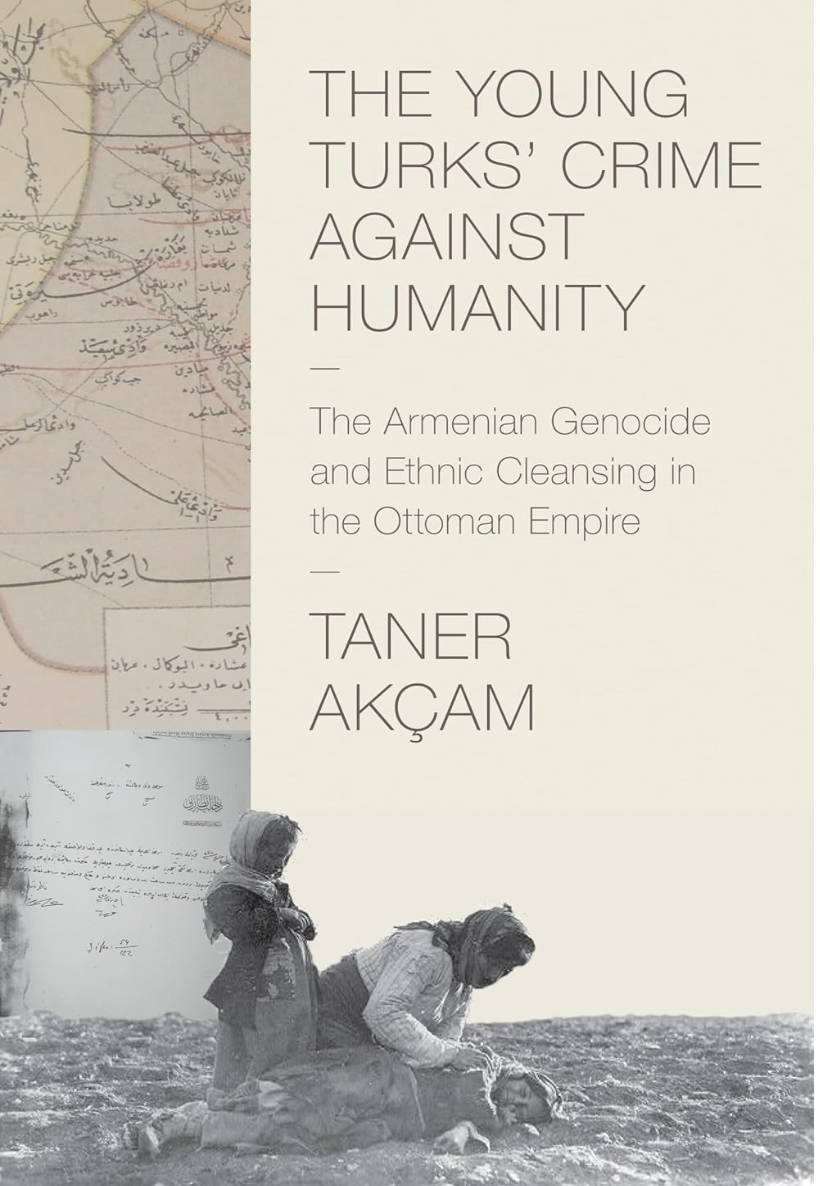
November 13, 2012
Speaker: Dr. Taner Akçam
The lecture presented new evidence from over 600 secret Ottoman documents featured in Taner Akçam’s most authoritative work to date. The book demonstrated in unprecedented detail how the Armenian Genocide and the expulsion of Greeks resulted from an official effort to remove Christian populations from the late Ottoman Empire. The discussion highlighted the role of bureaucratic structures, demographic engineering, and assimilation, showing that genocide involved more than physical destruction and reshaping how these crimes are understood.
The Art of the Armenian Kingdom of Cilicia
February 5, 2013
Speaker: Dr. Levon Chookaszian
Two Survivors' Perspectives: The Armenian Genocide and the Holocaust Through the Experiences of Survivors Who Outwitted Their Killers
April 10, 2013
Speaker: Dr. Robert Melson
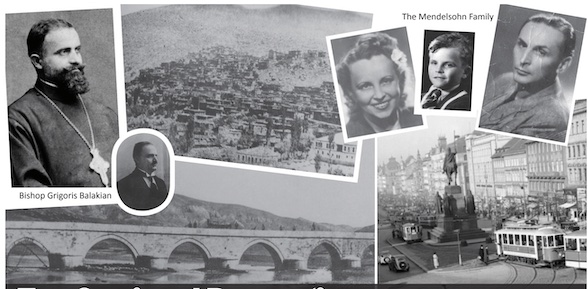
Professor Robert Melson discussed the histories of the Armenian Genocide and the Holocaust through the experiences of two survivors. The lecture explored what these personal stories reveal about perpetrators' motives and victims' strategies for survival. The event took place at the Holocaust Memorial Center in Farmington Hills, Michigan.
Intellectuals Analyzing the Soviet Legacy in Post-Soviet Armenia
May 2, 2013.
Speaker: Dr. Aghasi Tadevosyan
The talk examined Armenia’s transition from Soviet socialism to liberal democratic capitalism, focusing on the country’s Soviet legacy and its impact on political, economic, and social development. It explored changing public attitudes since the 2008 presidential election, debates over Russian colonial influence, and the role of post-colonial discourse in helping Armenian civil society navigate new paths for transition and development.
The Armenian DNA Project: Discovering History through Our Genes
November 8, 2011
Speaker: Peter Hrechdakian
The lecture provided an overview of the Armenian DNA Project, a resource for exploring Armenian ancestry and deep genetic history. It reviewed results from the project and academic research, highlighting key findings about Armenian genetic variation, origins, and relationships to other populations in the region.
Grandma’s Tattoos. Film screening and discussion with the producer, Suzanne Khardalian
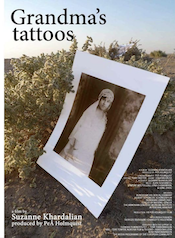
December 7, 2011
The documentary Grandma’s Tattoos by Suzanne Khardalian explores the story behind her grandmother’s blue tattoos, shedding light on the little-discussed experiences of Armenian women and girls during the Armenian Genocide. The film, Khardalian’s third on the subject following Return to Ararat (1988) and I Hate Dogs (2005), was produced in collaboration with her husband, Swedish filmmaker PeÅ Holmquist. Khardalian attended to answer audience questions after the screening.
The Nagorno-Karabakh Conflict: Structural, Political, Socio-Economic and Cultural/Perceptual Factors
April 12, 2012
Speaker: Dr. Ohannes Geukjian
The lecture analyzed Nagorno-Karabakh as an ethno-territorial conflict between Armenians and Azerbaijanis. It explored how the region became tied to ethnic identity, the historical creation of the Nagorno-Karabakh Autonomous Oblast in 1923, and the suppression of Armenian nationalist movements under Soviet rule. The discussion also examined how policies of perestroika and glasnost after 1985 enabled renewed Armenian mobilization for the region.
Women in Genocide: A Comparative Assessment
April 15, 2012
Speakers: Drs. Helene Sinnreich, Henry Theriault, Wenona Rymond-Richmond
A panel examined the distinct experiences of women in modern genocides and strategies to prevent future atrocities. Speakers included Helene Sinnreich (Youngstown State University) on the Holocaust, Henry Theriault (Worcester State University) on the Armenian Genocide, and Wenona Rymond-Richmond (University of Massachusetts) on Darfur, highlighting the specific challenges women face in these crises.
Race and Space: The Armenian Genocide in the Context of Population and Territory
May 3, 2012
Speaker: Dr. Uğur Ümit Üngör
Focusing on the eastern provinces of the Ottoman Empire, the talk showed how the Armenian Genocide was part of a broader policy of ethnic homogenization carried out by the Young Turk regimes and the early Turkish Republic from 1913 to 1950. Drawing on previously unexamined records, Dr. Üngör discussed the economic consequences of the genocide, the organized plunder, and how these violent processes destroyed historical regions, emptied multicultural cities, and paved the way for the modern Turkish nation-state.
Town Hall with U.S. Ambassador to Armenia
October 10, 2010
Her Excellency Marie L. Yovanovitch, United States Ambassador to Armenia, held a town hall meeting with the local Armenian community.
Aghet: A Genocide. Film screening and discussion with the producer, Eric Fiedler
December 11, 2010
German filmmaker Eric Friedler’s 90-minute documentary Prove It! was screened, featuring 23 actors portraying eyewitness accounts of the Armenian Genocide and including previously unseen historical footage. Originally shown on German public television (NDR), the film has been presented worldwide, including to members of the U.S. Congress. Friedler attended the screening and answered audience questions.
Of Shoes and Sherds: Excavations and Archeology in Armenia
March 14, 2011.
Speaker: Elizabeth Fagan
The talk provided an overview of ongoing archaeological projects in Armenia, highlighting excavations ranging from Stone Age caves and Bronze Age cemeteries to Iron Age fortresses, Hellenistic and Roman capitals, and medieval churches. While recent media attention has focused on discoveries such as the “world’s oldest leather shoe” and the earliest winemaking facility, Fagan emphasized the breadth of research being conducted by the Institute of Archaeology and Ethnography in Yerevan in collaboration with international teams. The lecture showcased how each excavation contributes to understanding life in the South Caucasus across millennia.
The Armenian Liberation Movement in the 18th Century
March 16, 2011
Speaker: Dr. George Bournoutian
The lecture addressed the Armenian liberation movement during the 18th century, a pivotal period in the development of Armenian national consciousness. Drawing on documentary evidence and material from his new book Armenians and Russia, 1626–1796, Dr. Bournoutian explored the political and social currents that shaped the emergence of Armenian national identity.
"Finding Zabel Yesayan" Film screening and panel discussion
March 23, 2011.
Film Producers: Talin Suciyan and Lara Aharonian
Panelists: Dr. Ara Sanjian (Moderator), Talin Suciyan, Dr. Kevork Bardakjian, Edmond Azadian
Understanding Why: The Psychology of the Genocide
April 11, 2011
Speaker: Dr. Steven K. Baum
Food, Culture, and Identity: An Illustrated Talk about Armenian Food Traditions
November 18, 2009
Speaker: Dr. Susan Pattie
Dr. Pattie's talk examined how Armenians maintain identity through hospitality and food, highlighting the lasting power of tastes, smells, and memories in connecting generations. The lecture addressed how Armenian food traditions have evolved over time and across the world, and considered the role of cookbooks in shaping a “national cuisine,” emphasizing the cultural and social significance of food in Armenian life.
Genocide and Memories of the Armenian Diaspora in Argentina
December 15, 2009
Speaker: Lucila Tossounian
The talk explored the experiences of Armenians who arrived in Argentina fleeing the Genocide at the beginning of the 20th century and how these experiences were transmitted orally across generations. Lucila Tossounian presented the work of the “Armenian Genocide: Memories of the Diaspora” Research Group at the University of Buenos Aires, which is creating the first oral archive of Armenian Genocide survivor testimonies in Argentina. The research examines how collective memory has been transmitted and how these modes of transmission shape the understanding of the Genocide.
Annual Holocaust and Armenian Genocide Commemoration: The Challenges and Opportunities of Oral Testimonies
April 18, 2010.
Speakers: Dr. Gerard Libaridian and Dr. Sidney Bolkosky
The Peculiarities of the Armenina Epic Daradevils of Sasun
October 20, 2008
Speaker: Dr. Azat Yeghiazaryan
The talk explored the unique place of the Armenian epic Sasna tsrer (Daredevils of Sasun) in world epic heritage. Unlike most great epics, which emerge at the beginnings of national histories, this medieval epic arose in the 9th–11th centuries, reflecting Armenia’s rich and complex history. Prof. Yeghiazaryan examined its roots in earlier cycles of Armenian epic songs, its Christian moral framework, and its relationship to other global epic traditions.
English Piracy and New Julfa Merchants in the Mid-18th Century: The Santa Catherina Affair
November 18, 2008
Speaker: Dr. Sebouh Aslanian
The talk explored tensions between English and Armenian merchants in 18th-century India. Using the case of the seized Armenian ship Santa Catherina, Dr. Aslanian examined how Armenian traders from New Julfa navigated competition with the growing power of the British East India Company and the challenges they faced without strong state backing.
The Nagorno-Karabakh Conflict and Other "Hot Spots" in the Caucasus
January 28, 2009
Speaker: Vicken Cheterian
Vicken Cheterian, a longtime reporter and analyst in the Caucasus, examined the rise of nationalism and ethnic conflicts in the region following the Soviet Union's collapse. He explored the roots of violence in Nagorno-Karabakh, Abkhazia, and Chechnya, as well as the 2008 Georgia war, highlighting the challenges and failures of diplomatic efforts to secure peace.
Holocaust and Armenian genocide Commemoration
April 2, 2009
"Confronting the Scourge of Genocide: From Knowledge to Action," Speaker: Dr. Samuel Totten
"Should We Teach About Genocide? And if So, What Should We Teach?" Speaker: Dr. Roger Smith
National Identity Perceptions and Representations in the Republic of Armenia
April 17, 2009.
Speaker: Dr. Arus Harutyunyan
Can contesting national identities exist in an ethnically homogeneous state? In her talk, Arus Harutyunyan emphasized the political and constructed nature of national identity over its ethno-religious aspects. Focusing on collective memory, territory, and belonging—examined through the Genocide and relations with Turkey, the war in Mountainous Karabagh, and dual citizenship for Diaspora Armenians—Dr. Harutyunyan discussed how Armenia’s national identity, often seen as unified, reveals internal conflicts.
Jakob Künzler and the Armenians
March 15, 2008
Speaker: Dr. Hans-Lukas Kieser.
British Encounters with Armenia in the Late 19th Century
April 7, 2008
Speaker: Dr. Joanne Laycock.
Child Survivors of Genocide: A Comparative Approach
May 2, 2008
Speakers: Drs. Joanna Michlic, Boaz Cohen, Donald Miller, Mrs. Lorna Touryan Miller.
Changing of the Guard
Marking the retirement of the Center’s former director, Prof. Dennis Papazian, and the accession of Dr. Ara Sanjian as the new director
October 14, 2006
The Middle East: The Roots and Realities of Enduring Conflict(s)
December 20, 2006
Speaker: Robert Fisk
Holocaust and Armenian Genocide Commemoration
April 20, 2007
"A Challenge for the Present: How to Think of the Past When Planning the Future" Speaker: Dr. Gerard Libaridian
"The Holocaust and Public Culture in Israel," Speaker: Dr. Tamir Sorek
Films of the Armenian Genocide, Holocaust, and Rwandan Genocide
April 28, 2006
Speaker: Dr. Lawrence Baron
The United States and the Armenian and Jewish Experiences of Genocide
April 8, 2005.
Speakers: Drs. Simon Payaslian, Kenneth Waltzer
The Armenian Genocide in Retrospect
September 26, 2003
Speaker: Dr. Richard G. Hovannisian
Great Britain and the Armenian Question
April 22, 2004
Speaker: Dr. Tigran Sarukhanyan
Scholars and the Dead Sea Scrolls: New Discoveries and New Insights
February 3, 2002.
Stones from the River: The Lost Jews of Armenia
February 4, 2002.
Speaker: Dr. Michael Stone
In a two-day lecture series, Dr. Stone discussed how his work as co-editor of the soon-to-be-published complete edition of the Dead Sea Scrolls shed important light on the evolving understanding of ancient Judaism and the origins of Christianity. In his presentation on Armenian Jewry, he reported on his archaeological excavations, which revealed a previously unknown medieval community in Armenia.
The Armenian Quest for Nagorno-Karabakh
April 16, 2002.
Speaker: Dr. Ara Sanjian
Dr. Ara Sanjian discussed the history of the Armenian struggle for Karabagh, its current situation, recent negotiations, and future prospects. Although fighting in Nagorno-Karabagh had been paused for the past eight years, nation-building within the region and diplomatic activity outside continued.
Holocaust and Genocide Denial
October 12, 2000.
Speaker: Dr. Israel Charny
The Armenian Liberation Movement in the 18th Century
March 16, 2001.
Speaker: Dr. George Bournoutian
The Genocide of the Armenians and Turkish Denial
March 10, 2000
Speaker: Dr. Taner Akçam.
Prospects for Peace in the Caucasus
April 27, 2000.
Speaker: Thomas Goltz